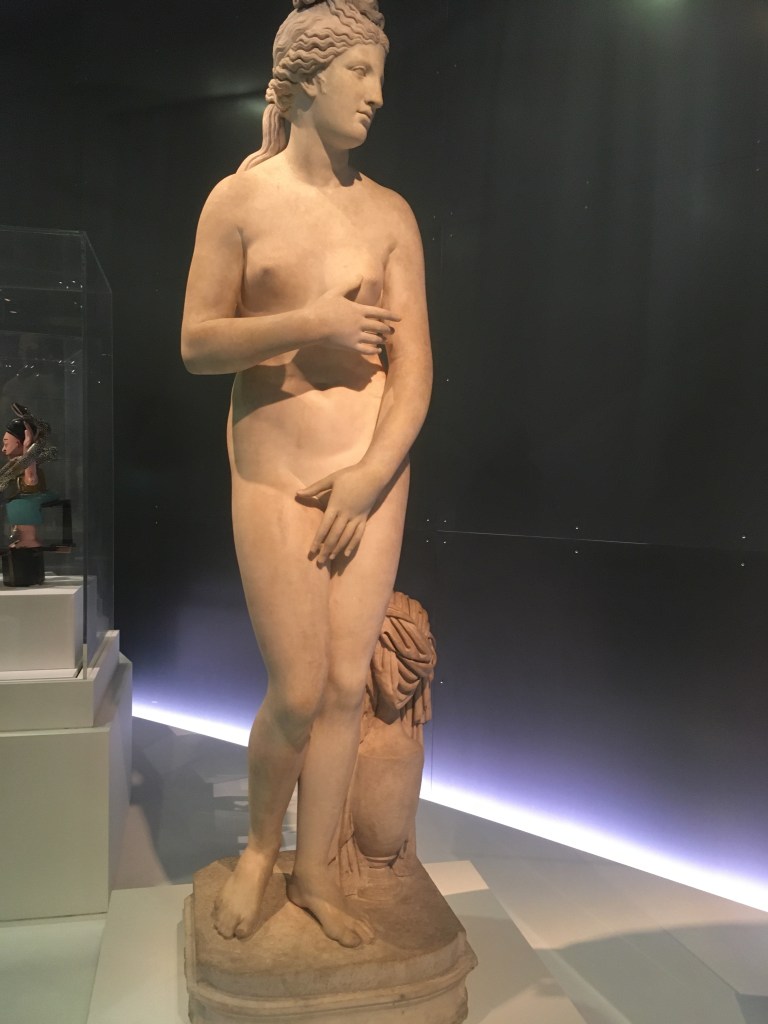
Here’s Venus, beautifully carved by Roman sculptors in around AD 100-150. She’s stepping out of her bath and looking gorgeous. She was the choice of Mary Beard, one of the guest contributors of The Citi Exhibition Feminine Power: the divine to the demonic. This impressive exhibition at the British Museum provides an opportunity for rarely seen objects, or ones which might not be noticed as boldly whilst on display, a chance to take centre stage.
Clearly, the female human form has been represented across the globe from ancient times to today. Perhaps you could argue that the female has never been more objectified since we now have so many images of perceived beauty and power in female form across our visual and social media.
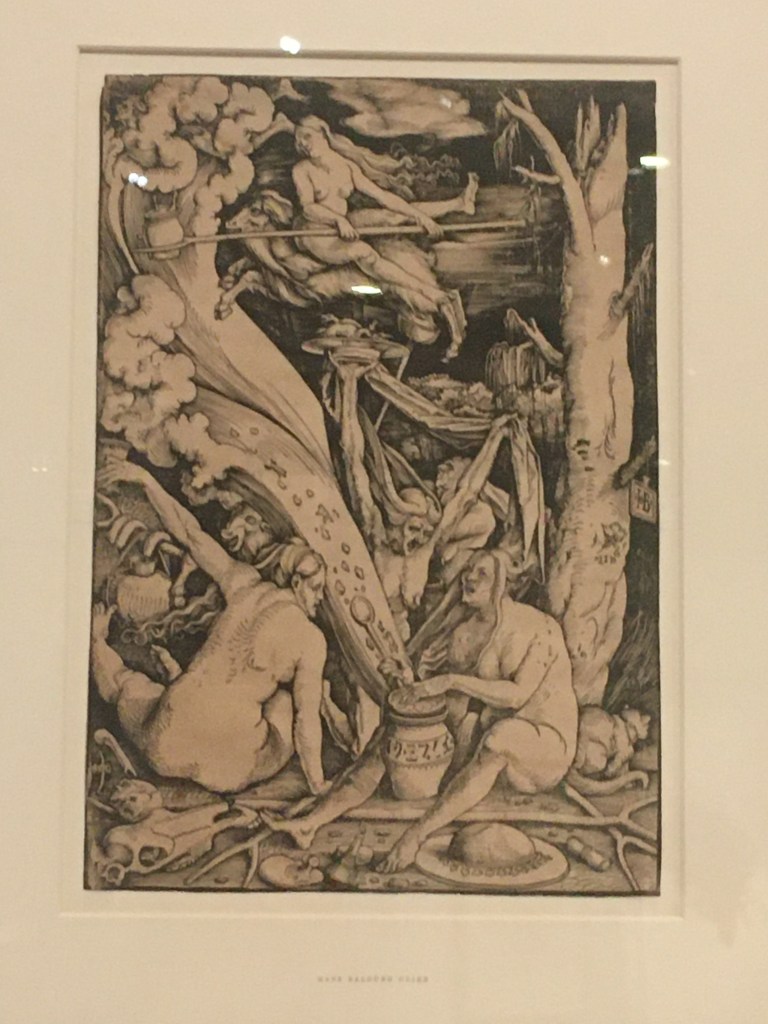
It’s fascinating to see very early impressions of the female form as a deity and also the fear which women could engender. Were they witches? The image of The Witches Sabbath by Hans Baldung Grion about 1484 conjures and promotes the idea that women can be dangerous. I can’t help wondering whether William Shakespeare might have seen this image and been inspired to introduce the three ‘hags’ into his famous cauldron scene in Macbeth.
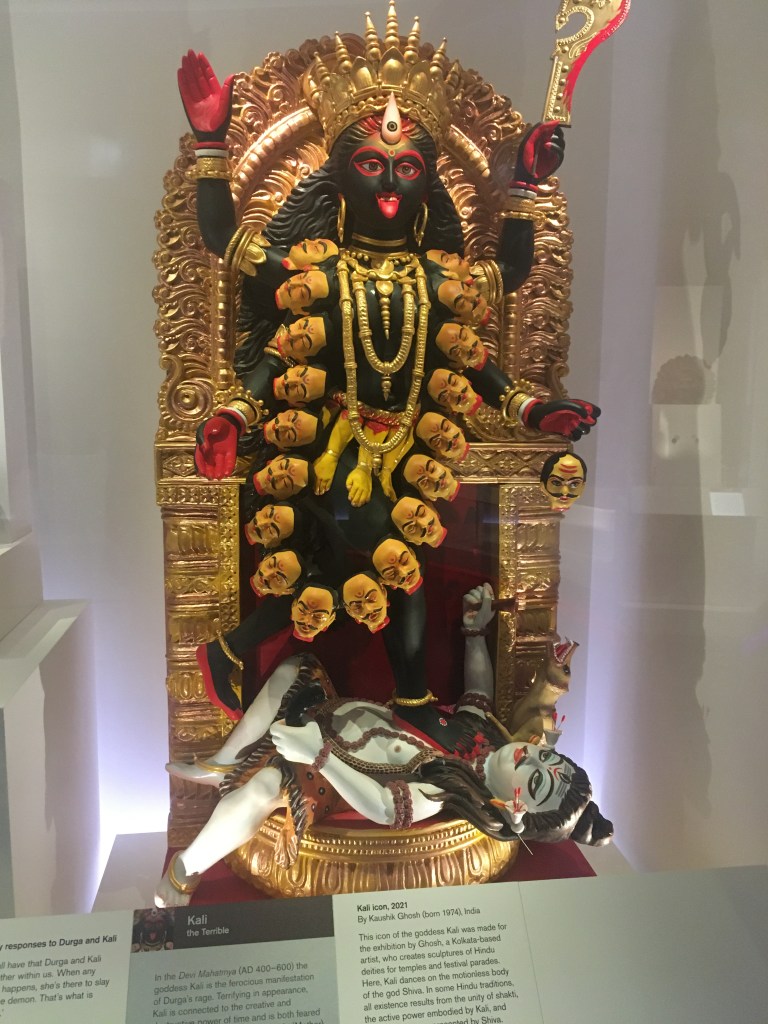
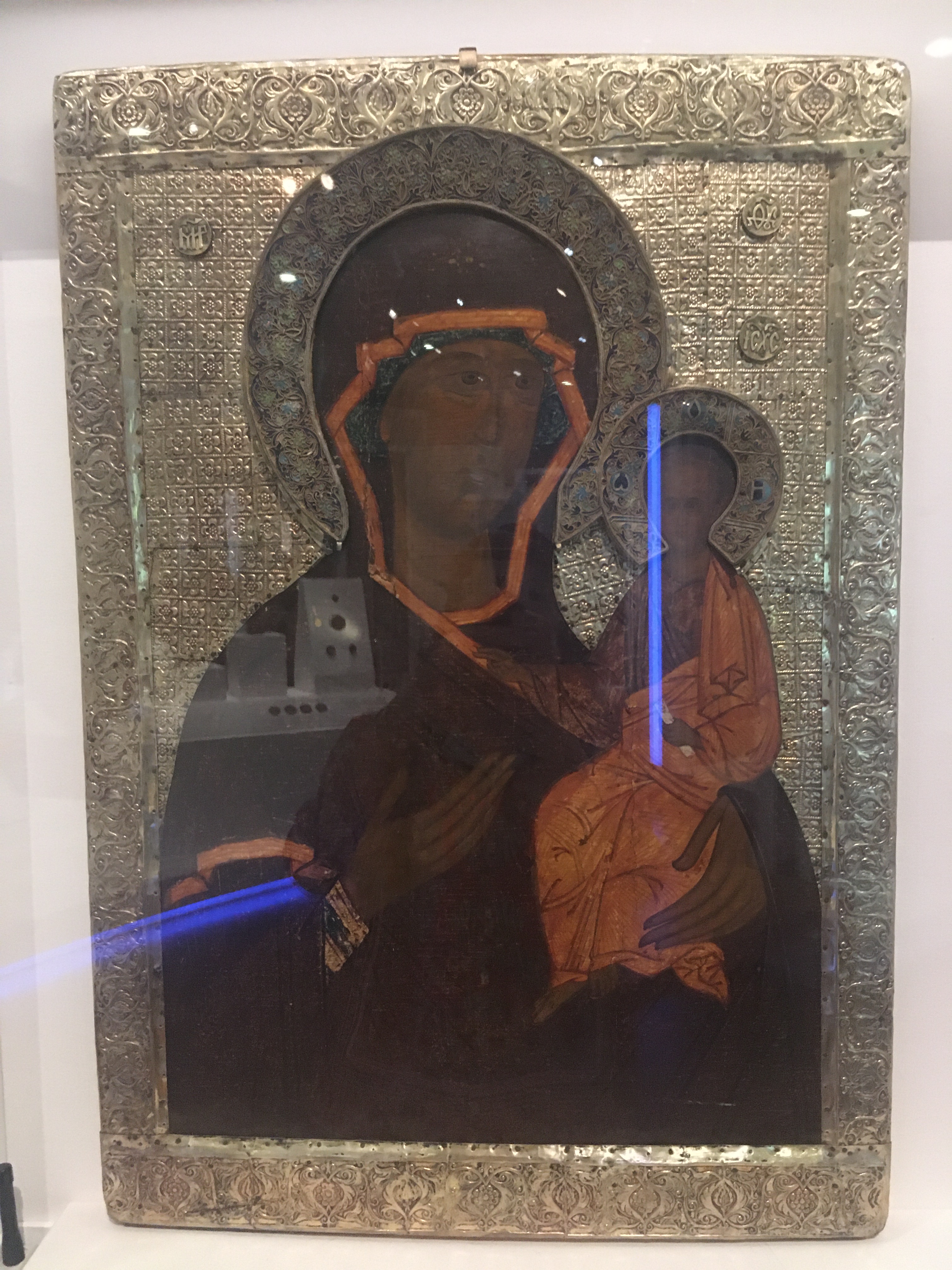
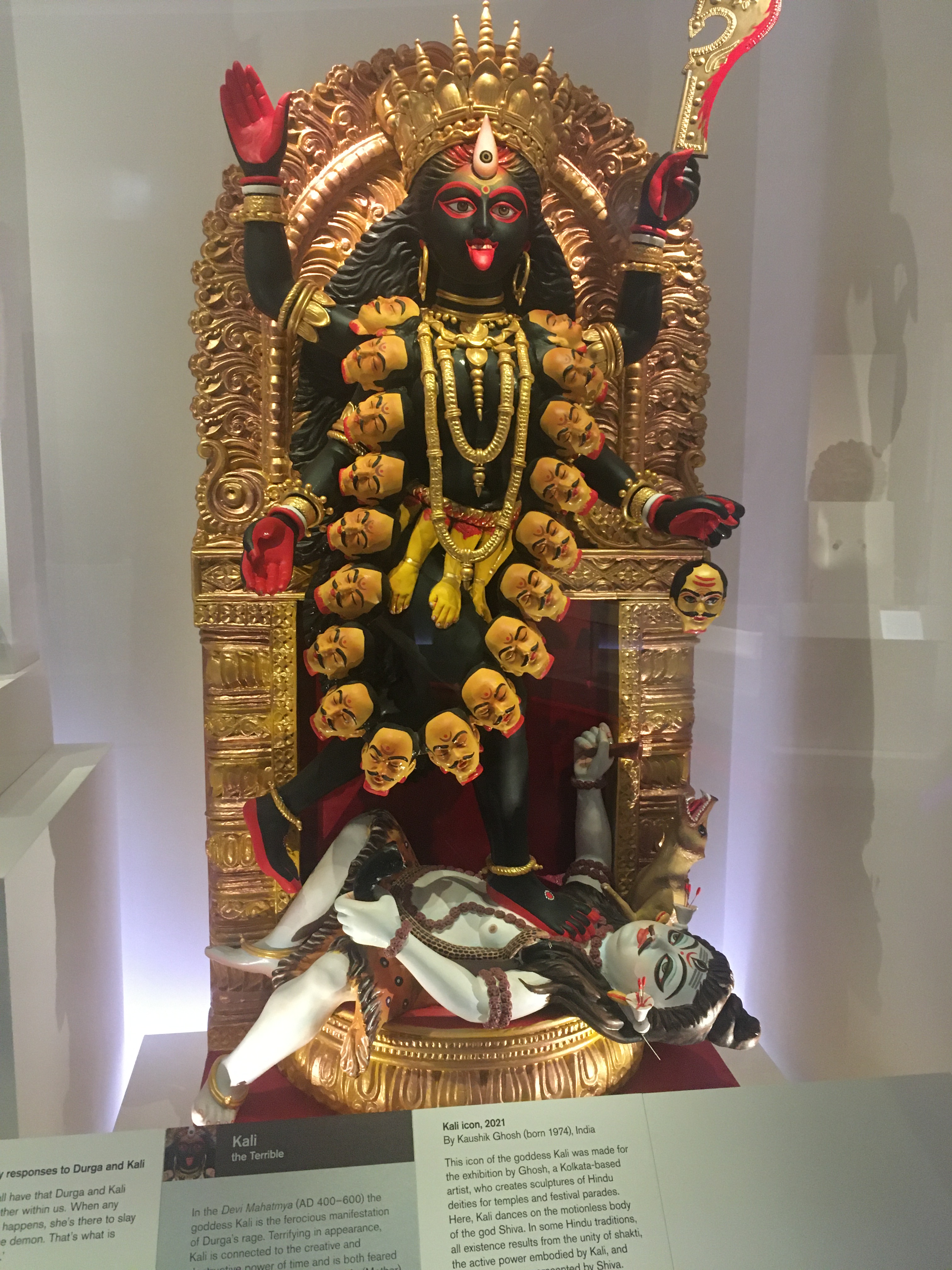
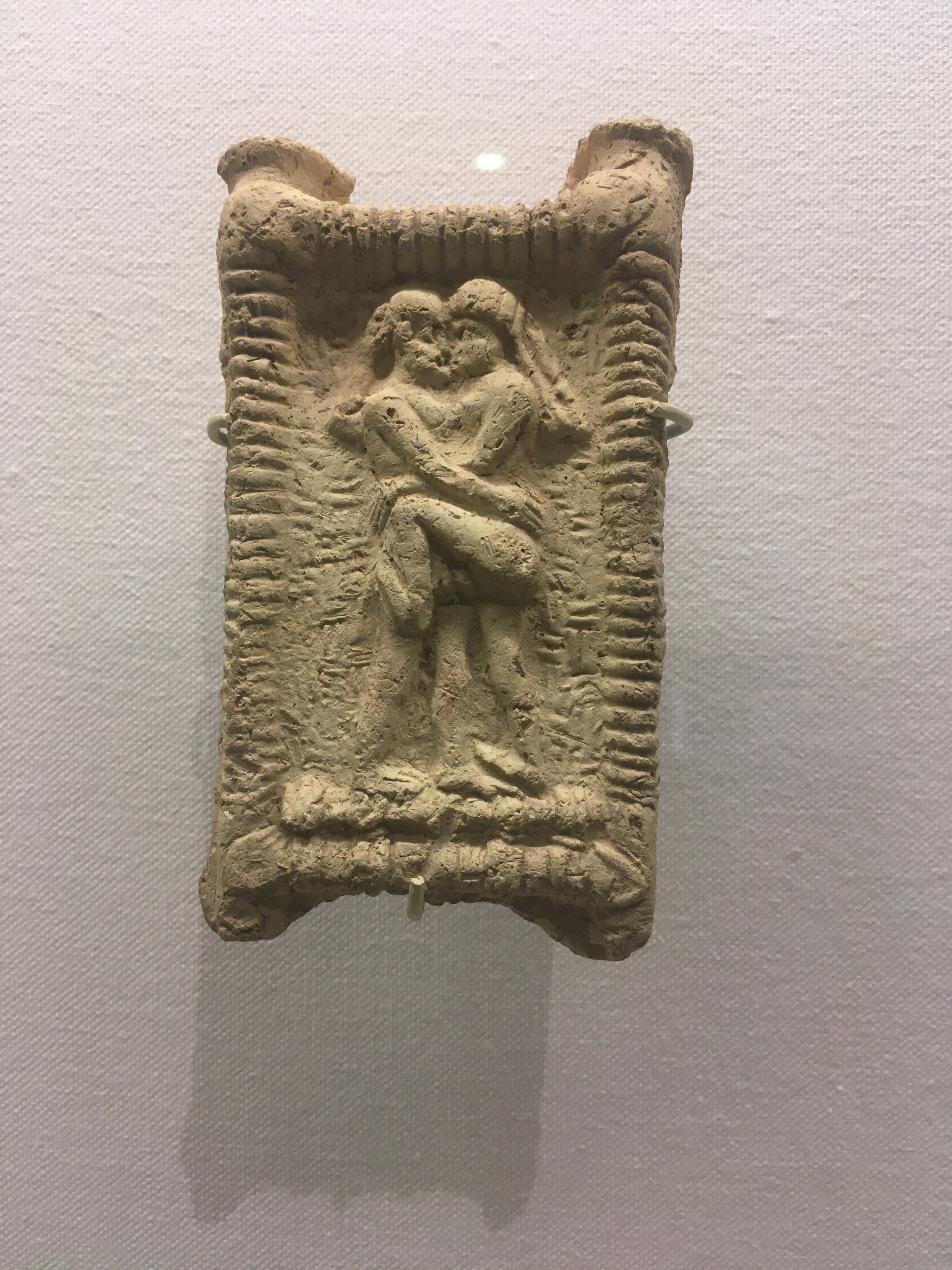
All the major religions have female deities and it’s fascinating to see the relics from past civilisations jostle with impressions of female power in a contemporary style.
The show is on until 25th September in the Joseph Hotung Great Court Gallery.
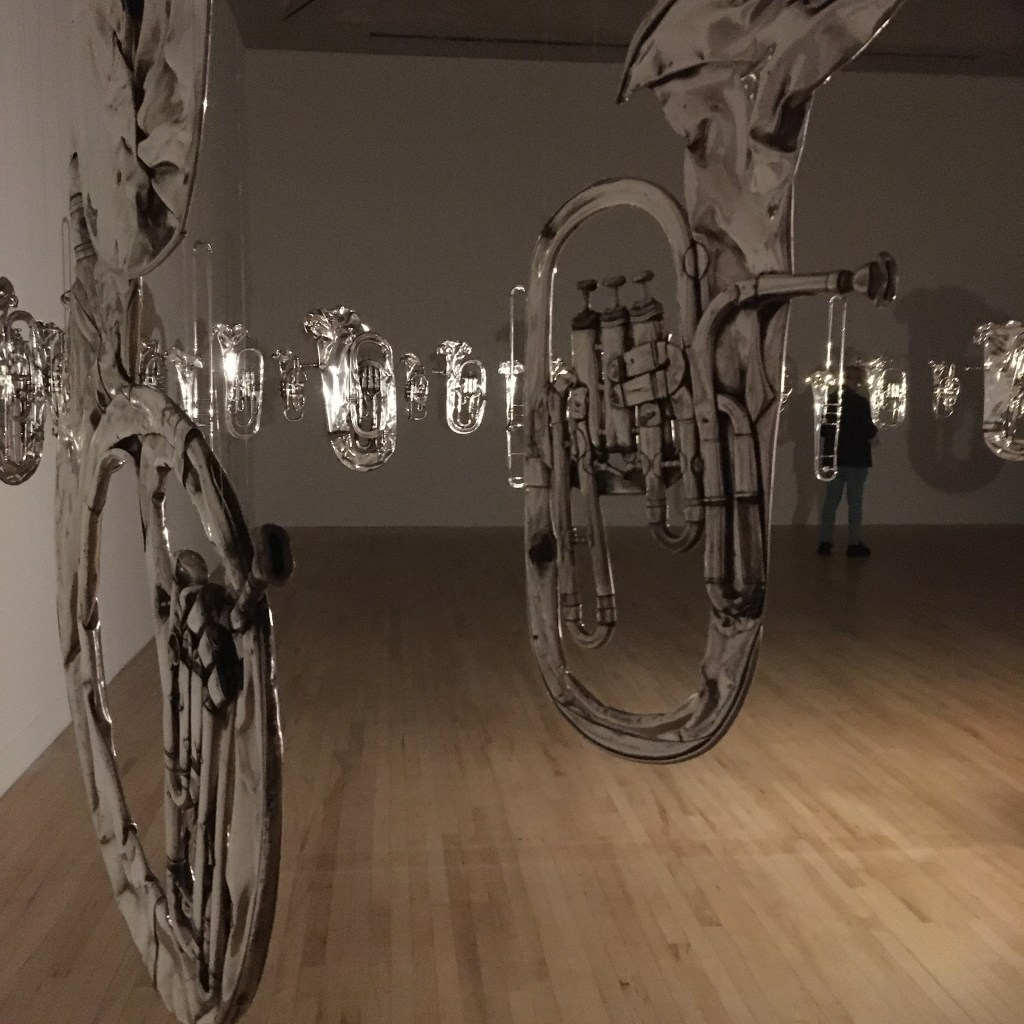
This piece is quite familiar: Perpetual Cannon. I’ve seen it before, at the V&A and also at the Baltic Centre in Newcastle. It was made for a circular installation but looks amazing in every space it is displayed. There’s something both comforting and strange about seeing brass instruments which have had the last breath squeezed out of them beneath the weight of a steam roller. And then you think, yes, that’s a perfect conclusion for these pieces which were designed to absorb human breath and make music. Once no longer functioning, this is the perfect way to recycle and retire old trumpets, tubas and horns.
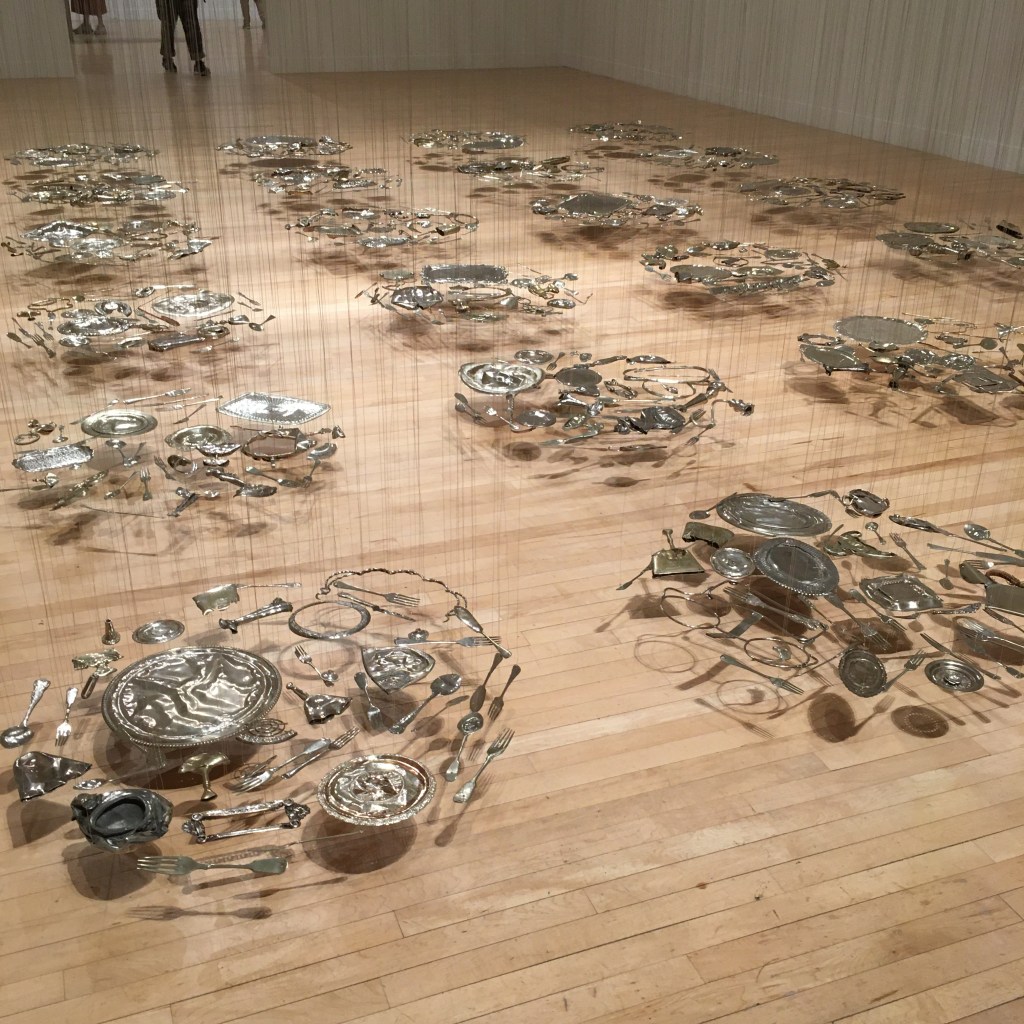
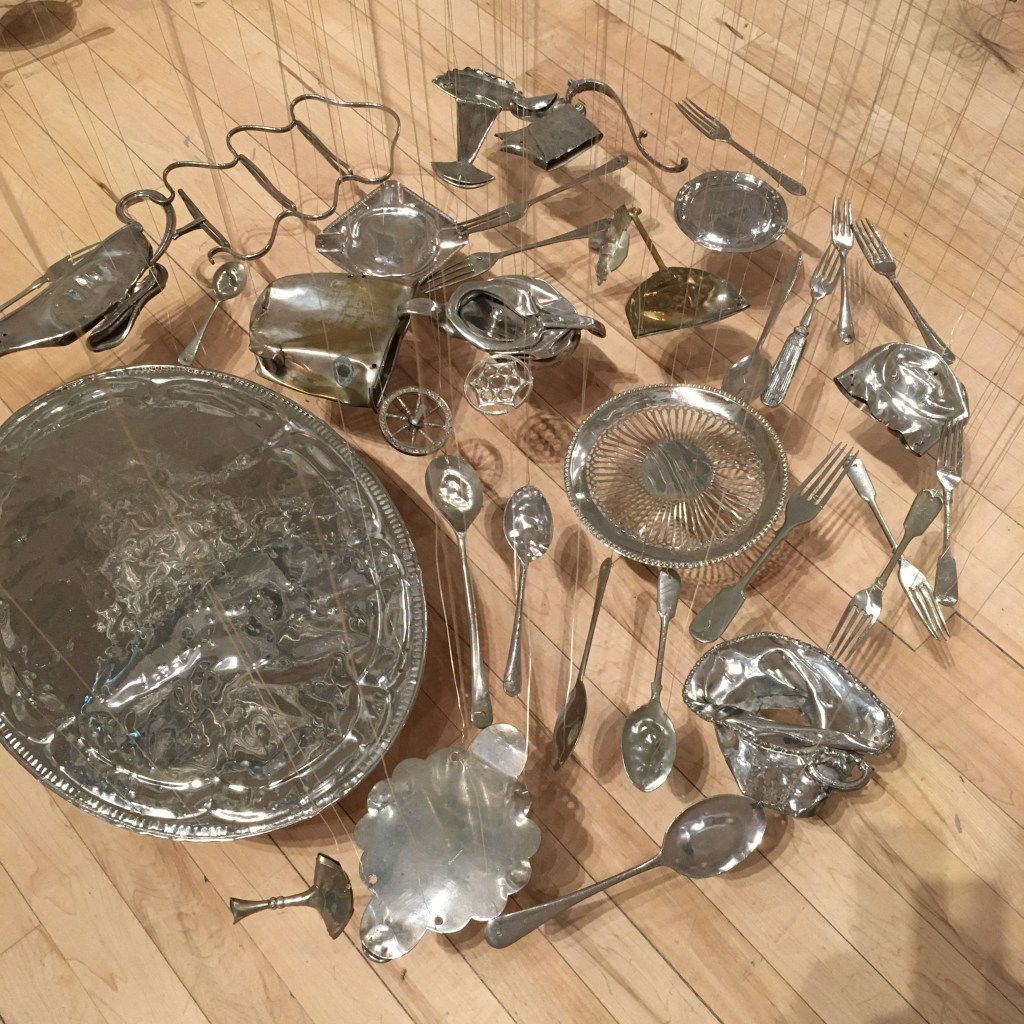
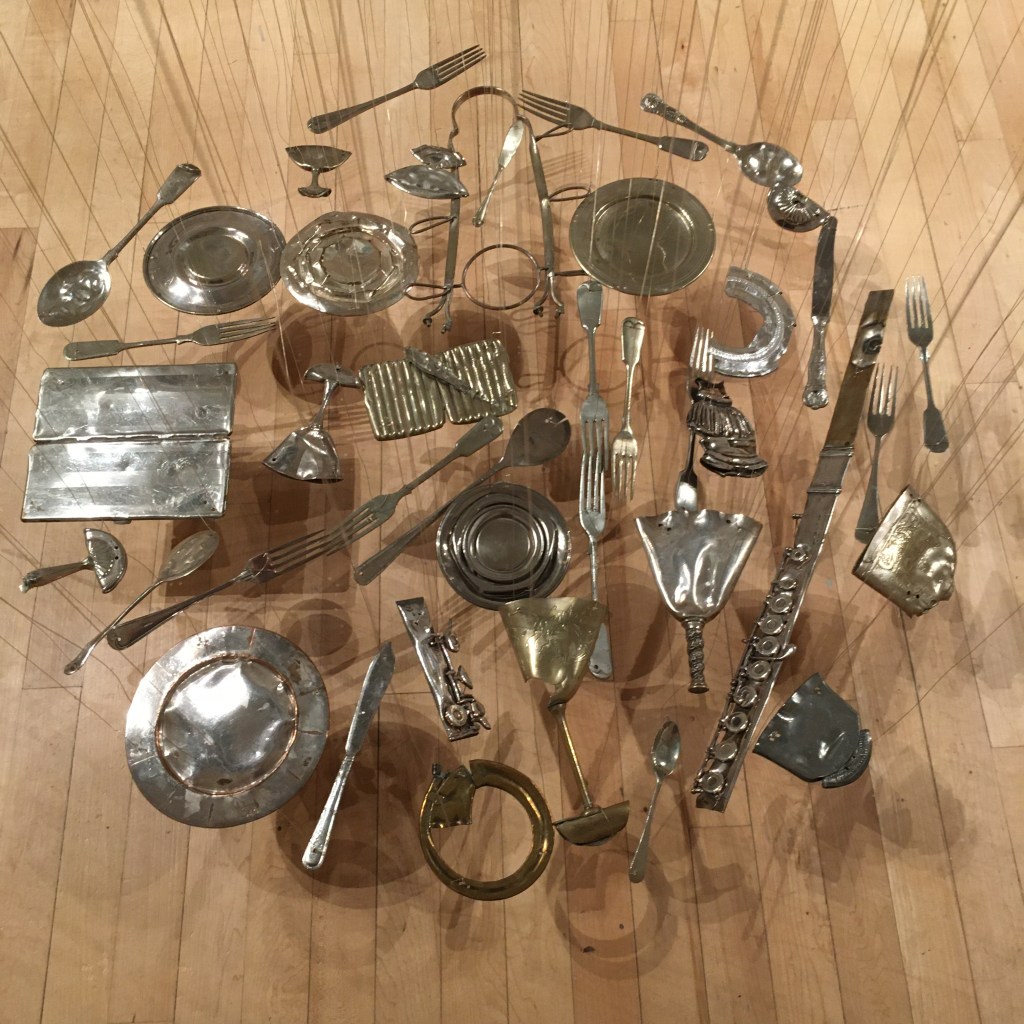
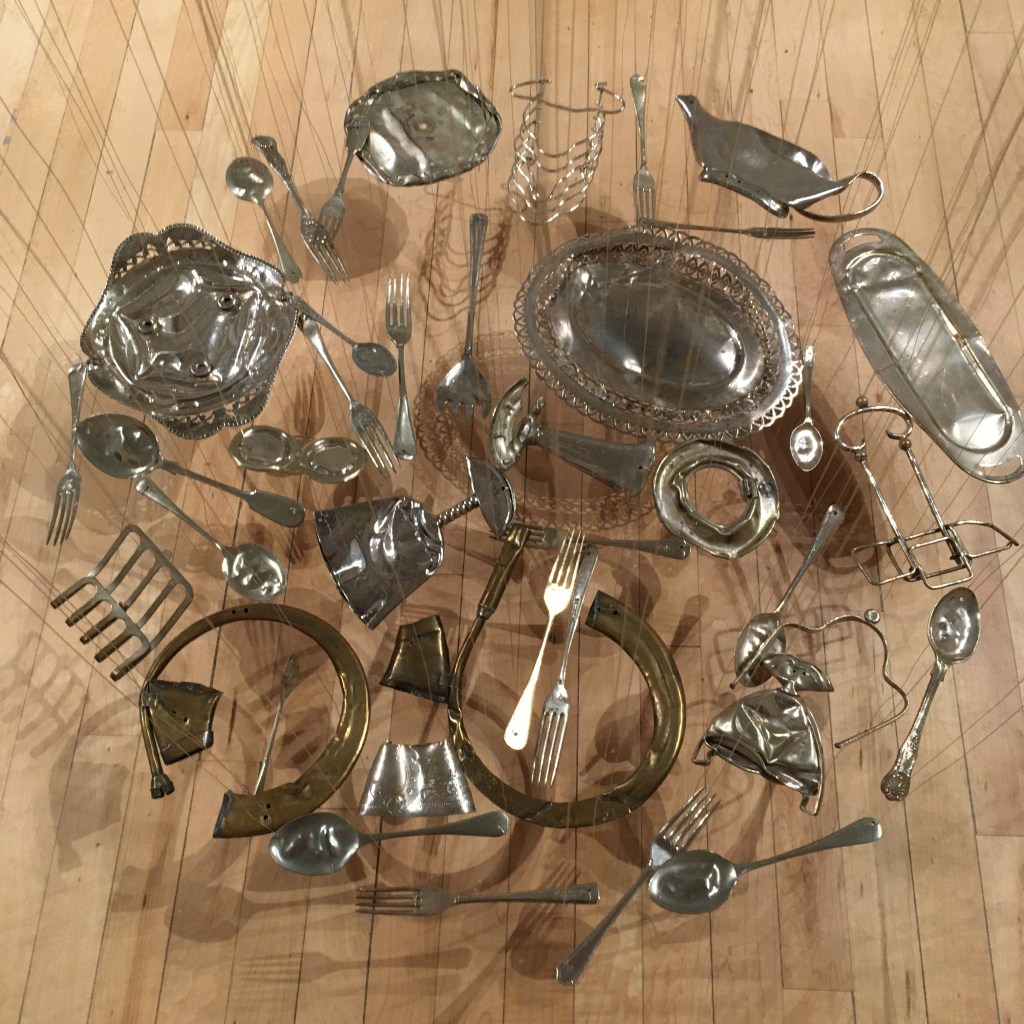
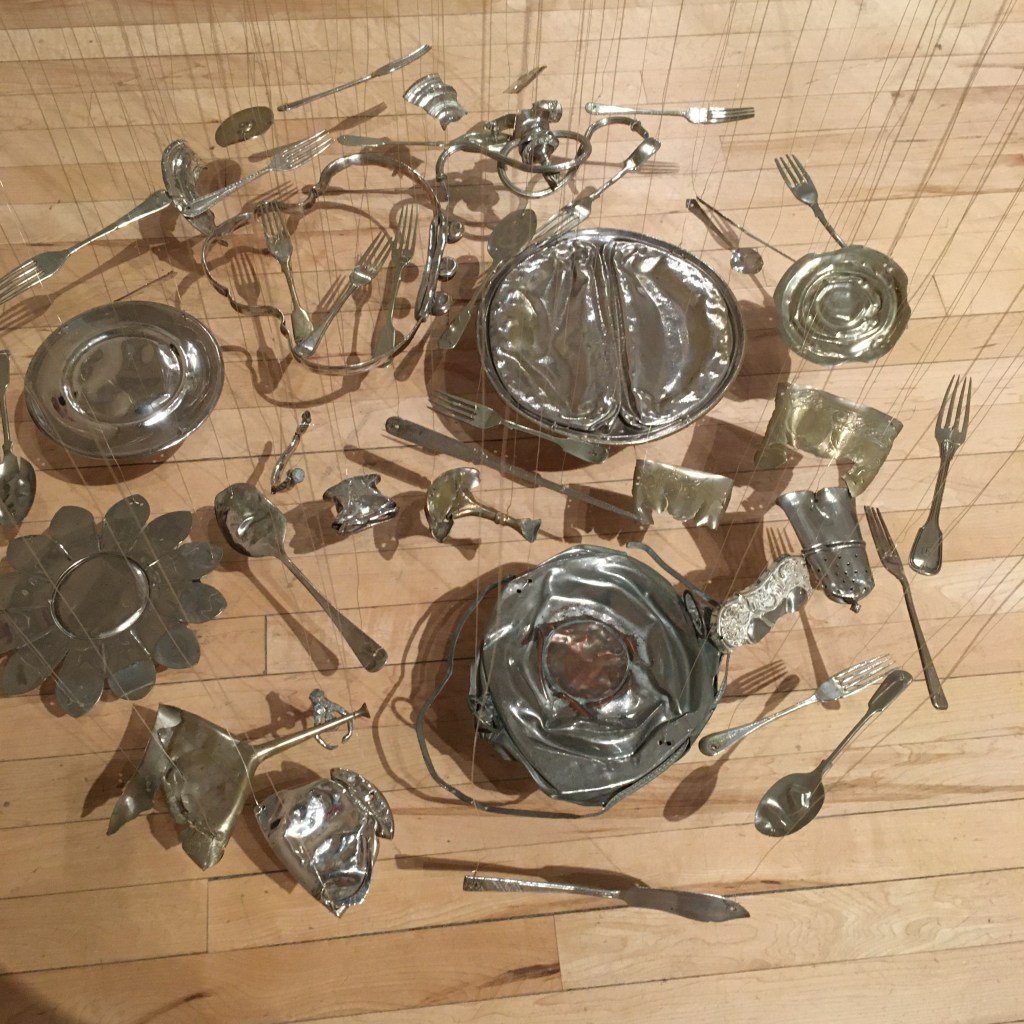
This is a close up of Thirty Pieces of Silver. It fills the space in the most beguiling and attractive way. The flattened pieces of silver plate objects seem to float above the floor in perfect circles. The squashed form seems to enhance the memory of the 3D life these pieces once led and they all have stories to tell.
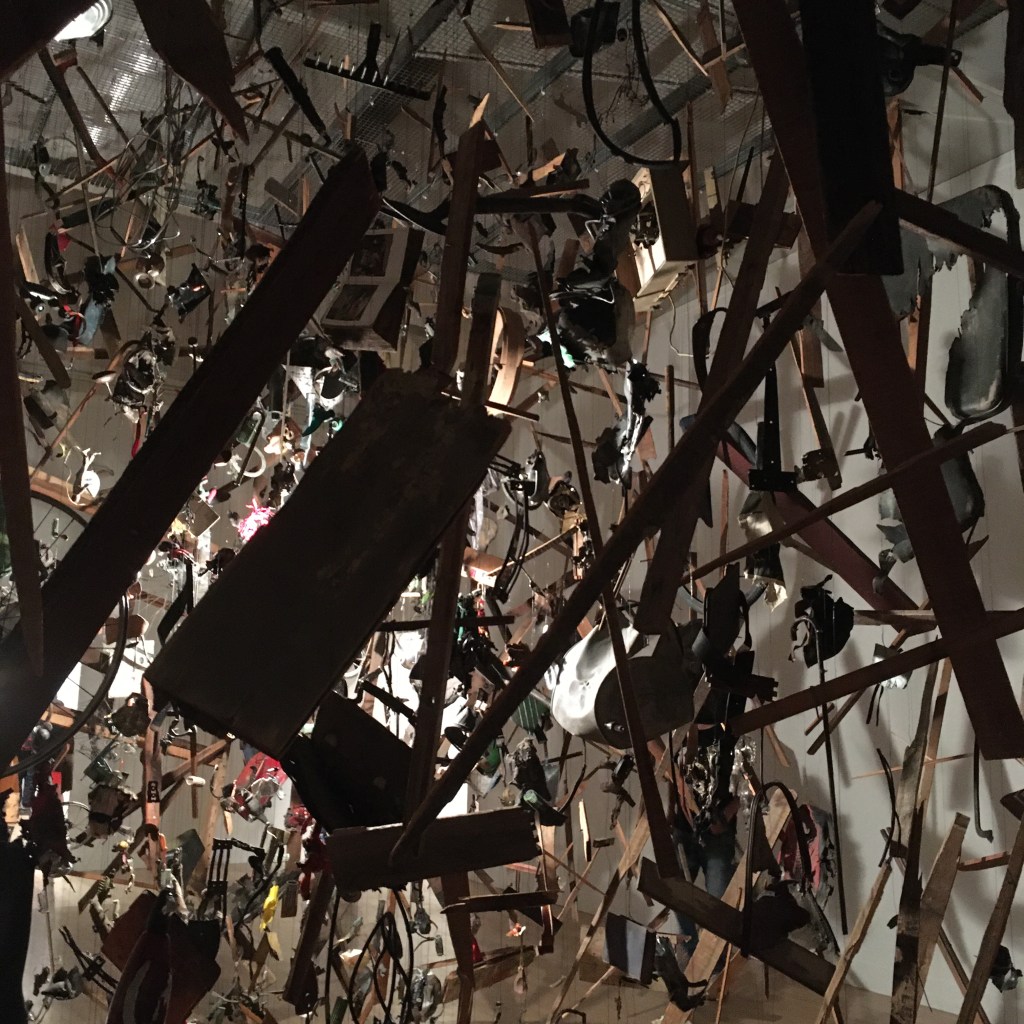
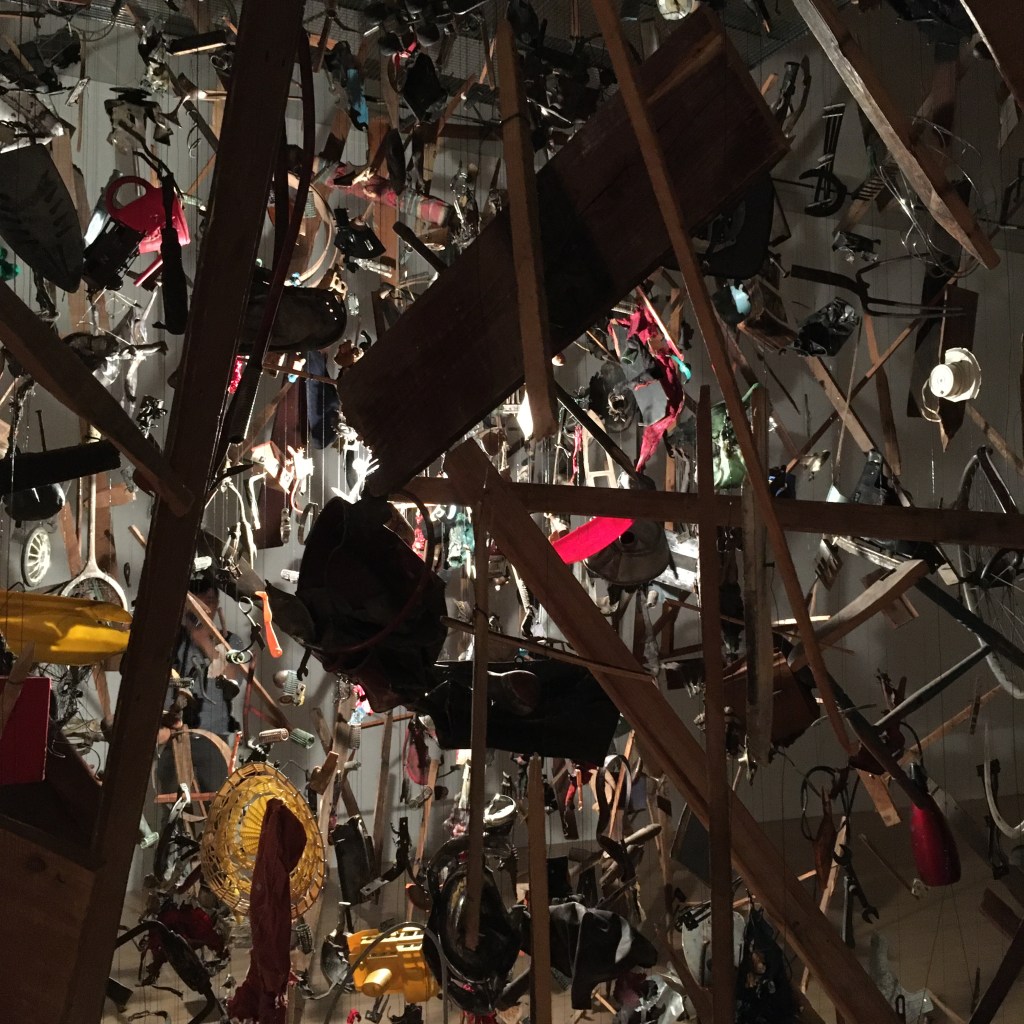
Cold Dark Matter : An Exploded View is great. Who wouldn’t want to blow up a garden shed? Parker worked with the Army School of Ammunition who obligingly obliterated an old shed and contents she transported to their training site. Then, when all the pieces were picked up after the explosion, she arranged them in this fabulous configuration, like a moment frozen in time, when everything was spinning away from its place and into space. You get a tension of what was once there, what was meant to be and what can be replaced by destructive actions.
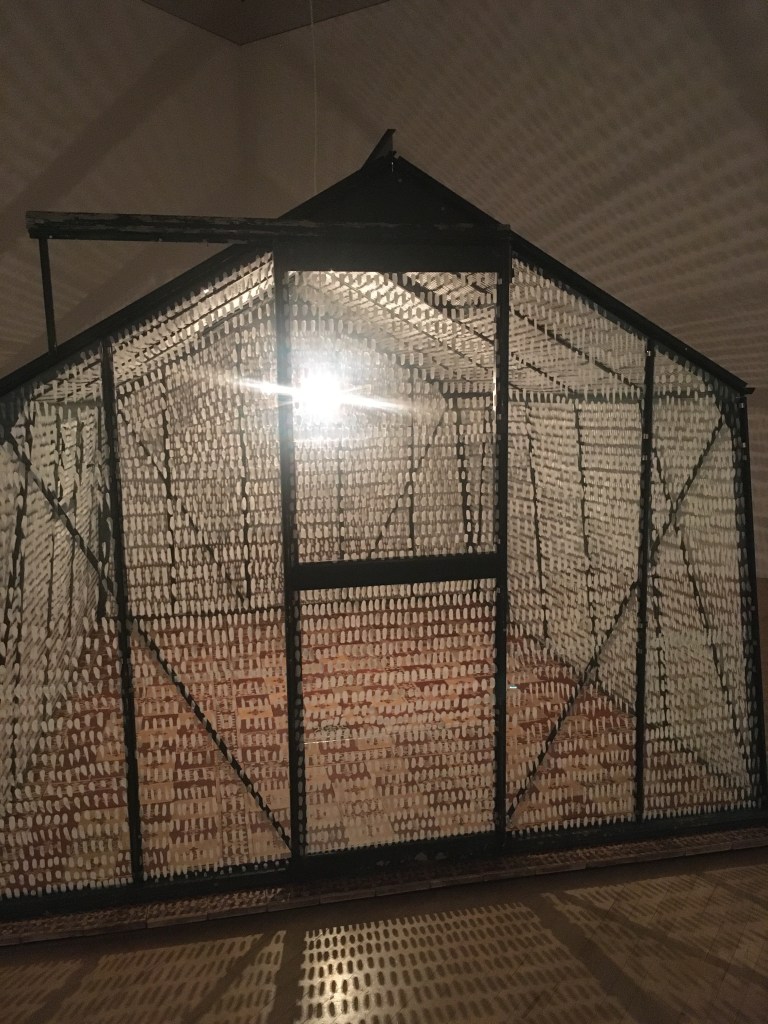
I enjoyed her piece entitled Island. She painted the panes of a greenhouse with white brushstrokes of cliff chalk and lined the floor of the greenhouse with worn encaustic tiles from the Houses of Parliament. The light inside flickers, grows, glows and fades as if the piece is breathing.
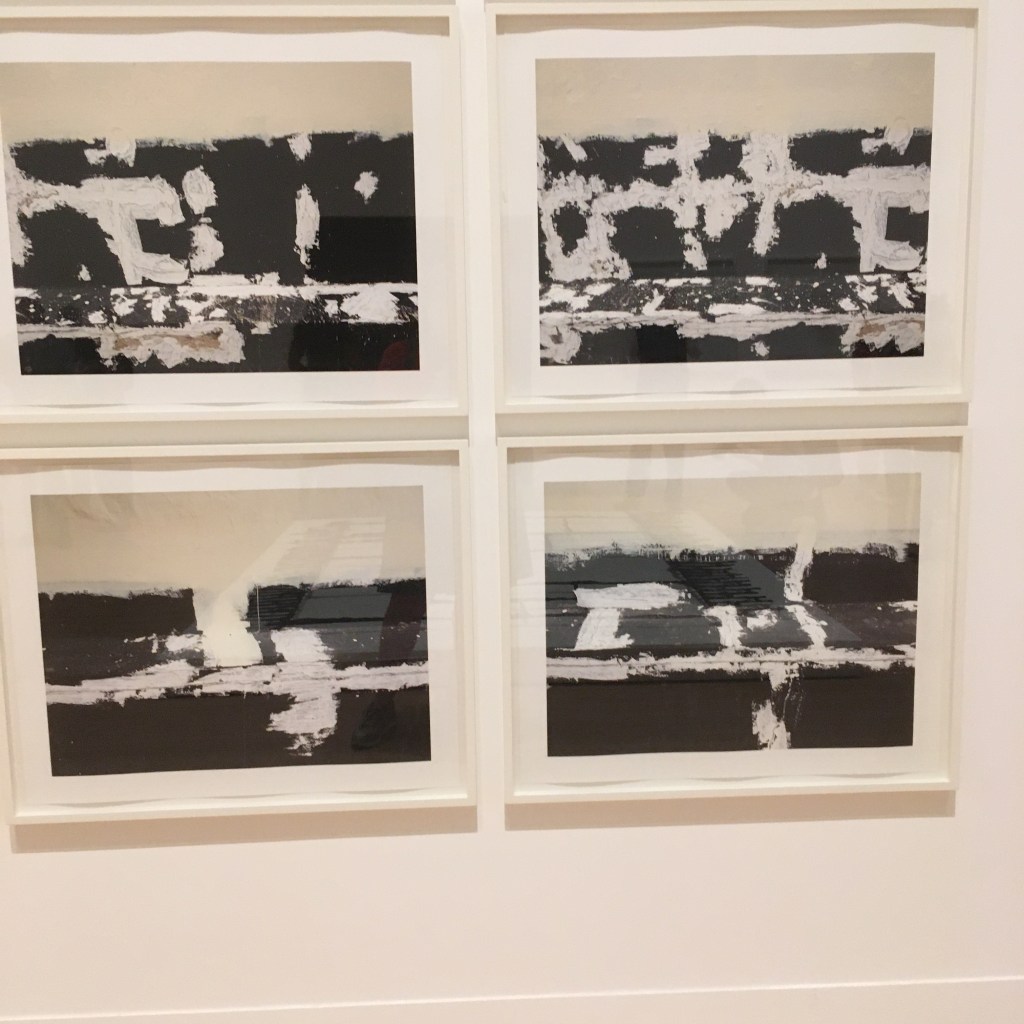
Throughout this excellent exhibition are examples of Cornelia Parker’s enquiring mind spotting objects which may be beyond use, may be altered by accident or human hand and capturing the moment when they become art. I loved the photos of the wall outside a prison near her home when the cracks had just been painted. Apparently later that day a prisoner convicted of murder scaled the walls and escaped. The images look like monochrome expressionist art.
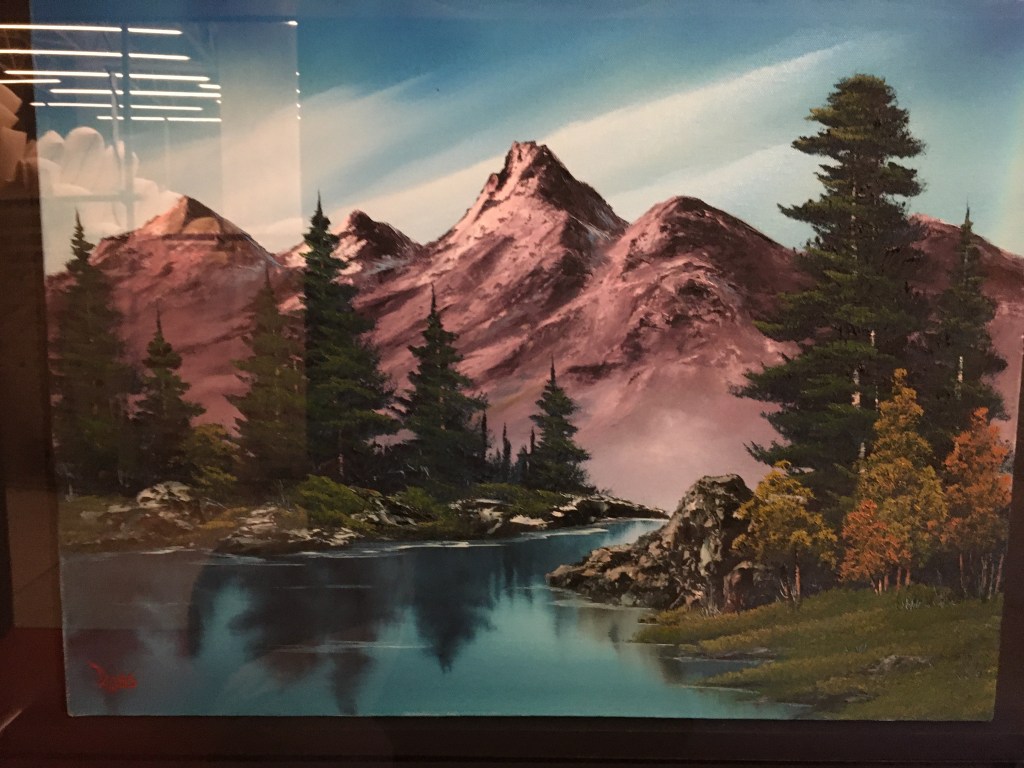
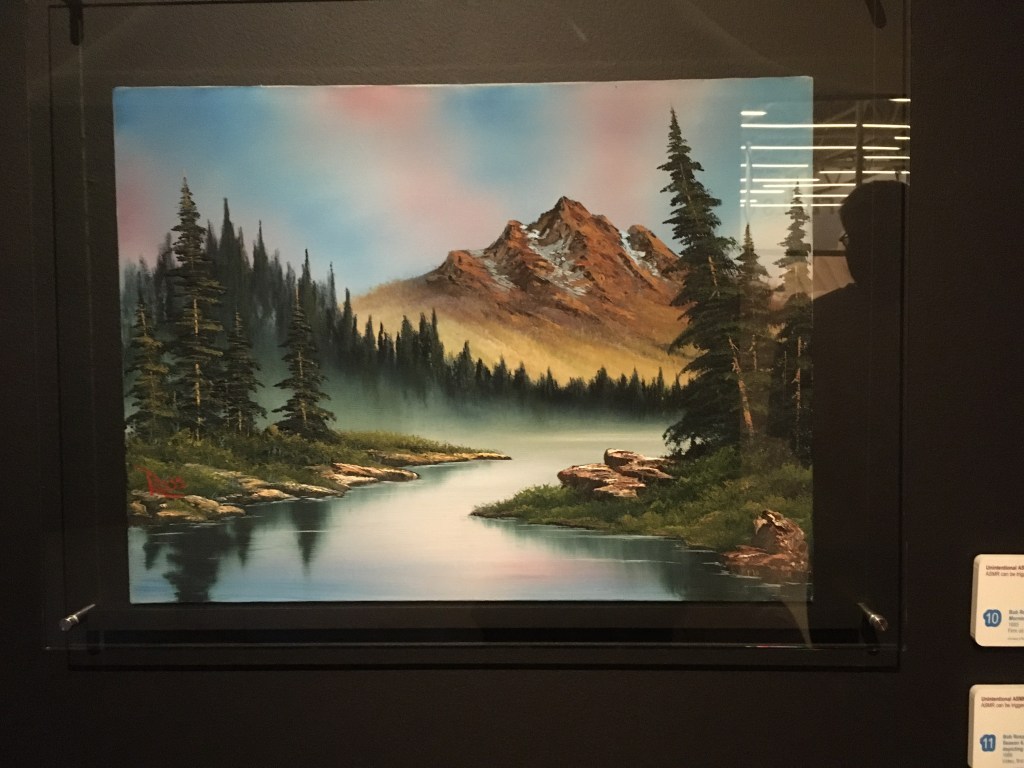
Yes, this is a painting by the American artist Bob Ross. We see him a lot on BBC 4 in the early evening. What I hadn’t realised about this charming show with the shuddery camera work is that we are being influenced by the impact of ASMR of both an aural and visual kind. We watch with fascination as Bob scrapes paint onto canvas with a palette knife or whispers to us as he dabs and daubs paint with a brush to create the highlights of a fir tree or scrapes back paint with the tip of his brush to create little lines which depict branches. The finished paintings are quite chocolate-boxy in style but very expertly done. It was a pleasure to see three examples of his paintings close up. Chatting to this show’s curator, James Taylor-Foster, at the press preview, he told me that Bob Ross created every painting in exactly 26 minutes. He created one painting for reference (glancing at it as he is filmed) another for the camera and a third, immediately afterwards which was photographed for a book about his art. I was riveted.
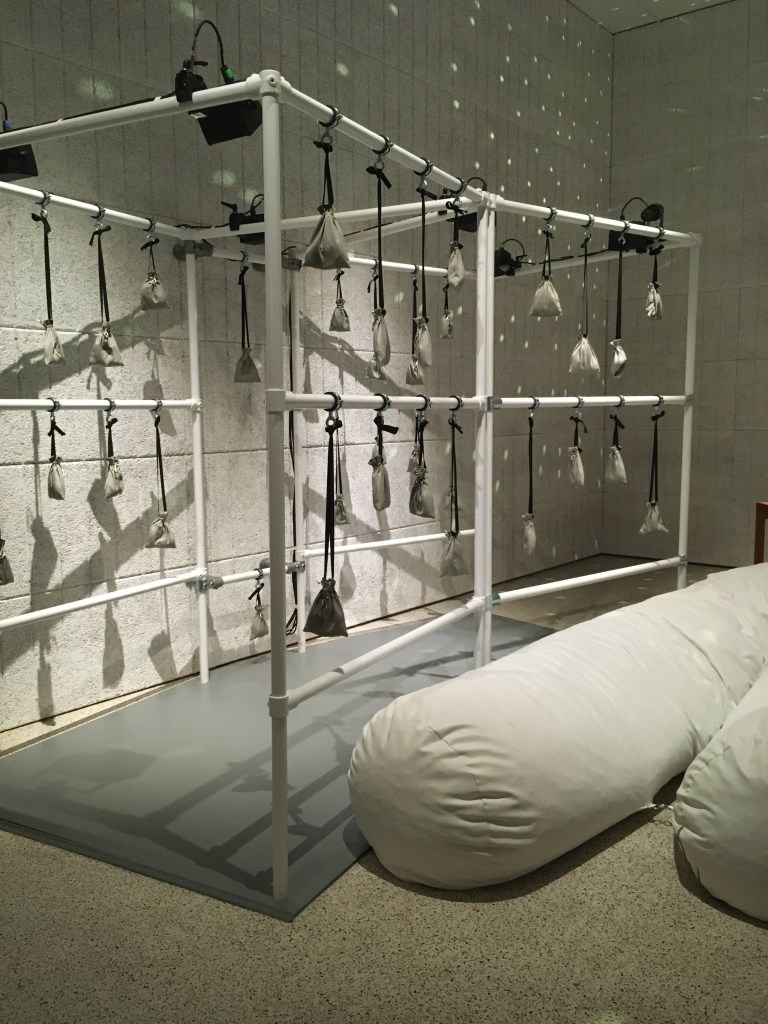
The show invites you to listen to earphones and hear a wide variety of sounds created by ASMR experts. For example little taps, scrunching a plastic bag, hearing rain on a roof are all sounds which give pleasure. Some people can whisper in a compelling way or simply speak within a timbre, generally quiet, which makes us sit up and pay close attention. Being told a story, no matter how rambling, can be a pleasure if the speaker’s voice is sonorous, warm and attractive.
Then there are sounds made by objects. I did enjoy dropping a coin into a round box and hearing the satisfying whirr as it went round and round before clattering into the well at the bottom. All children love marble games for the same reason.
Being a paper collage artist I’m for ever ripping and snipping paper. Well guess what, the sound of paper tearing or being carefully cut with scissors is one of those sounds. I’ve alway thought my art was a kind of meditation and now I know why.
Because this show was more about sound than images I don’t have that many images to post here but I do recommend this exhibition. It is a pleasurable experience and, in a room filled with big, baggy worm-like beanbags to loll upon, there are good reasons for staying there a while and simply immersing yourself in a relaxing experience.
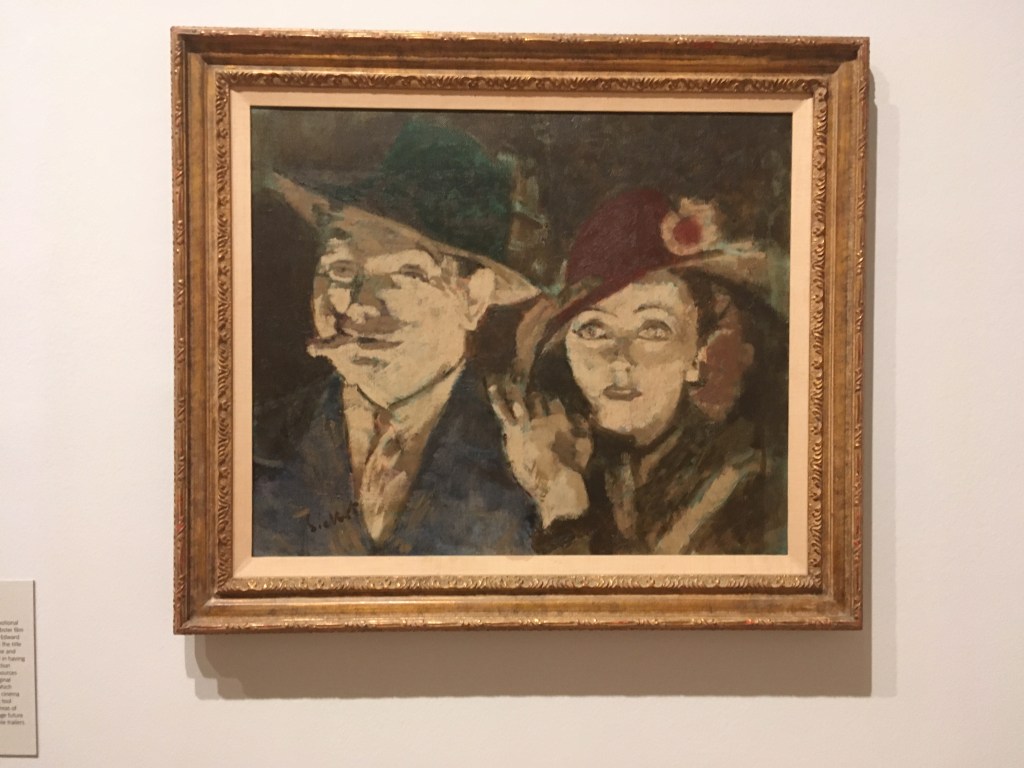
Jack and Jill, 1937, based on a promotional image for the 1936 mobster film Bullets or Ballots.
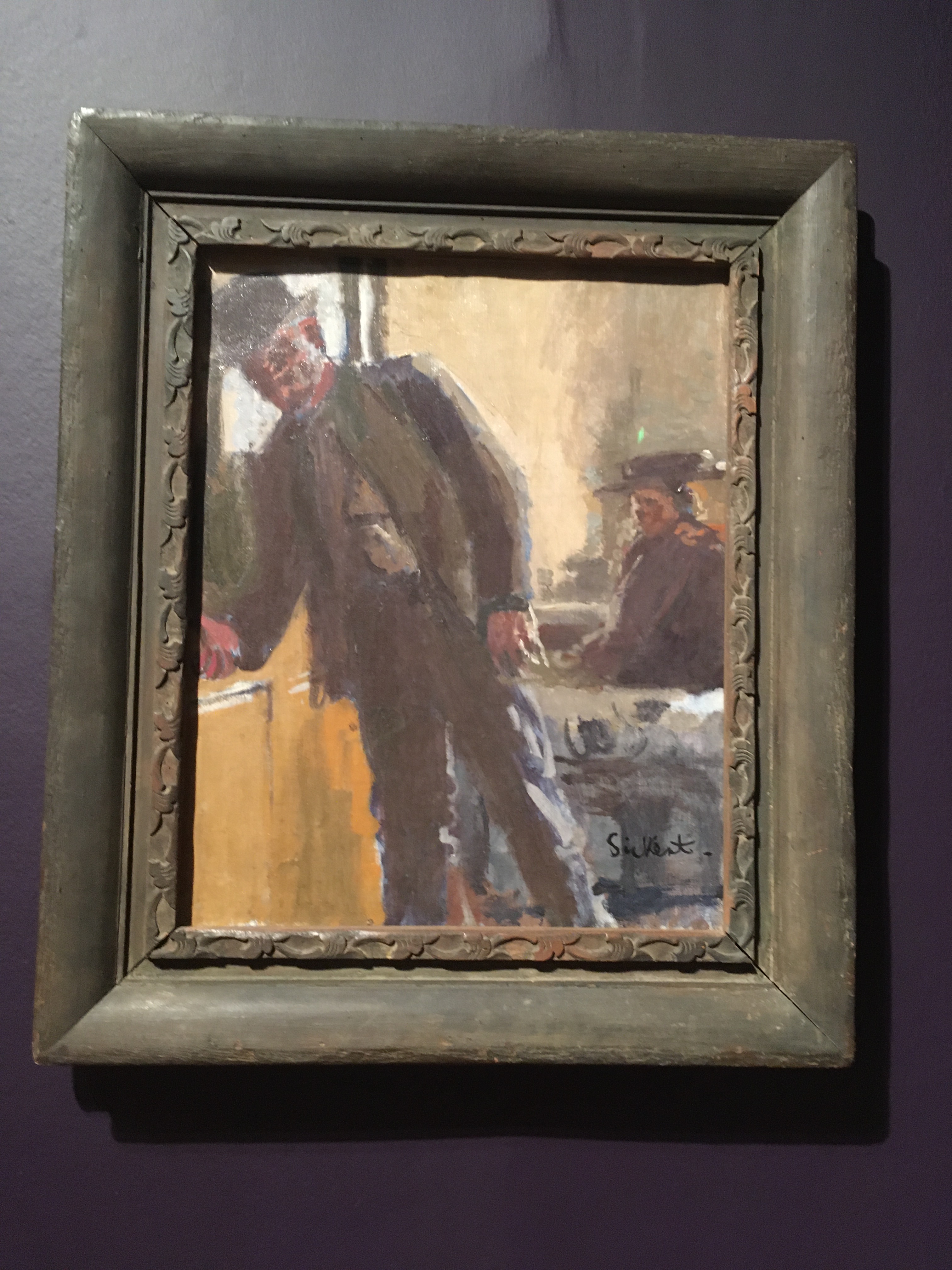
I’ve always been a Sickert enthusiast. OK, he doesn’t do pure colour, or even much colour, but his subjects always have a wonderfully intense feel to them. He often used photographs as reference – so many artists do, and why not when you need an interesting image to work from – and, as you can see in the image above, which is based on a promotional still for the mobster film, Bullets or Ballots, he has taken a photograph and rendered it painterly. There’s very little under-drawing and he has plunged into the painting with broad brush strokes creating a very urgent impression of the two protagonists.
But going back in time, here’s a self-portrait, also made from a photograph. The blobs of paint are cohesive and blend beautifully to create a wild, expressive painting. I have a theory that Sickert worked at high speed too. I don’t think you can get this effect from a piece which has been slowly laboured on (but I’d love to talk to more experts about this).
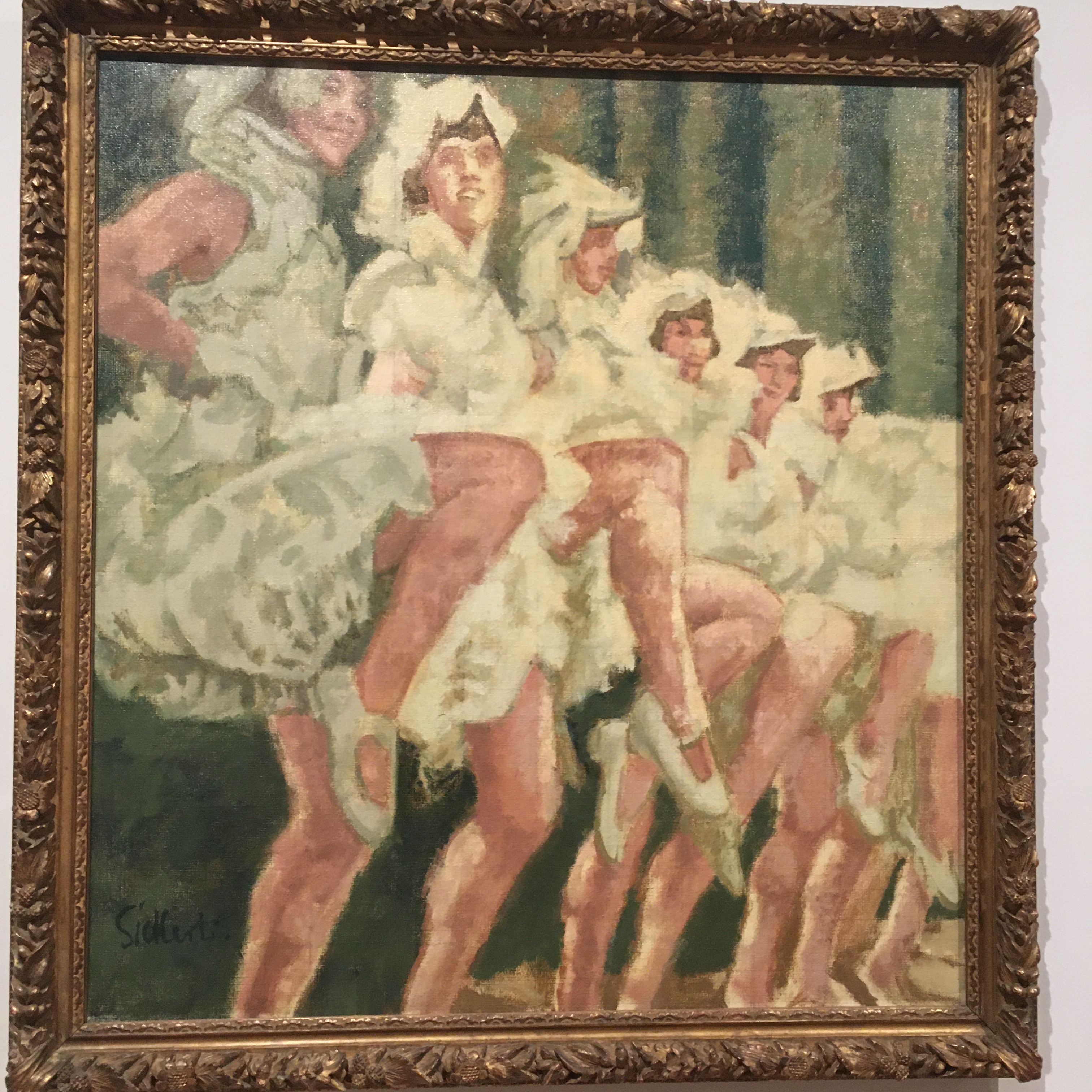
Sickert, born in 1860, started out as an actor. He was clearly drawn to theatre, performers and the audiences who filled music halls and arenas. He follows in a fine tradition of artists such as Hogarth, who loved a bawdy crowd in a theatre, or Degas who loved dancers and musicians and Lautrec who captured unusual angles of performers. These three examples, above, include High Steppers 1938, Theatre de Montmartre 1906 and Bonnet et Claque, Ada Lundberg at the Marylebone Music Hall.
You get a real sense of Being There from the paintings. The angles are curious and, with many of them, you feel as though you are right in the action; Ada Lundberg is singing right in front of you.
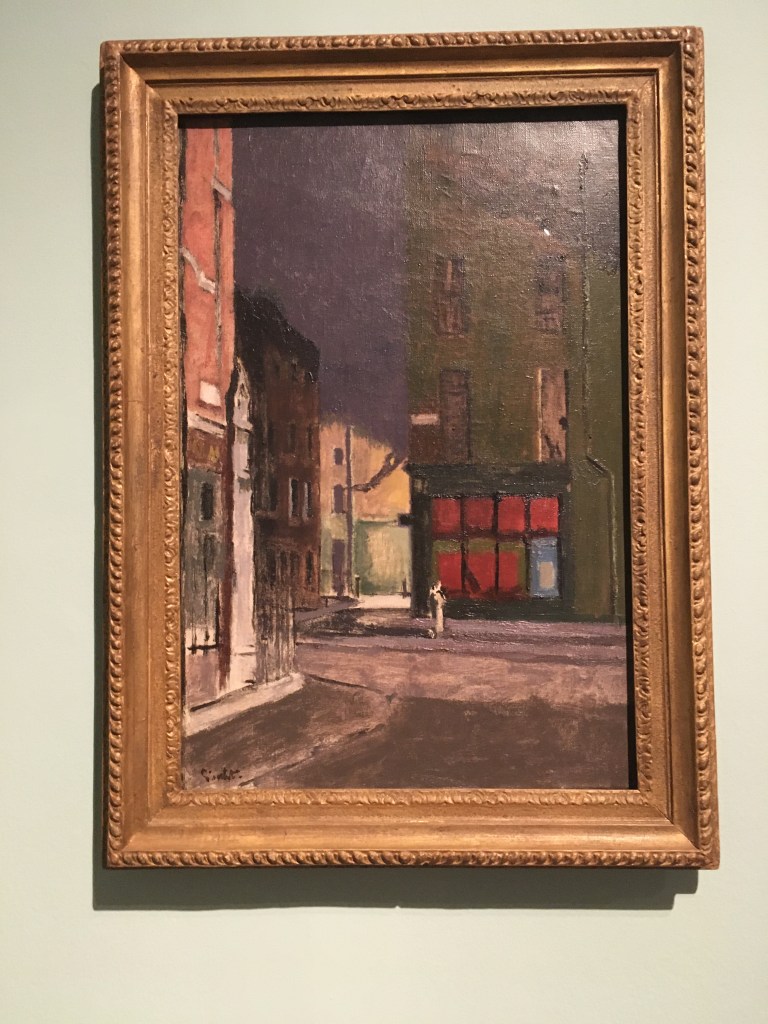
I was very drawn to this moody impression of a deserted Maple Street from 1916. It’s just a bit sinister, unpeopled, possibly late at night but that pop of red in the shop window is not only thrilling but quite chilling too. Loved it.
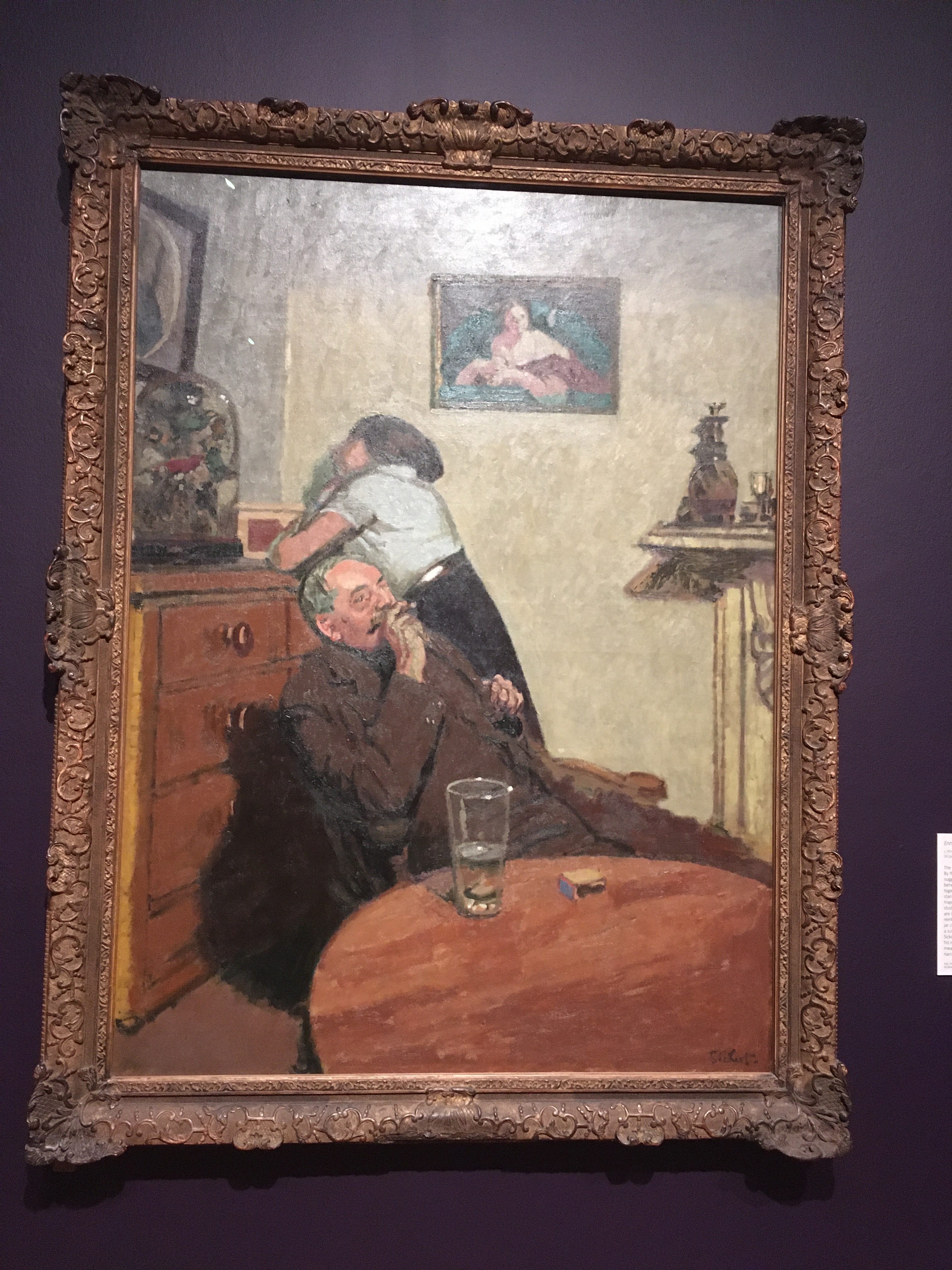
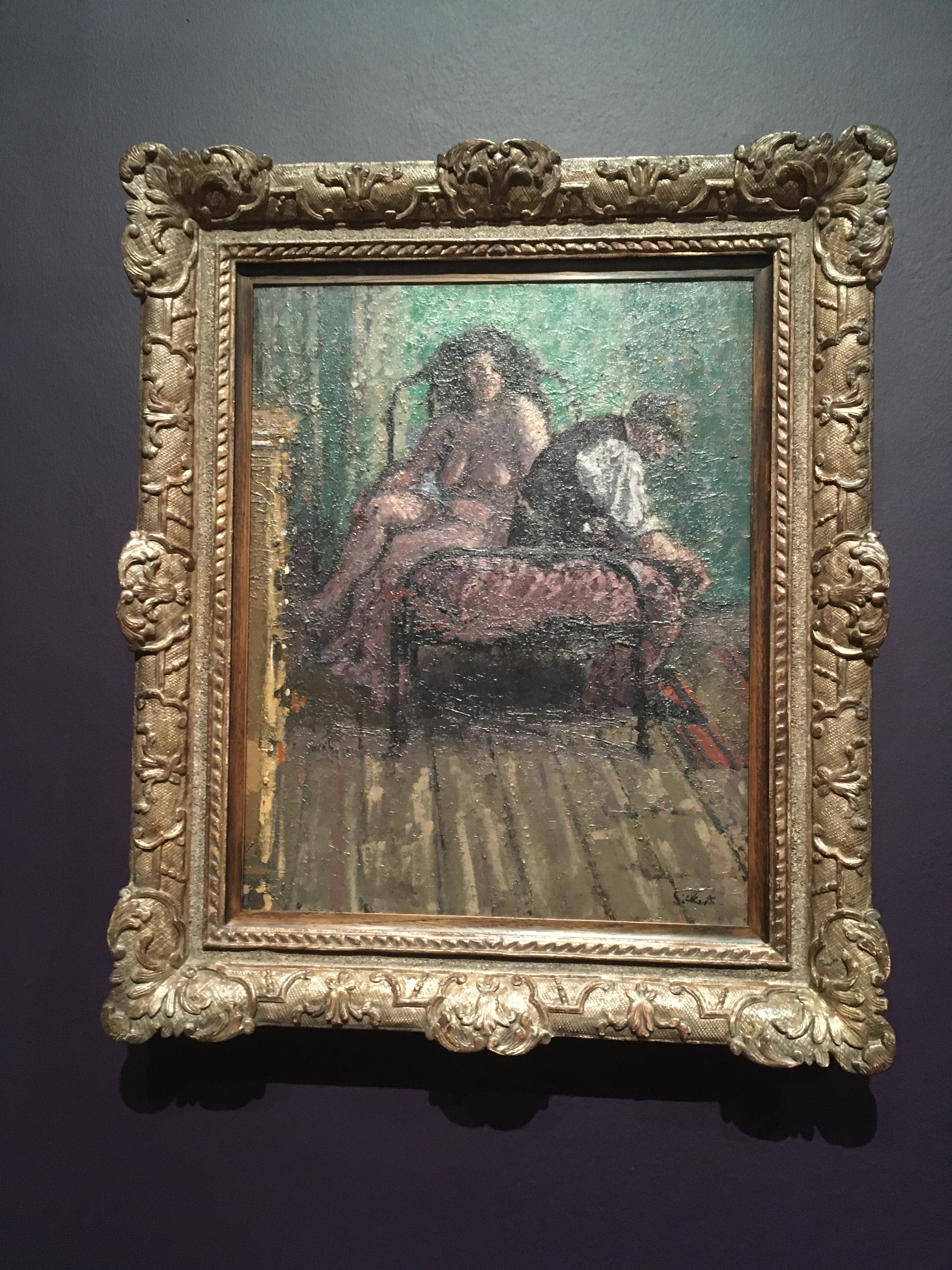
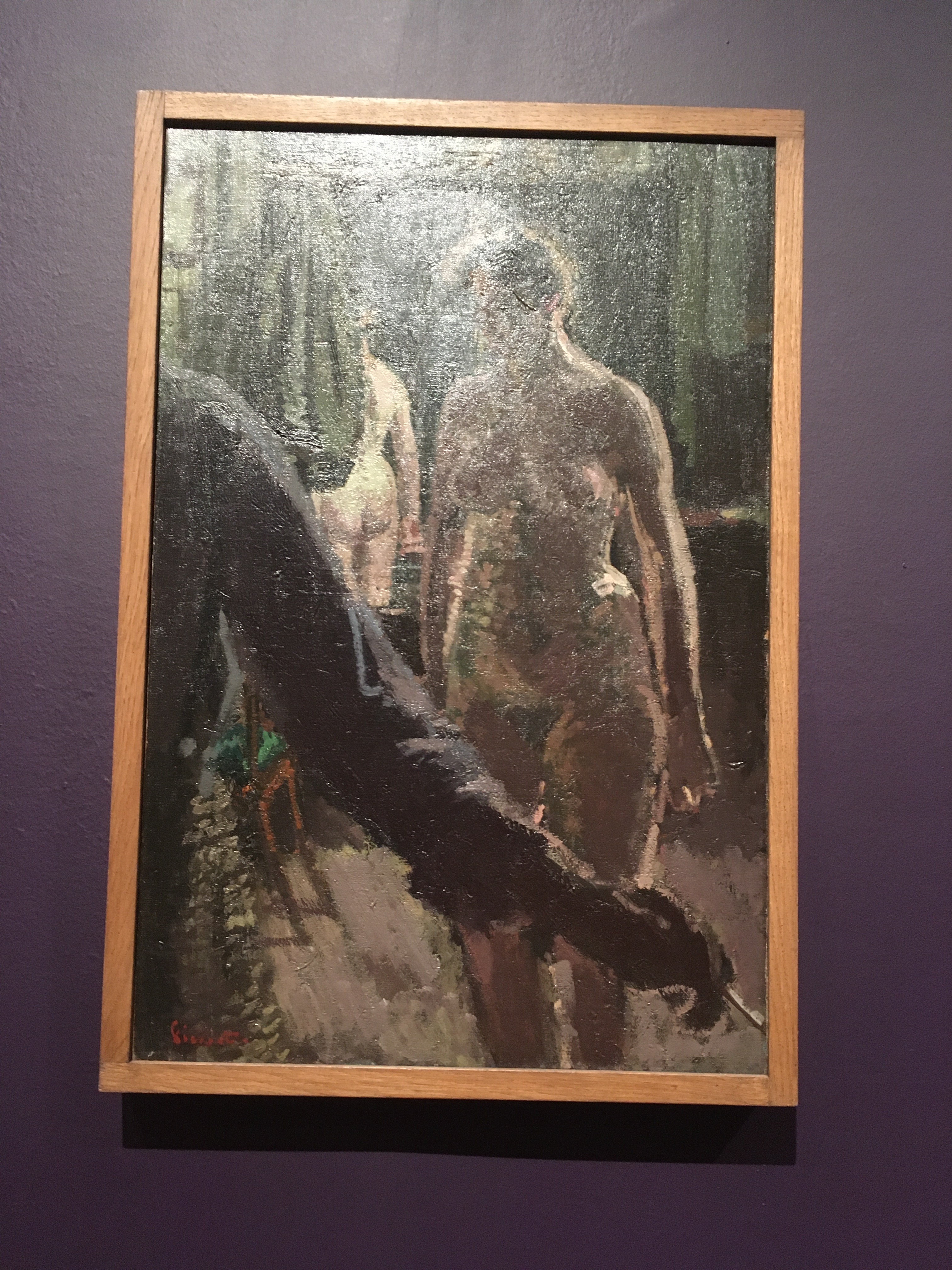
Ah, relationships. I get the feeling that Sickert was not successful in his relationships with women, but perhaps I’m reading these paintings too literally. These three all show couples operating at an emotional distance from each other. There is no tender gaze going on, more a sense that they’re on the brink of separating or just putting up with a claustrophobic situation. His Camden Town Murder range of paintings are unsettling. His nudes are amazing but you do feel that the women depicted have a defeated look about them.
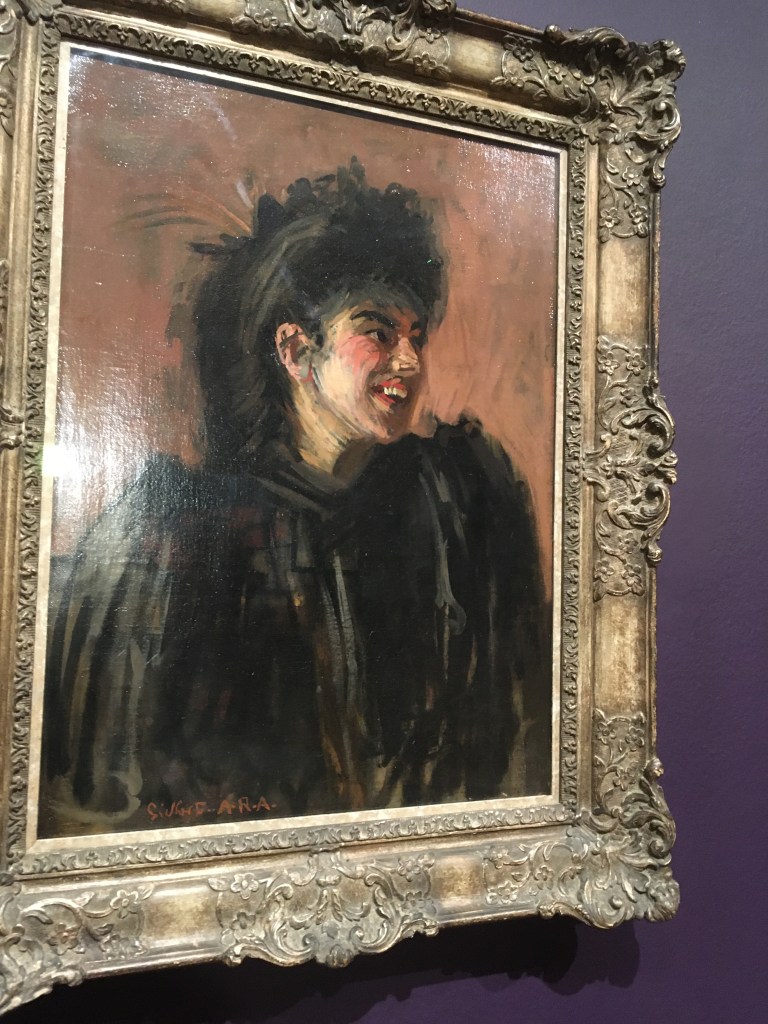
Here’s a really unusual portrait. It’s rare to see teeth in a portrait, or teeth that are the focus of the painting but he’s captured the character of The Blackbird of Paradise in 1892 which was exhibited with the title ‘A Study of Expression’. Again, I see speed of painting and a freedom of style which is very engaging. I think Hogarth would have approved.
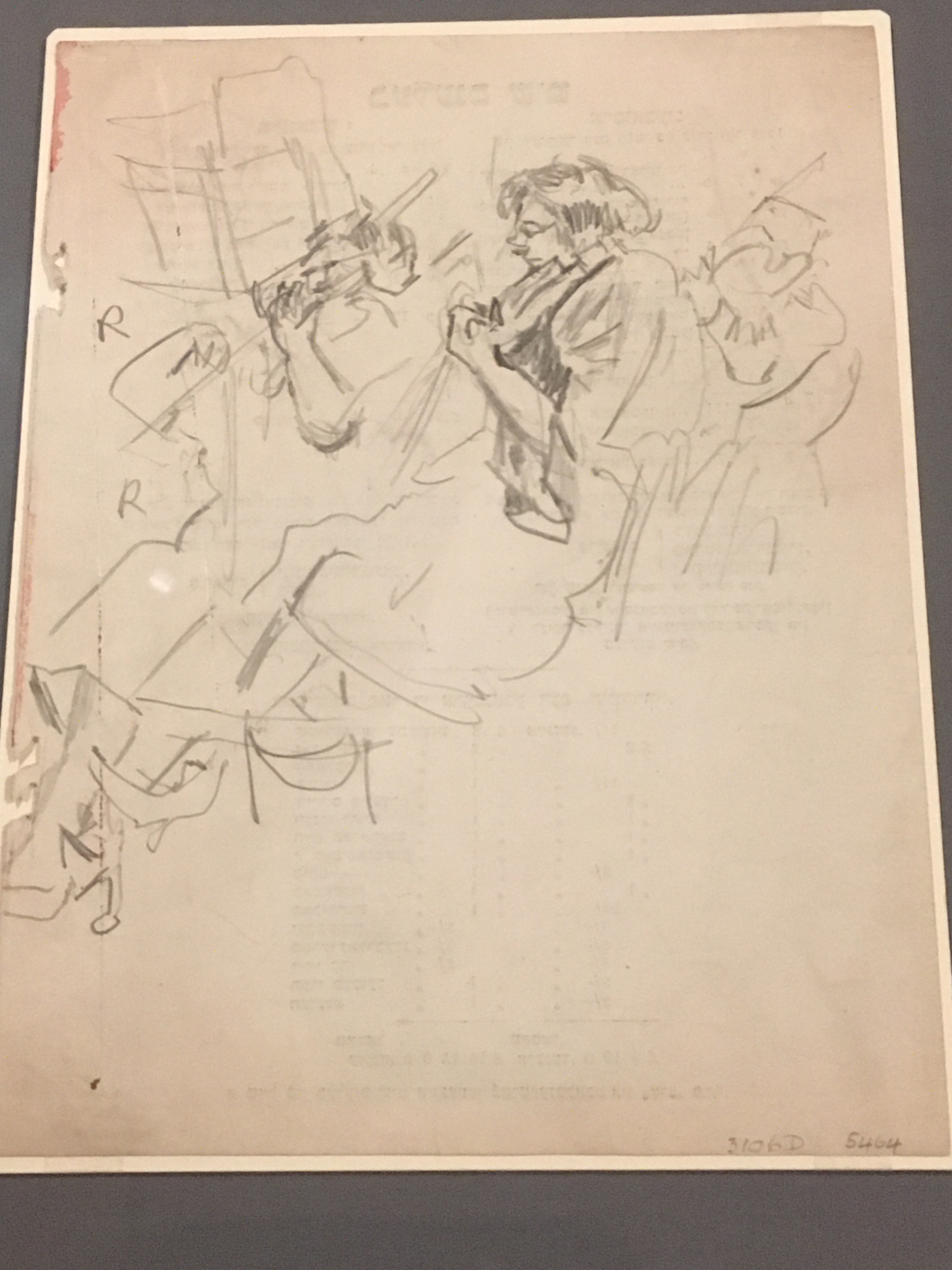
And finally, a few sketches which show us that Sickert didn’t only use photographs but liked capturing the action as it unfolded in quick and expressive drawings which inspired the paintings.
Walter Sickert is on at Tate Britain from 28th April to 18th September 2022.
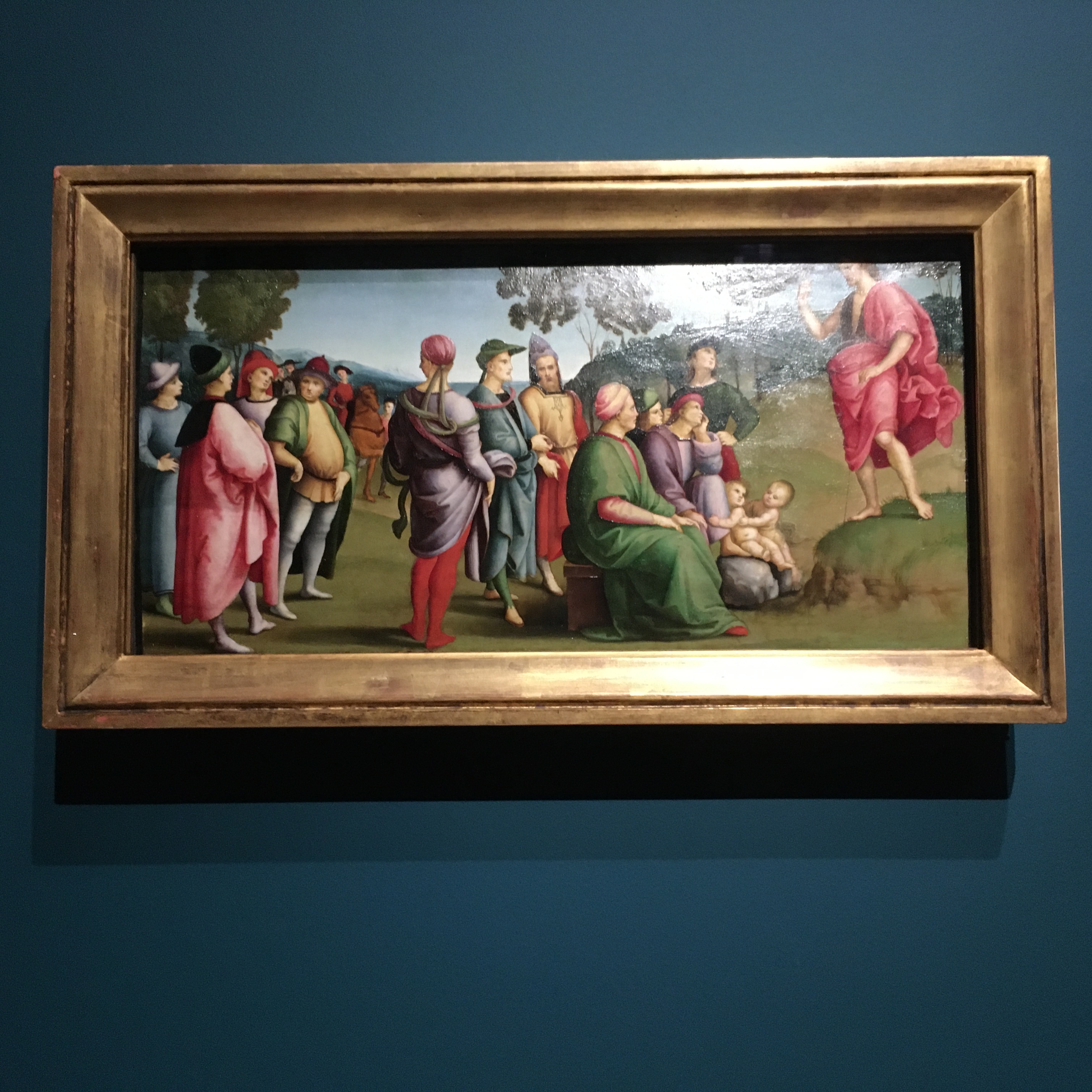
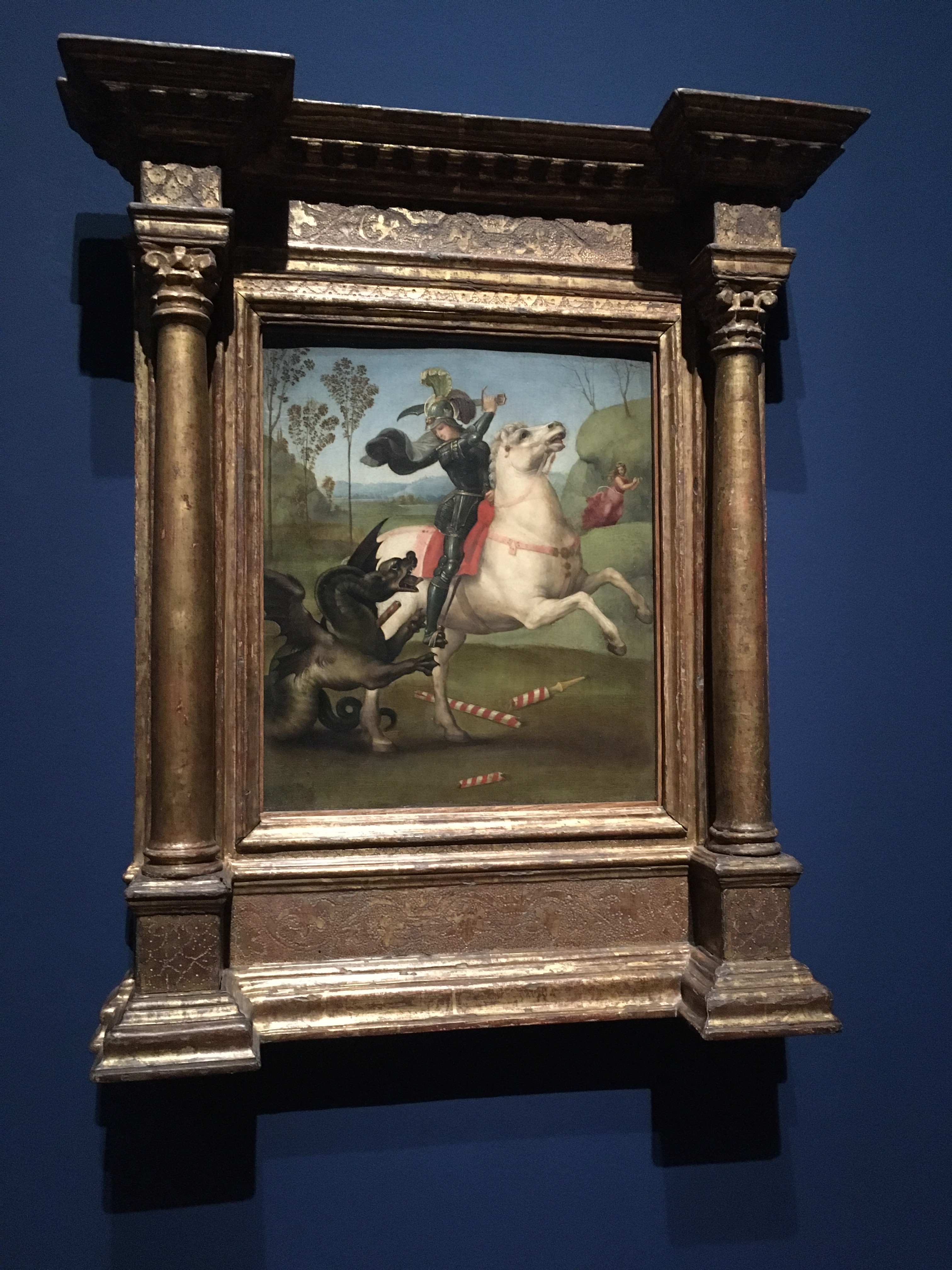
What makes this exhibition so fabulous is the way the curators have included many of Raphael’s sublime finished works but have also included many of the drawings or preparatory sketches which were made before each piece. With some exhibitions you might leave with the idea that the artist only ever completed finished masterpieces. The truth is that a great deal of ‘eyeballing’, as Hockney calls it, goes into the sketching of models, the arrangement of set pieces, selection of props and studies of backgrounds before the first layer of ground or glaze is put in place. With this show at the National Gallery, you really get a feel for the working artist, the way he saw the world, his relationship with his subjects, his assistants and his patrons as well as the philosophy which underpinned much of the work.
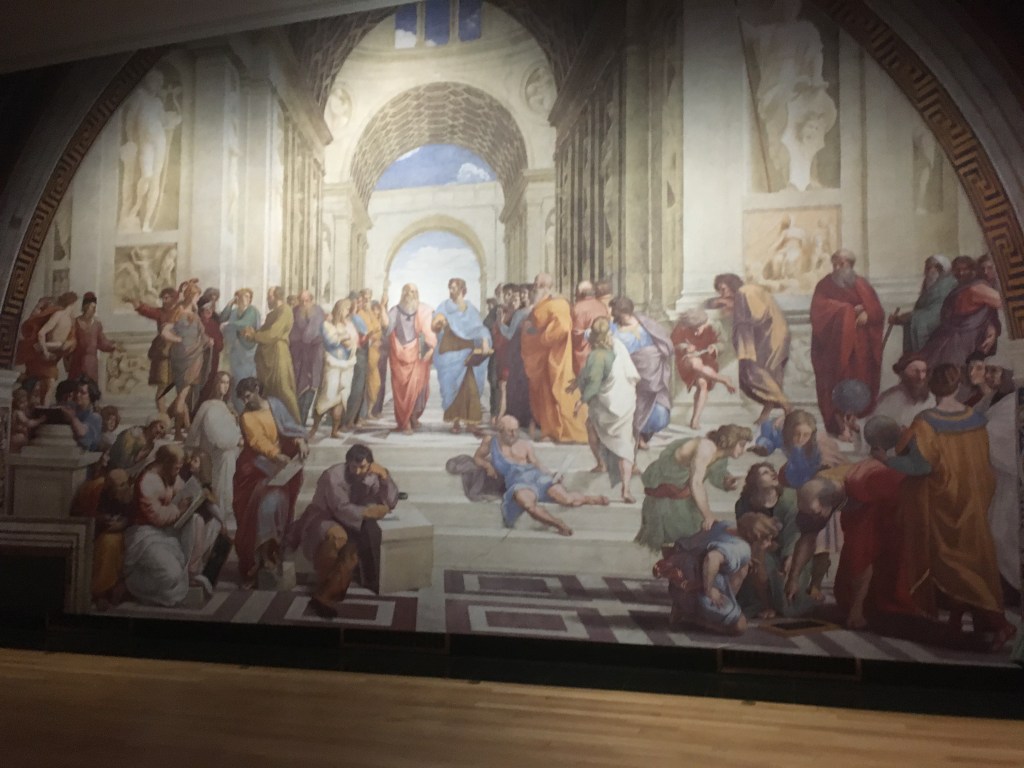
It’s great to see reproductions of huge frescoes. This, above, is a very clever reproduction of the work called The School of Athens – we see Plato (pointing upwards) and Aristotle (pointing downwards) at the centre. The figure at the front, seated and sketching on a block is reputed to be a portrait of Michaelangelo. The two artists, though working in Rome at the same time, were not friends.
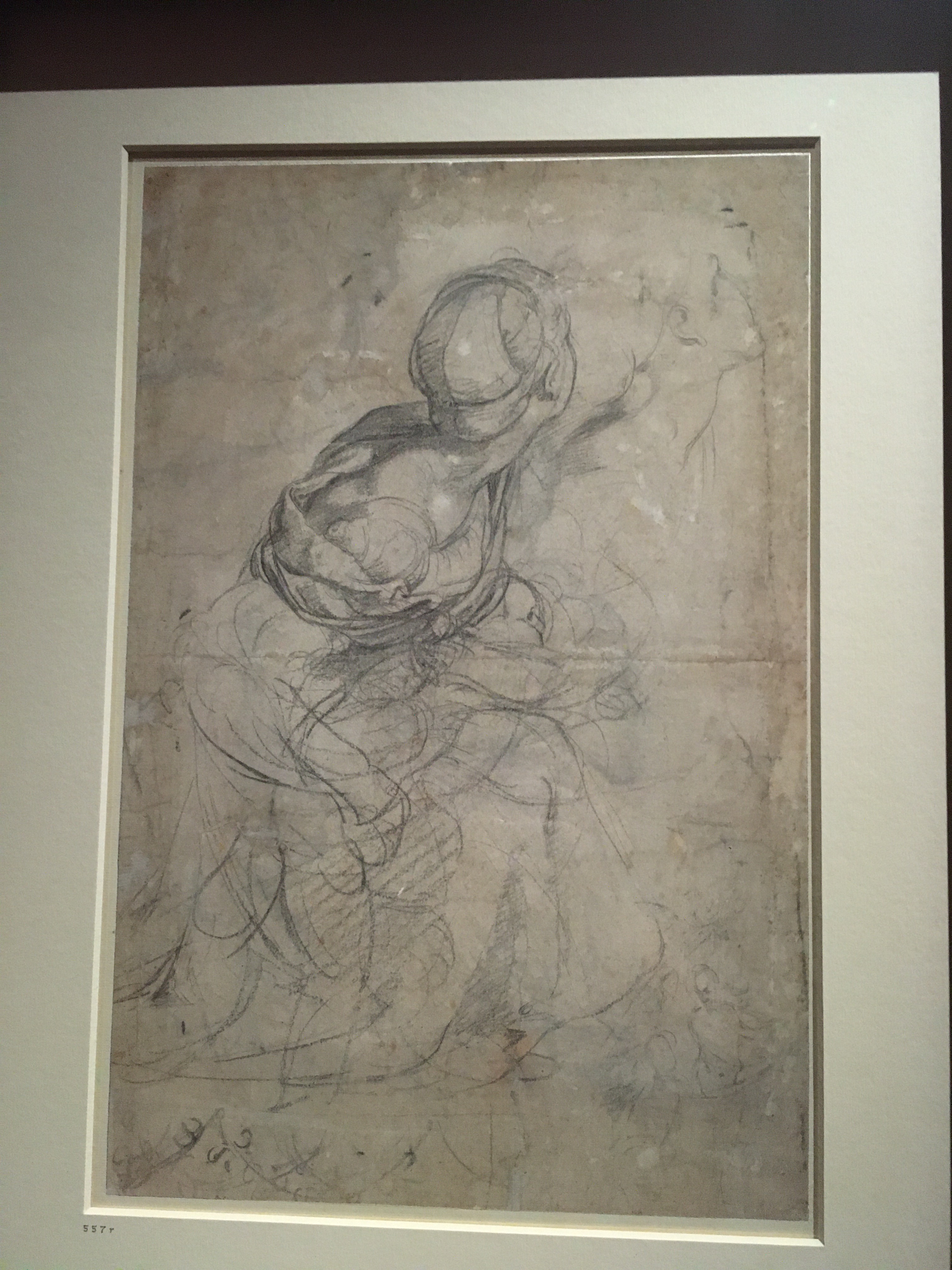
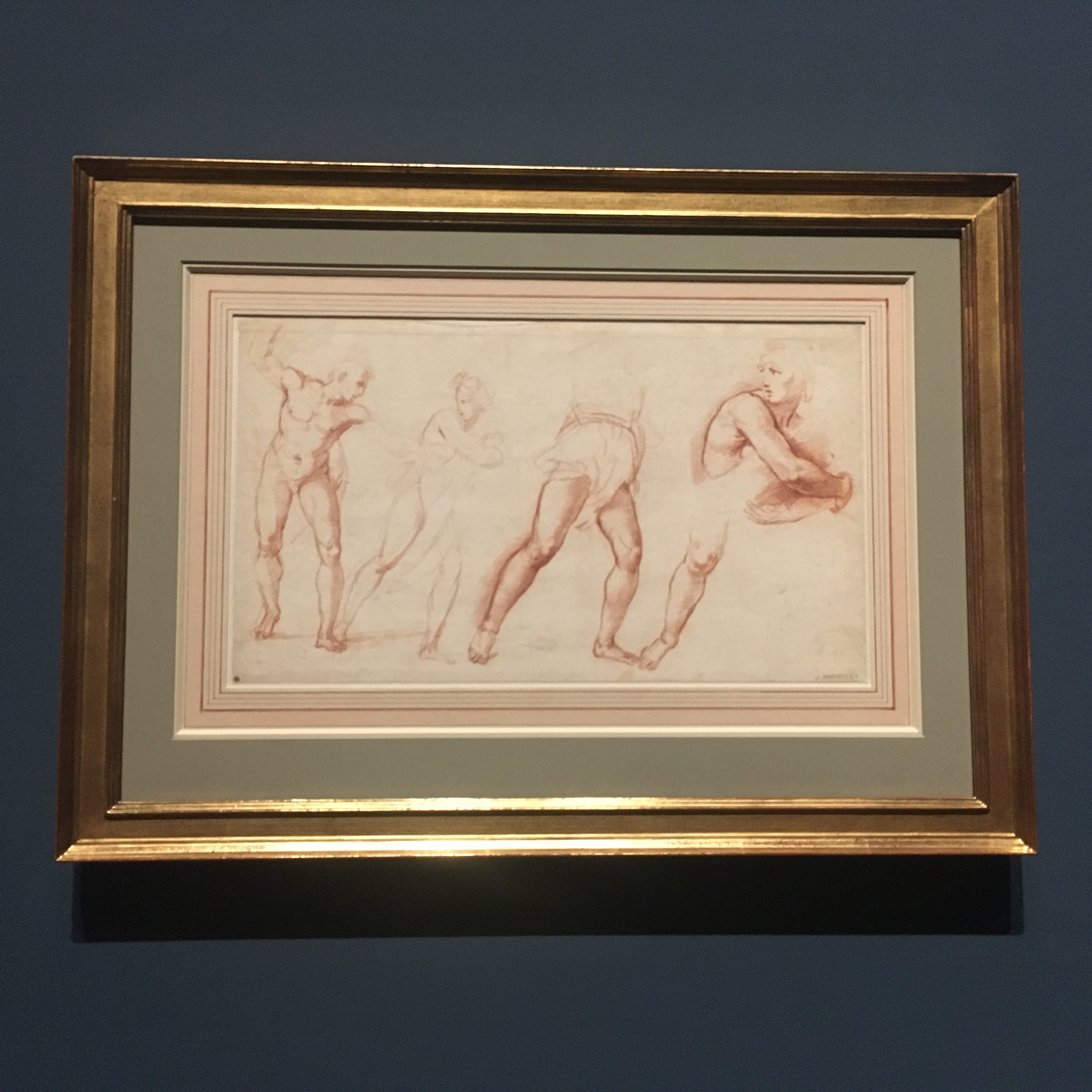
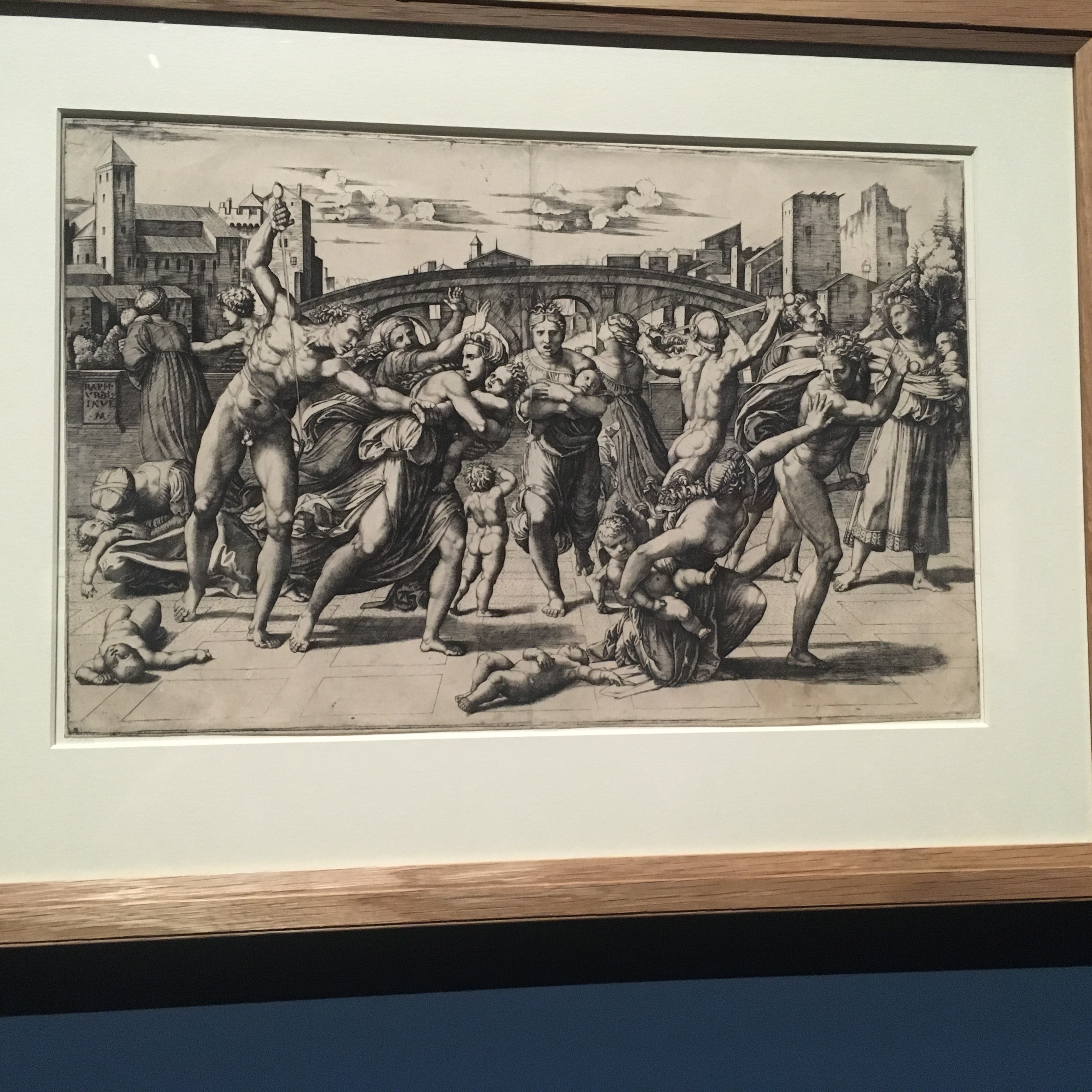
The preparatory drawings are rarely seen in exhibitions and it’s so enjoyable to peruse these sketches. Clearly Raphael had a very expert eye for the human form, male and female, and spent time working with life models to create poses which evoke emotion, movement, action. It’s like a peep behind the curtain of a very polished show and seeing all the ropes and pulleys which make illusions work.
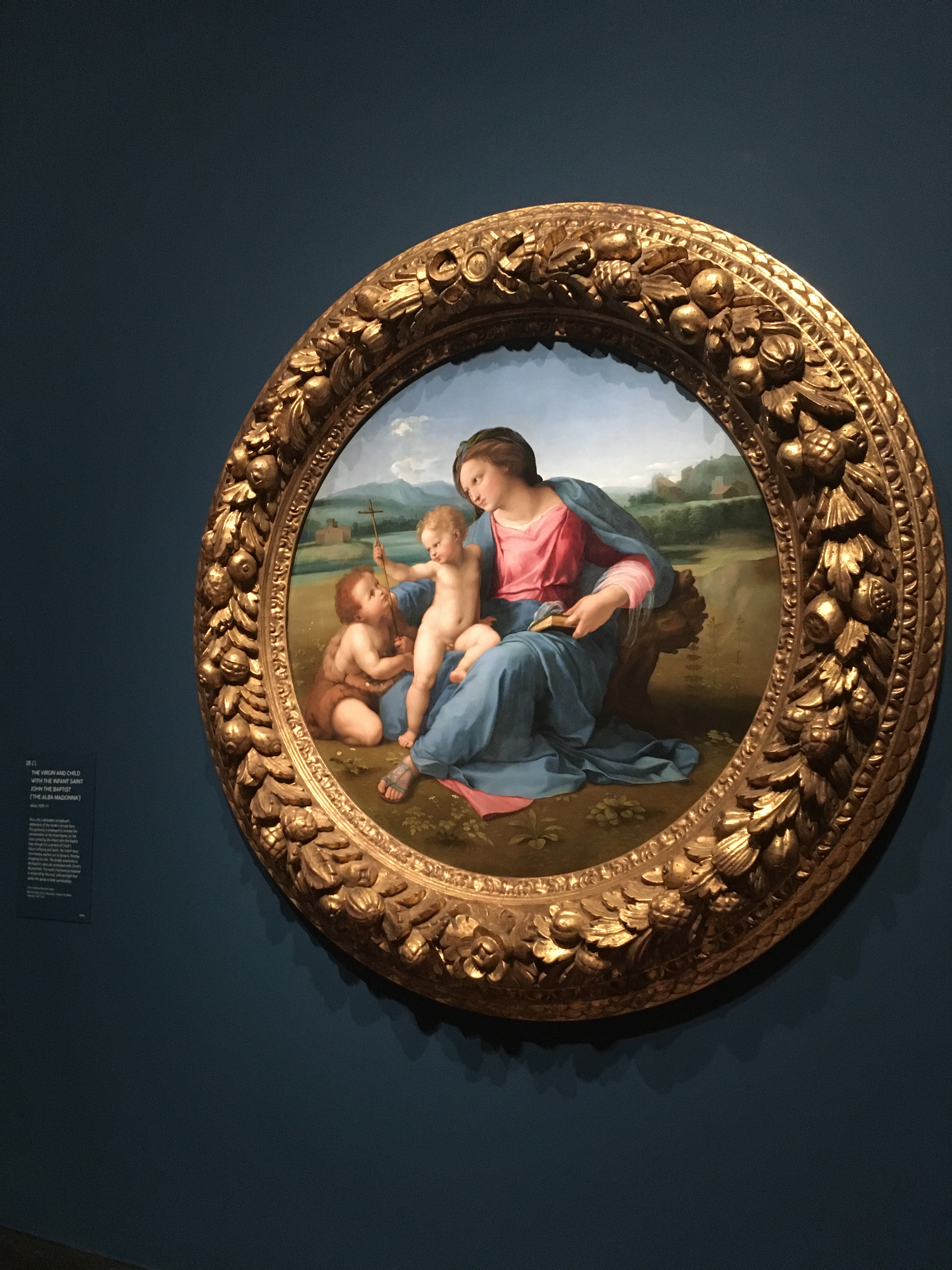
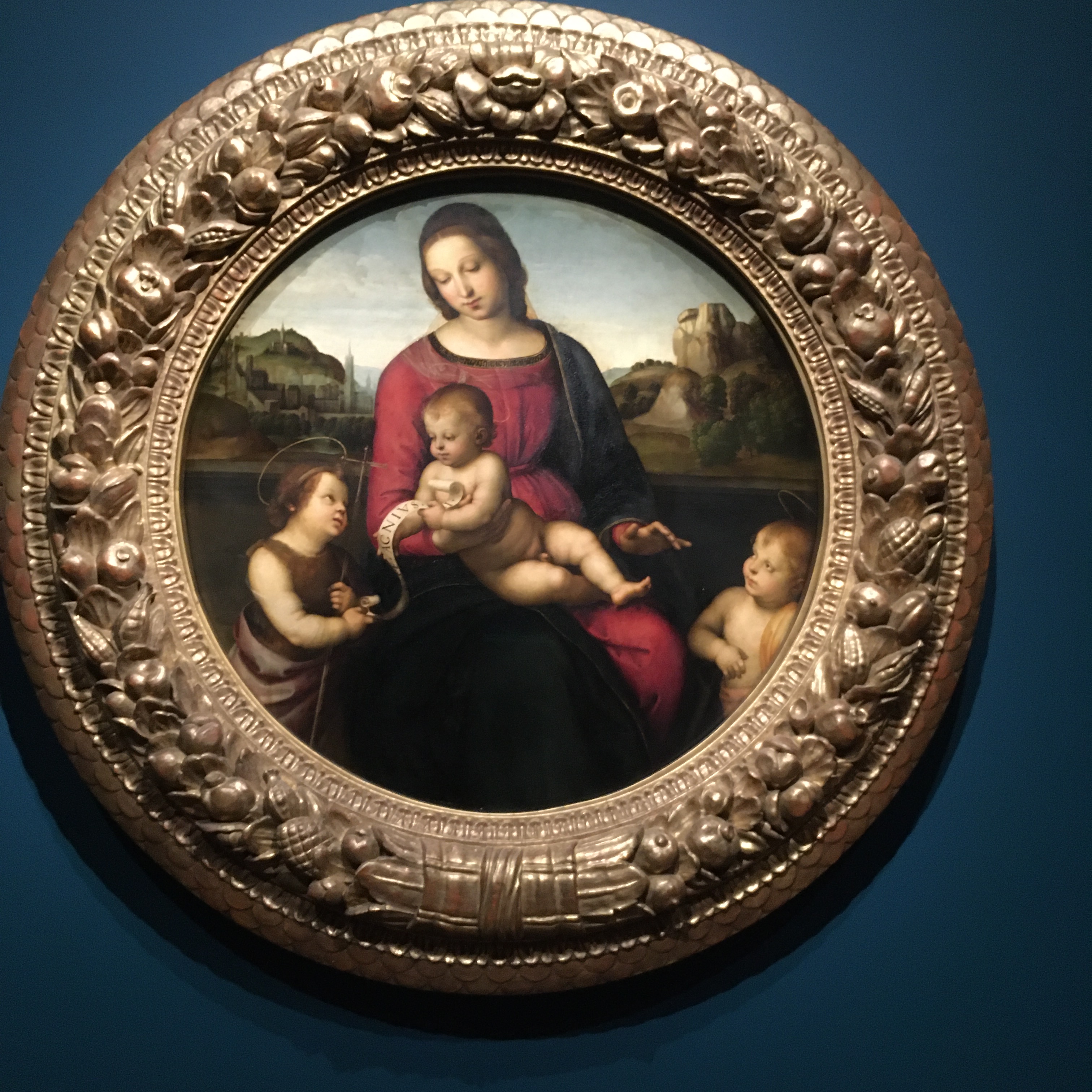
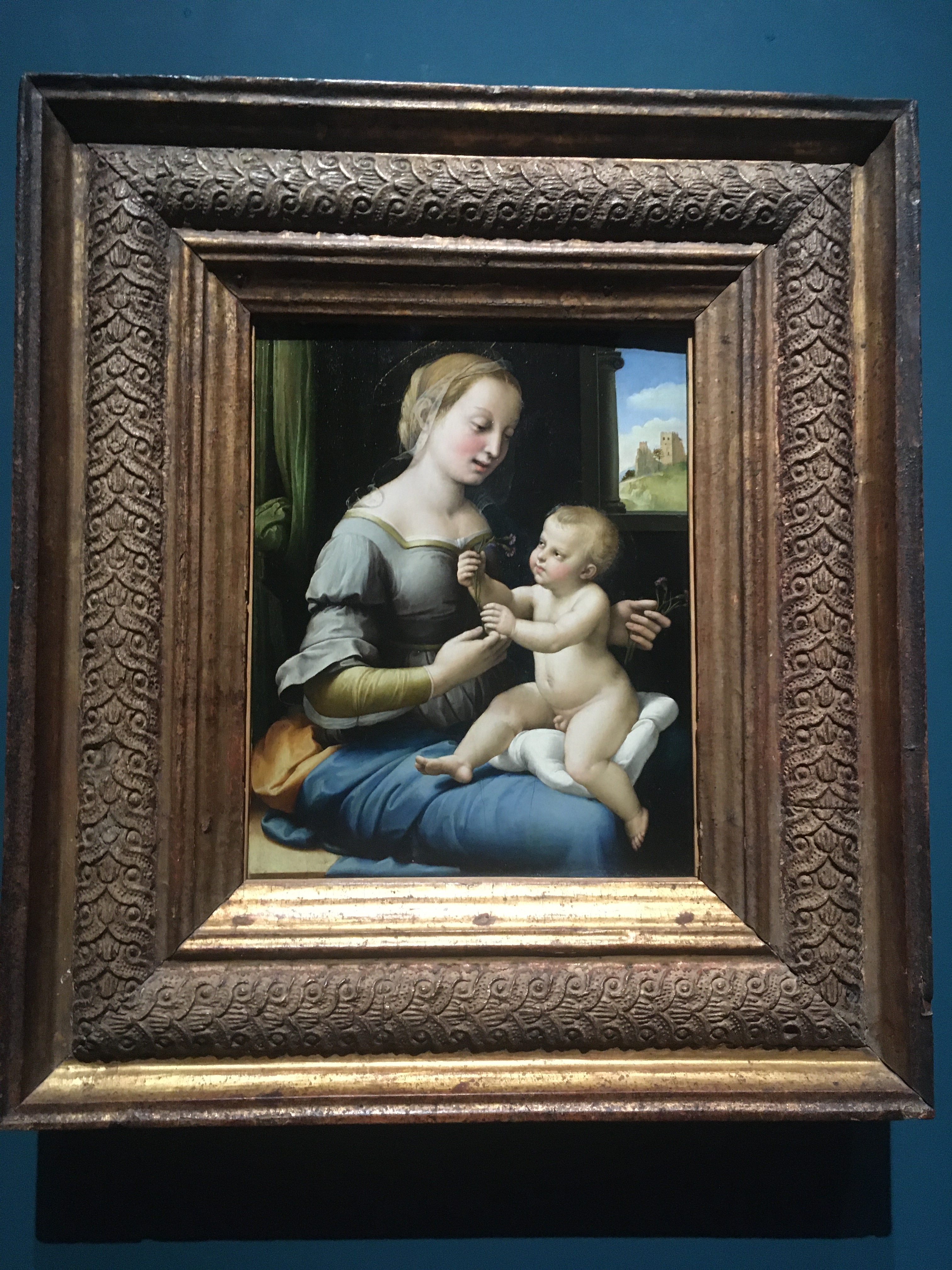
We have some beautiful madonnas – especially two Tondo (round) paintings which capture the bond between mother and child and the tenderness of their relationship.
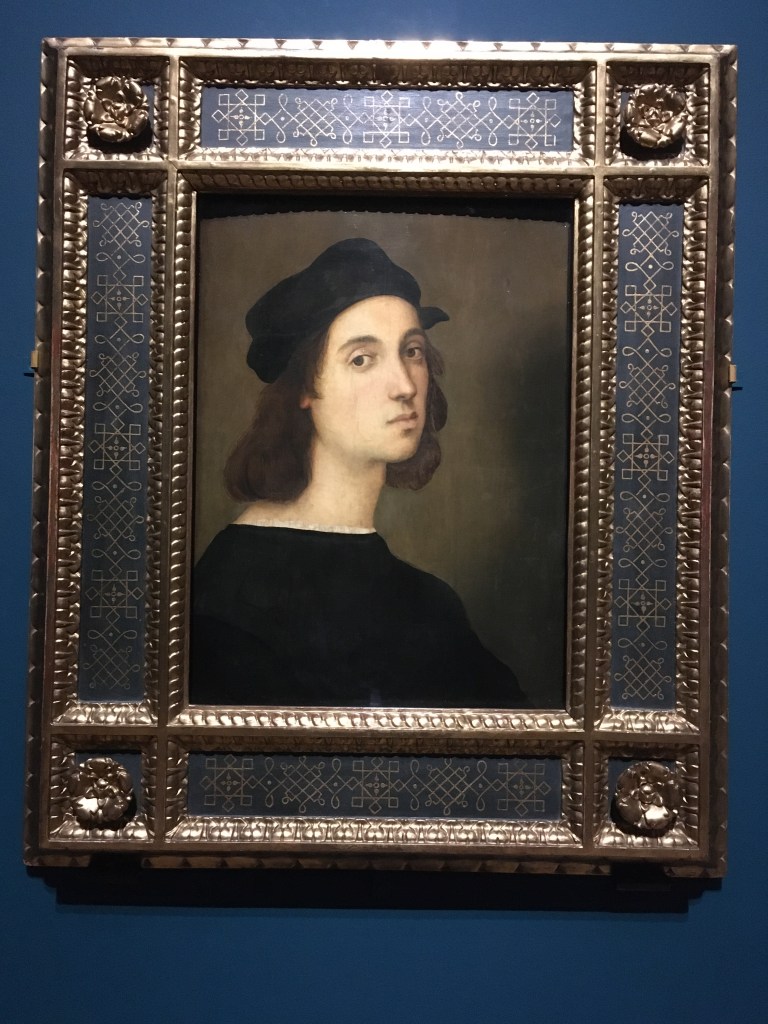
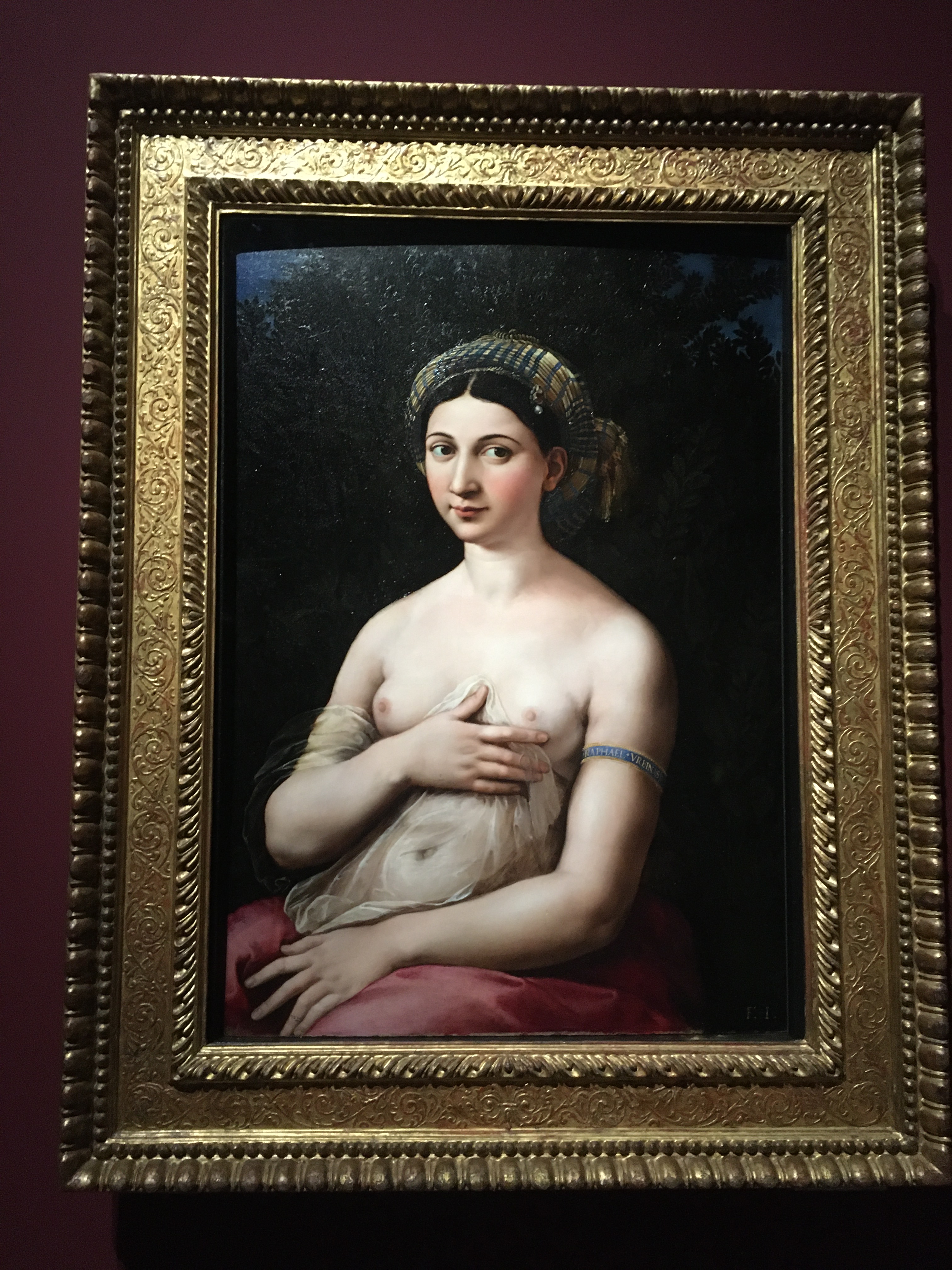
The portraits in the final room are a joy. On the left is a self-portrait of Raphael with his talented studio assistant, Giulio Romano. The central portrait is La Donna Velata (apparently a great love of the artist) and the rather more saucy Portrait of a Woman from 1519-20. What you take away from these portraits is the bond and the relationship between subject and painter. There’s a real feeling of engagement and affection.
What a shame that Raphael died so young but his legacy is huge and artists ever since have admired and tried to replicate his extraordinary style, his attention to detail and sheer technical brilliance. This is a fabulous show.
Anyone who makes, paints or creates in some way needs a space. Virginia Woolf was right, you need a ‘room of one’s own’, a place where you can make a mess, explore ideas and do your own thing. It’s really satisfying to see an exhibition which celebrates the importance of the space you work in. It expands the notion of a physical space into the realms of experimental space, space as performance, space to live in and entertain in.
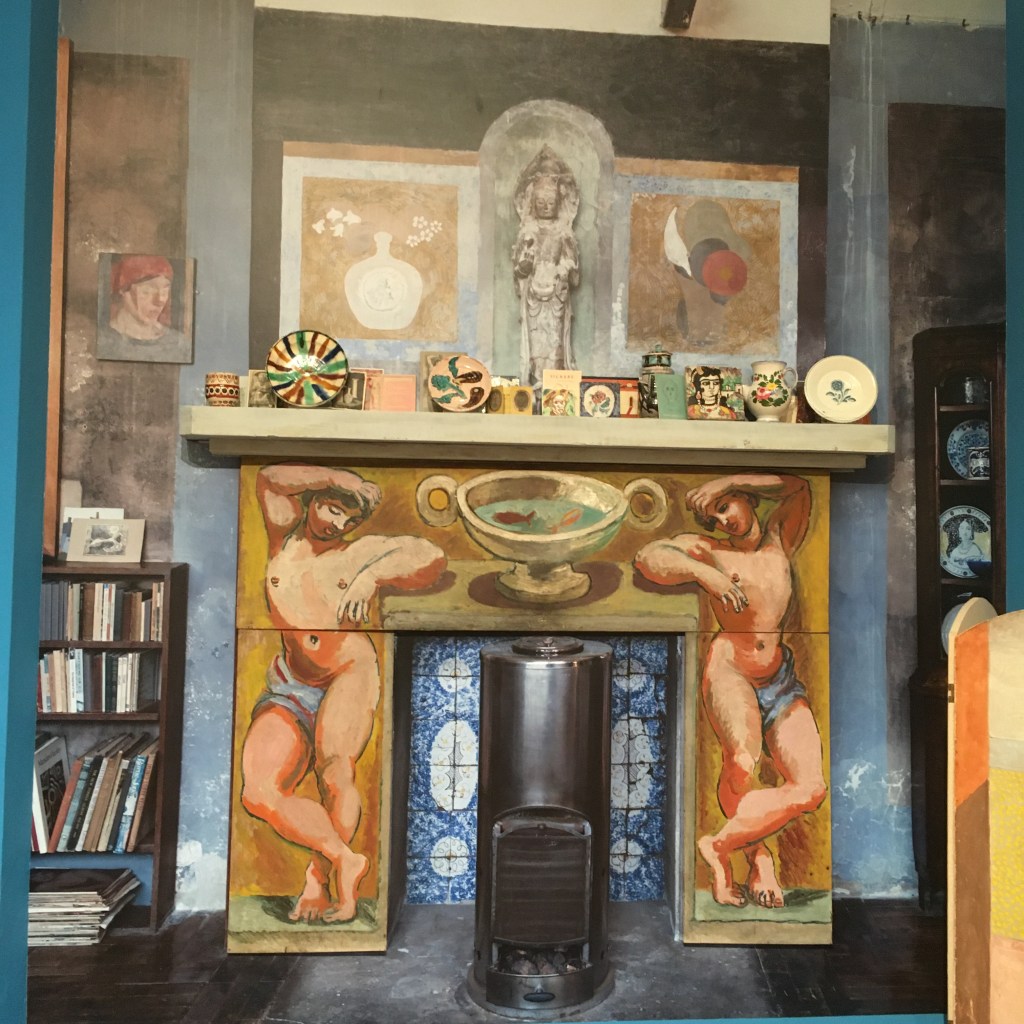
Duncan Grant, Chimney Piece, c 1925
I’ve loved the way the Bloomsbury set used their home as a vast canvas and this chimney piece, painted by Duncan Grant, gives you a great idea of the way Charleston Farmhouse was turned into a huge interior canvas for artwork.
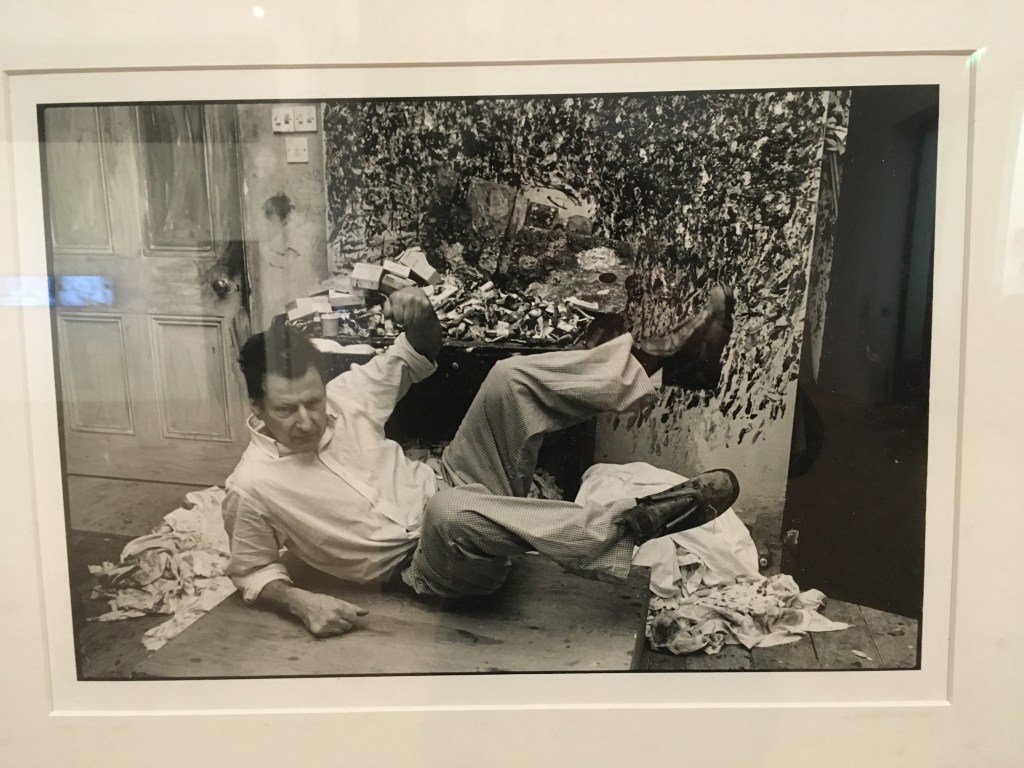
Here’s Lucian Freud in his studio with that famous wall daubed with excess paint, the pile of rags and mess of paint tubes on his table. The photo was taken by Bruce Bernard in 1983 and shows Freud in his famously painty spattered shoes which feature in a nude self-portrait he painted.
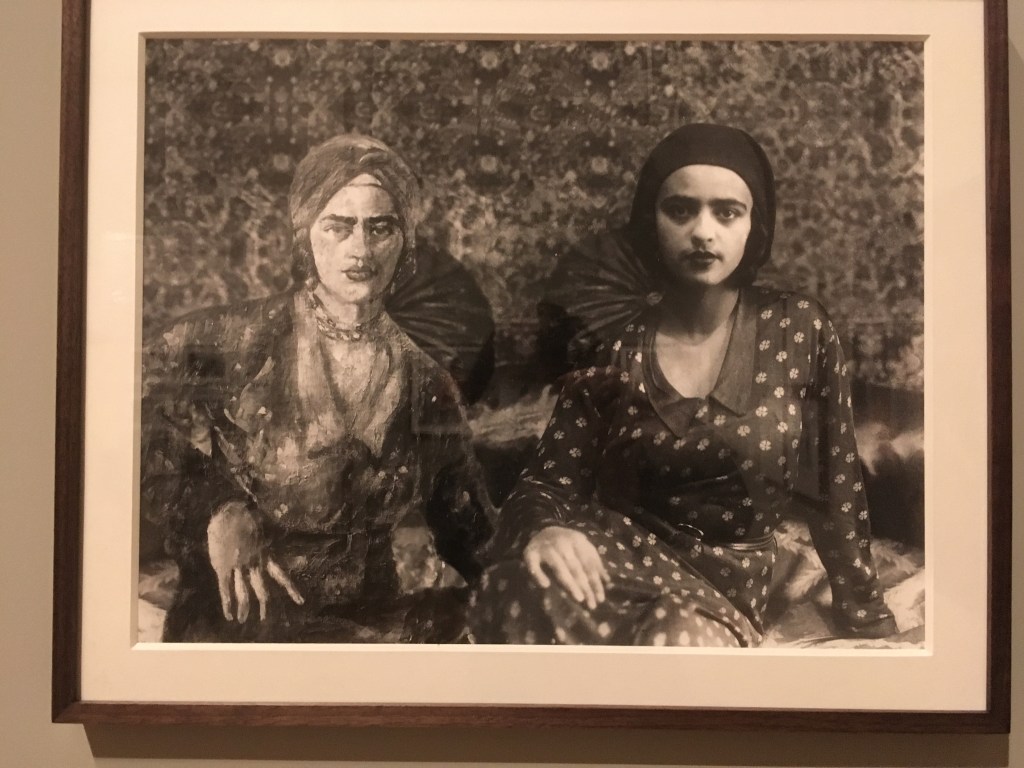
I was taken by this mingling of photography and painting by Vivan Sundaram 2001, which presents a very witty compare and contrast of art forms.
This show has been very imaginatively assembled in a non-literal way, with enjoyable artworks, installations, sculptures and films. But they all convey the sense that the possession of a personal space has allowed and encouraged the creation of art. And that’s what we all need.
A Century of the Artist’s Studio is on show at The Whitechapel until 4 June 2022
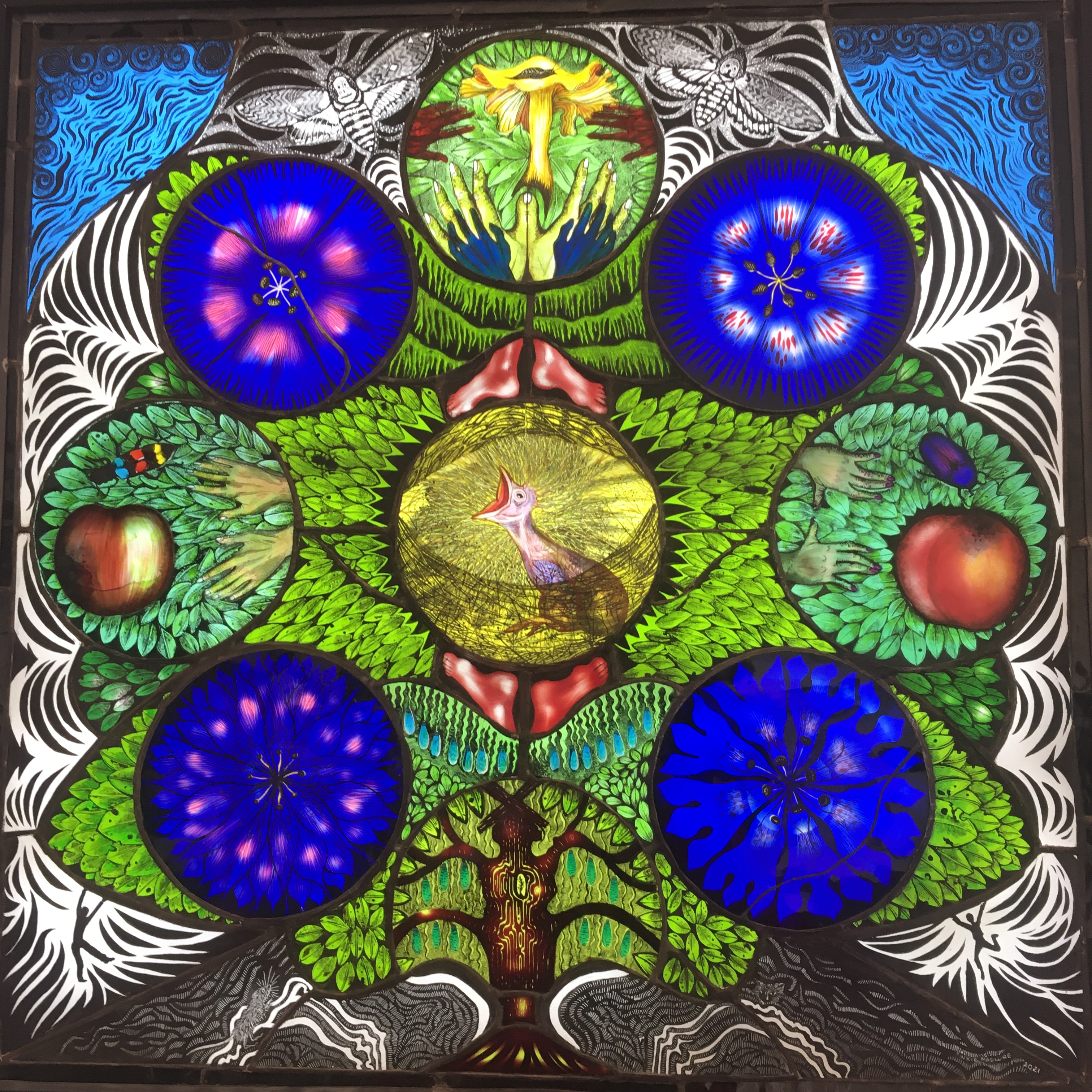
Pinkie Maclure, Tree of Life and Death Scenarios, 2021 Stained glass lightbox
I guess I was attracted to this work by Pinkie Maclure, in North Lands Creative room East Wing E16, because of the fabulous colours and the intriguing narrative to the piece. It takes stained glass artwork to a new level.
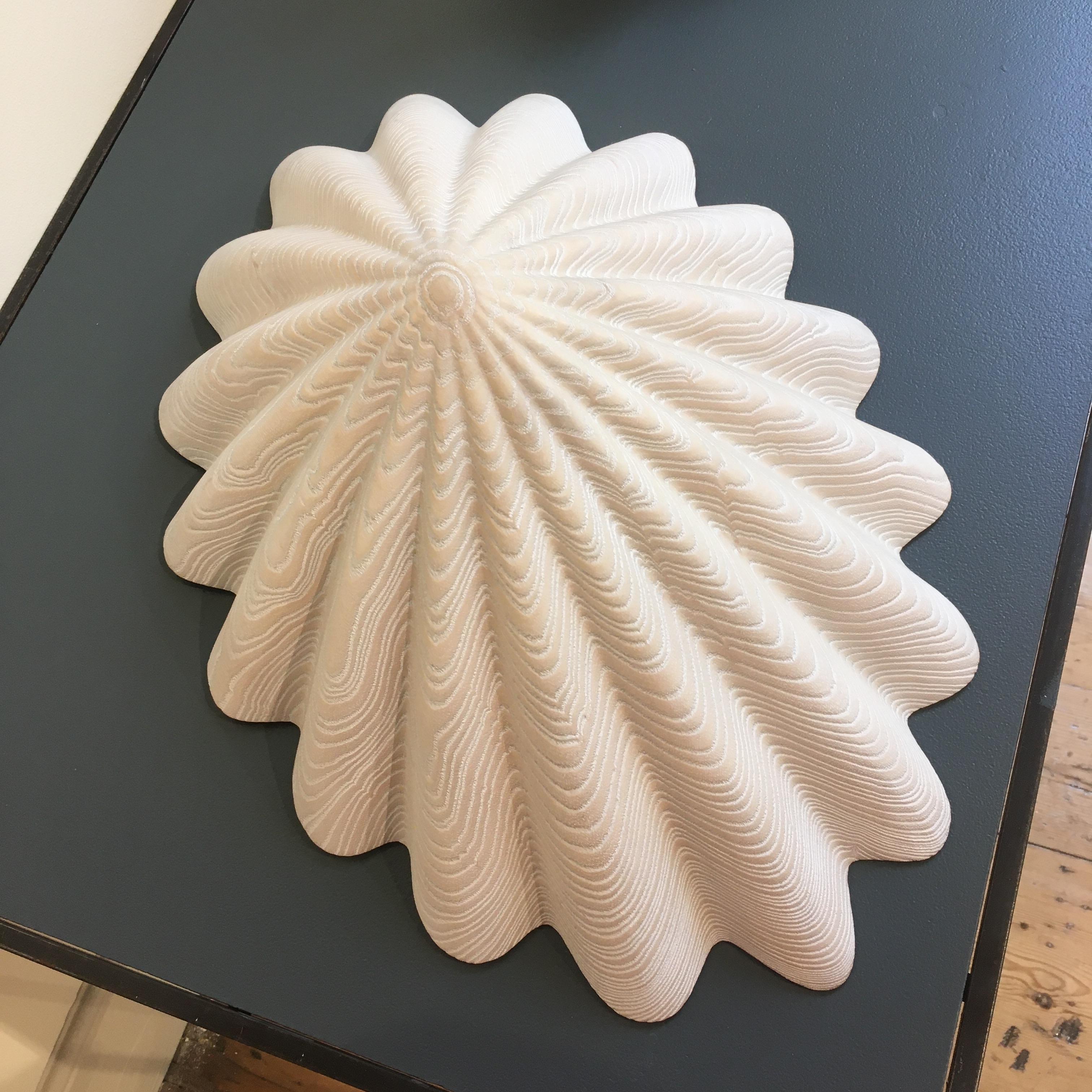
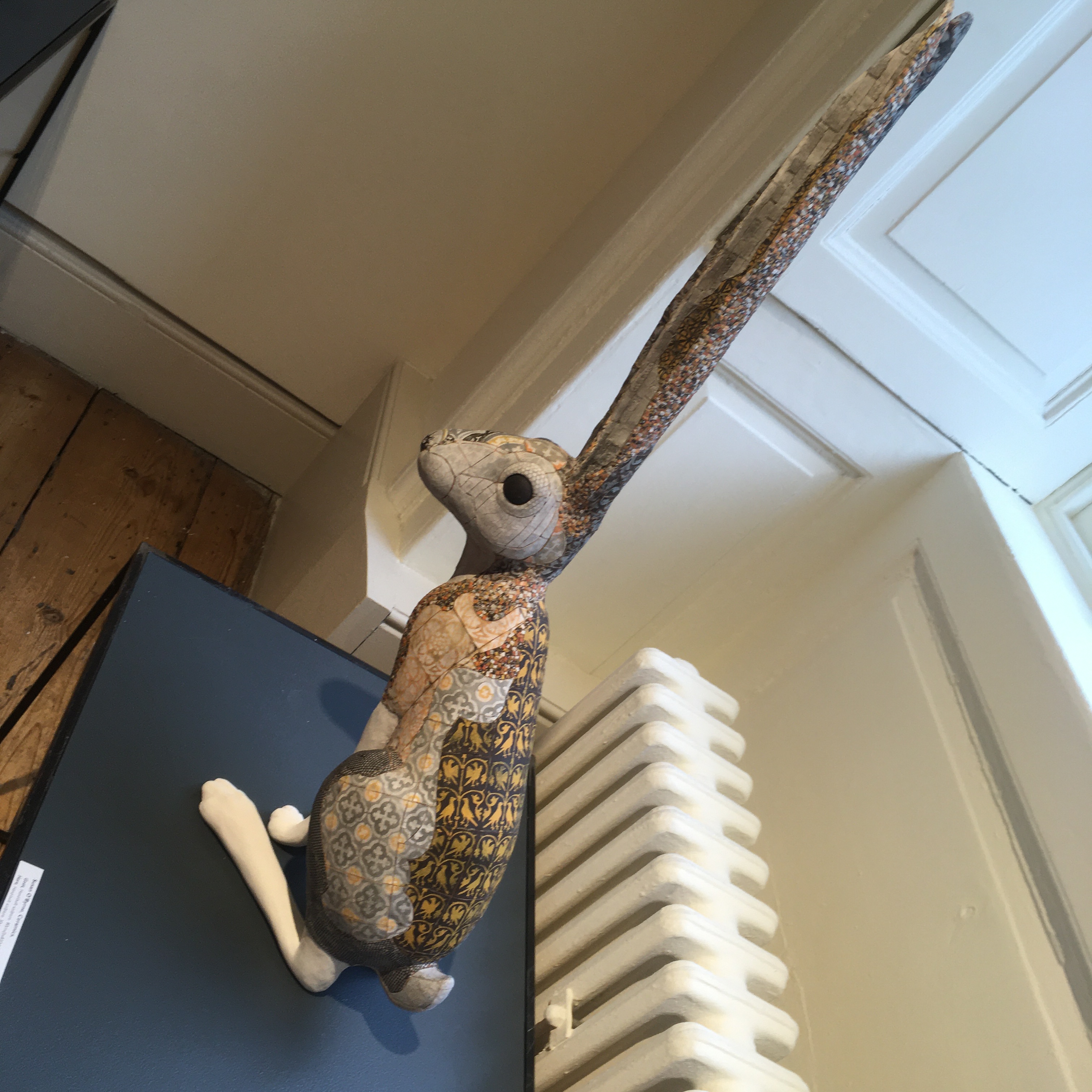
Duke Christie, Limpet (pale) shell form made from wind fallen ash tree Susan O’Byrne, ceramic hare
These two at the Craft Scotland room, West Wing W10, caught my eye. I loved the surface on these pieces: carved Limpet by Duke Christie and a very decorative ceramic hare by Susan O’Byrne.
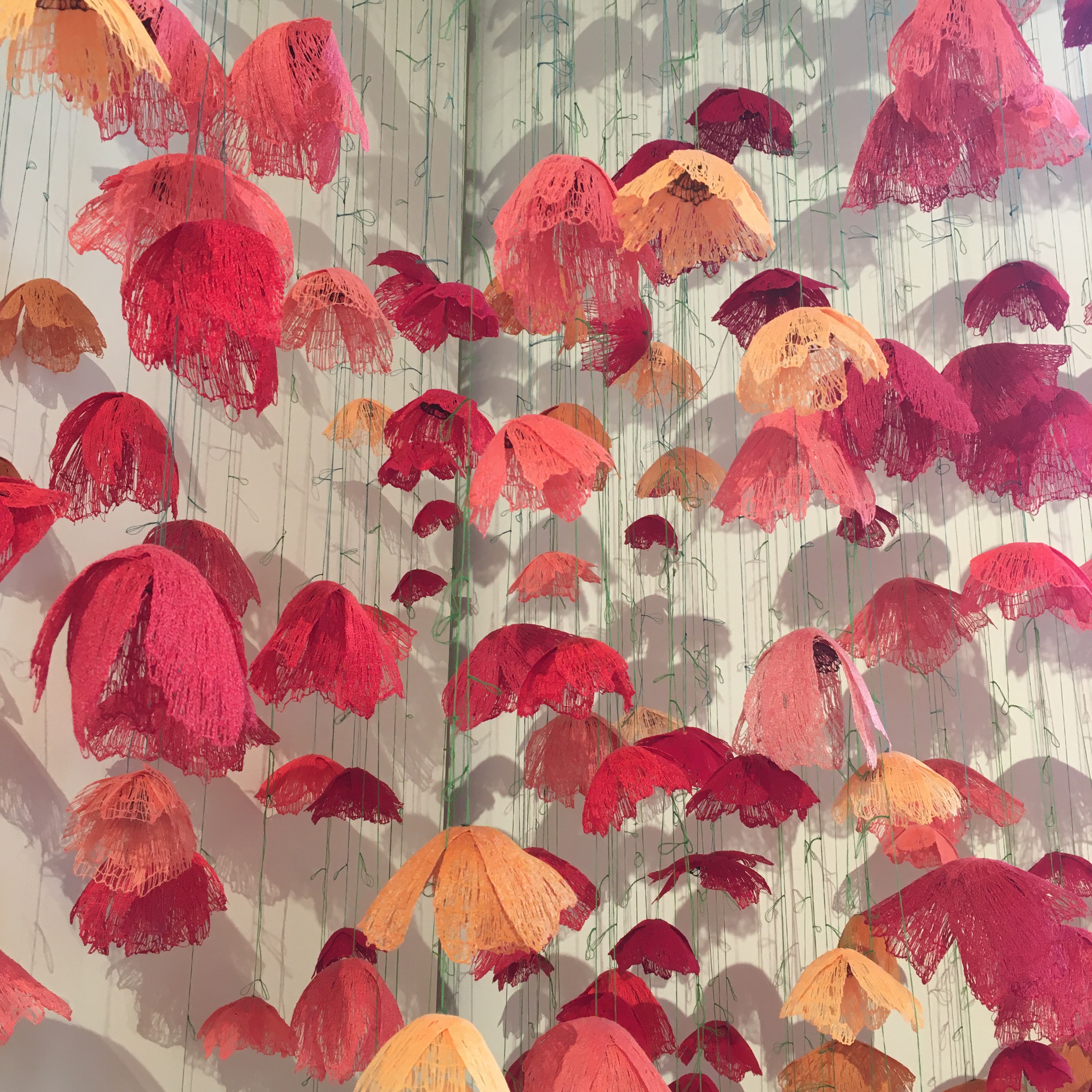
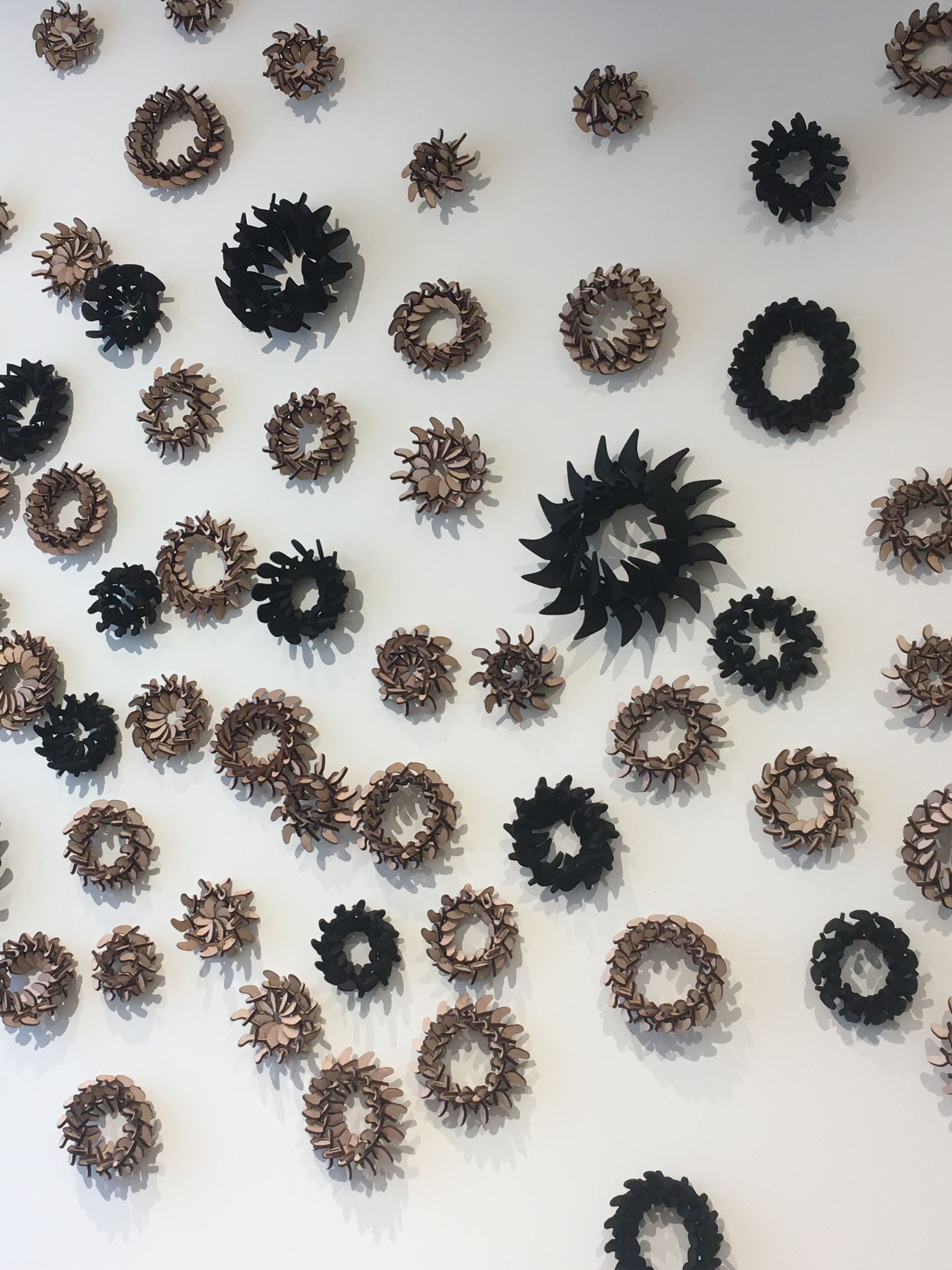
It’s hard to resist multiples when they festoon a wall. I was very taken by Amanda McCavour‘s very pretty paper and embroidery poppies which cut a dash in the Cynthia Corbett Gallery, South Wing S9. And Naomi Mcintosh’s installation was decorative and arresting.
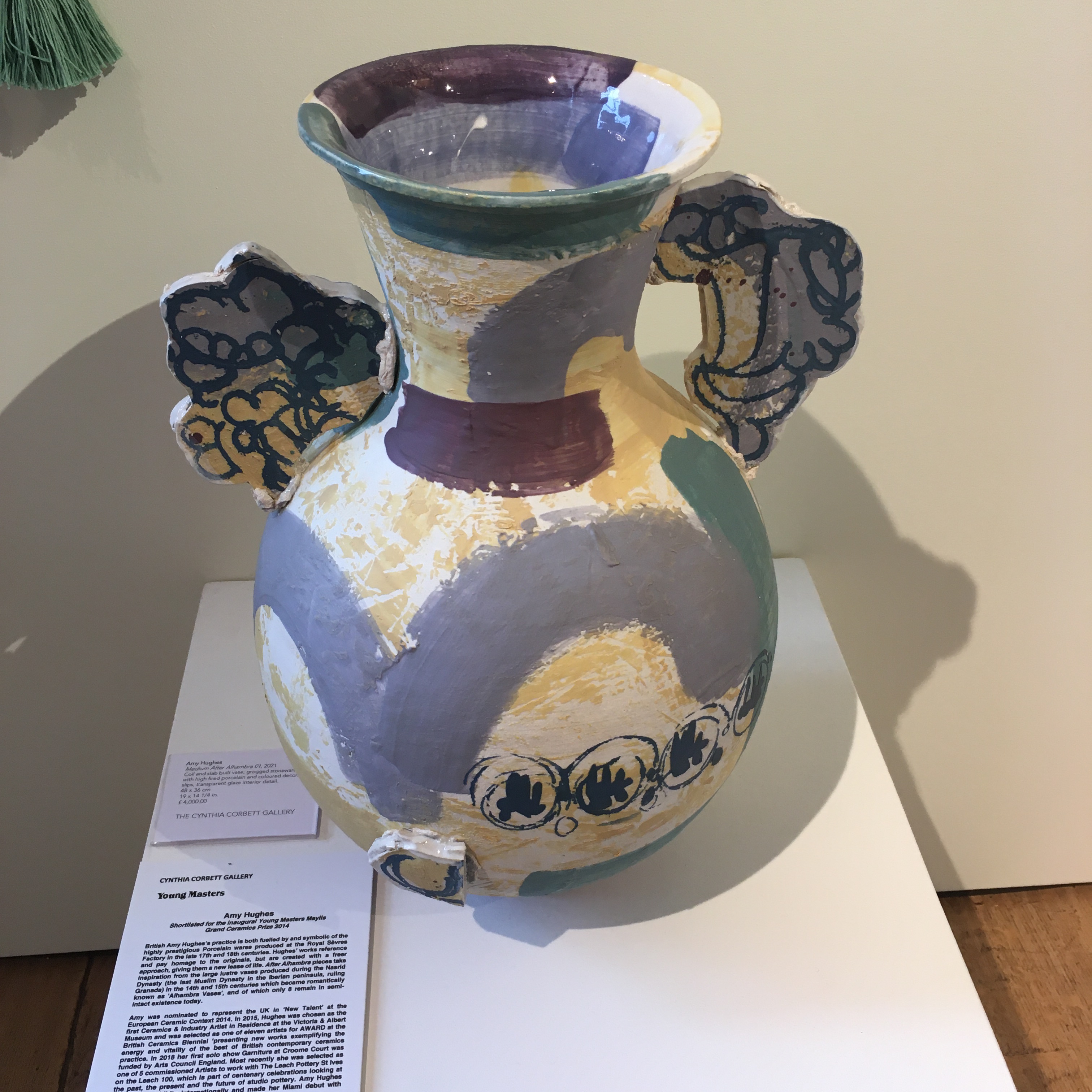
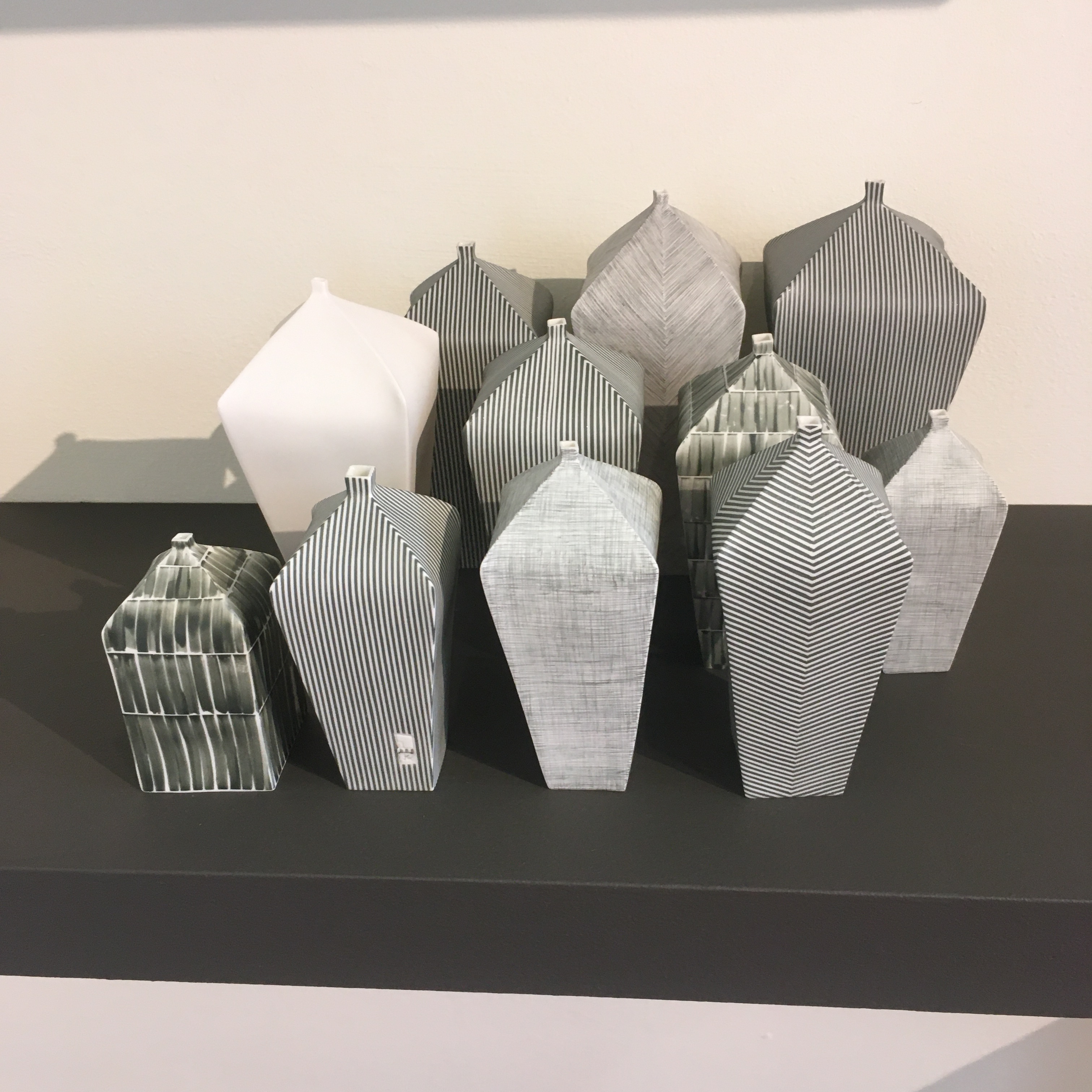
There’s a huge abundance of wonderful ceramics on show. I can’t show all the photos I took but here are couple. I think it’s the texture and decoration which does it for me.
A bit disturbing. But very clever mix of talents and media from the partnership between Sharon Griffin and Wayne Chisnall in a show of work called Unlockdown.
Collect is on at Somerset House 25-27 February 2022. Great to have it back in action!
It’s so good to see a model celebrated in an exhibition. Yes, it was the artist who created the work but without the generosity and creative contribution of the model it would have been so much harder to complete the work and develop an idea. James Whistler was fortunate to have met the beautiful young Irish girl, Joanna Hiffernan. She met Whistler when he moved to London, having initially made the journey to Paris from his home in Massachusetts to become a painter. Clearly she was a glorious girl, good looking with tumbling locks of long auburn hair, bright eyed, intelligent and a very sympathetic model. They were lovers, friends and confederates. They never married but Whistler left everything to her in his will. It sounds as though she endured long hours in chilly studio rooms posing for Whistler and his contemporaries. I commend the Royal Academy for telling her story through the works she contributed to as well as the broader context of the painters’ experiences.
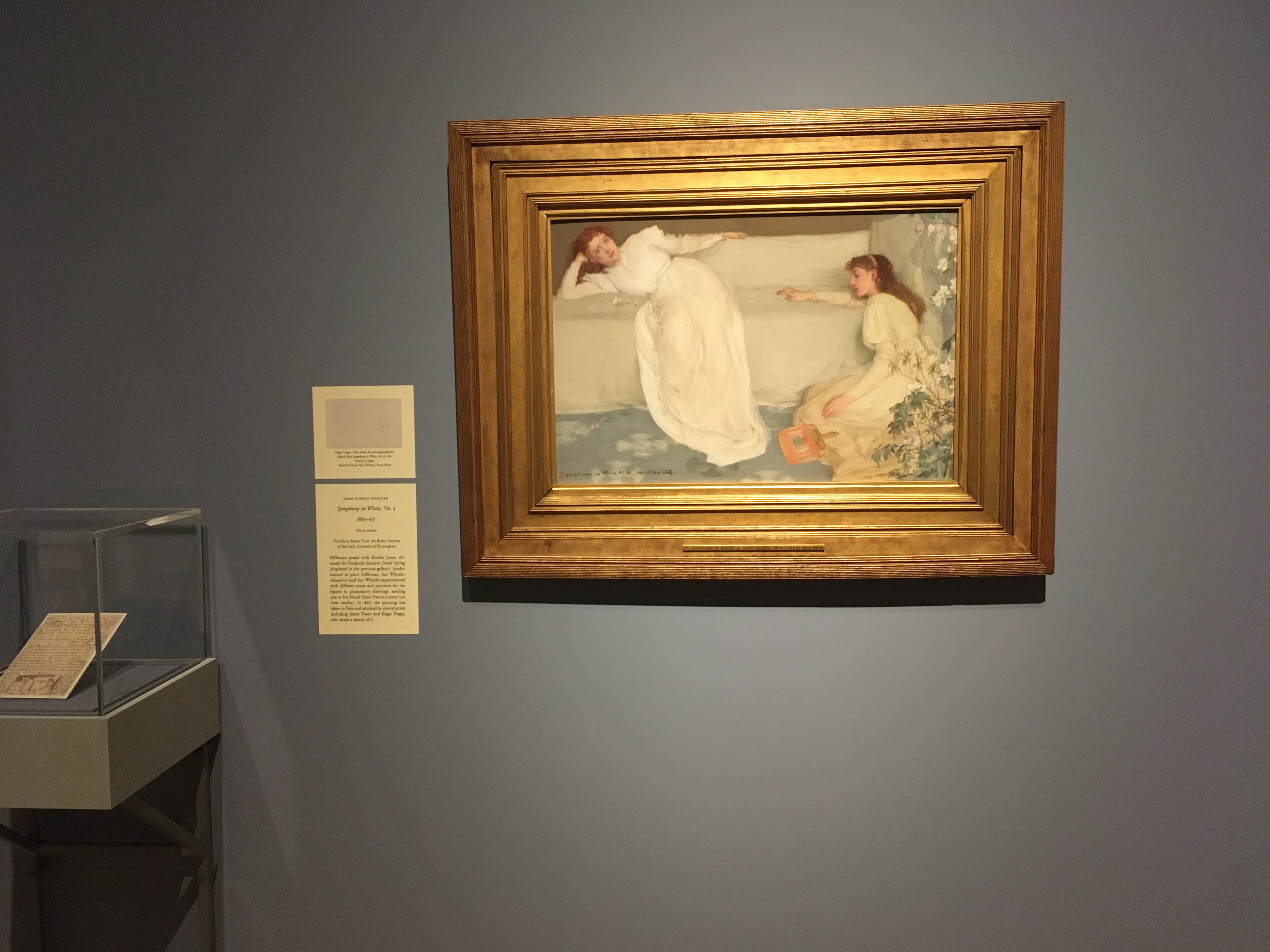
Here is Joanna in the painting which made Whistler’s name. She stands there dreamily clutching a white flower (it looks a bit like syringa) staring into the middle distance in her demure white frock. It’s a mesmerising image and enjoyable to stare at. In the same gallery we can see other paintings featuring white clothing and they have the same engaging atmosphere.
Symphony in White No 2 The Little White Girl Symphony in White no 3
Then there are the wonderful portraits of Joanna made by Gustave Courbet. Apparently he adored her and kept the first portrait but made copies for sale.
I did love this sketchy painting of the artist at work while the girls in the studio rest and chat. It’s a surprisingly intimate scene.
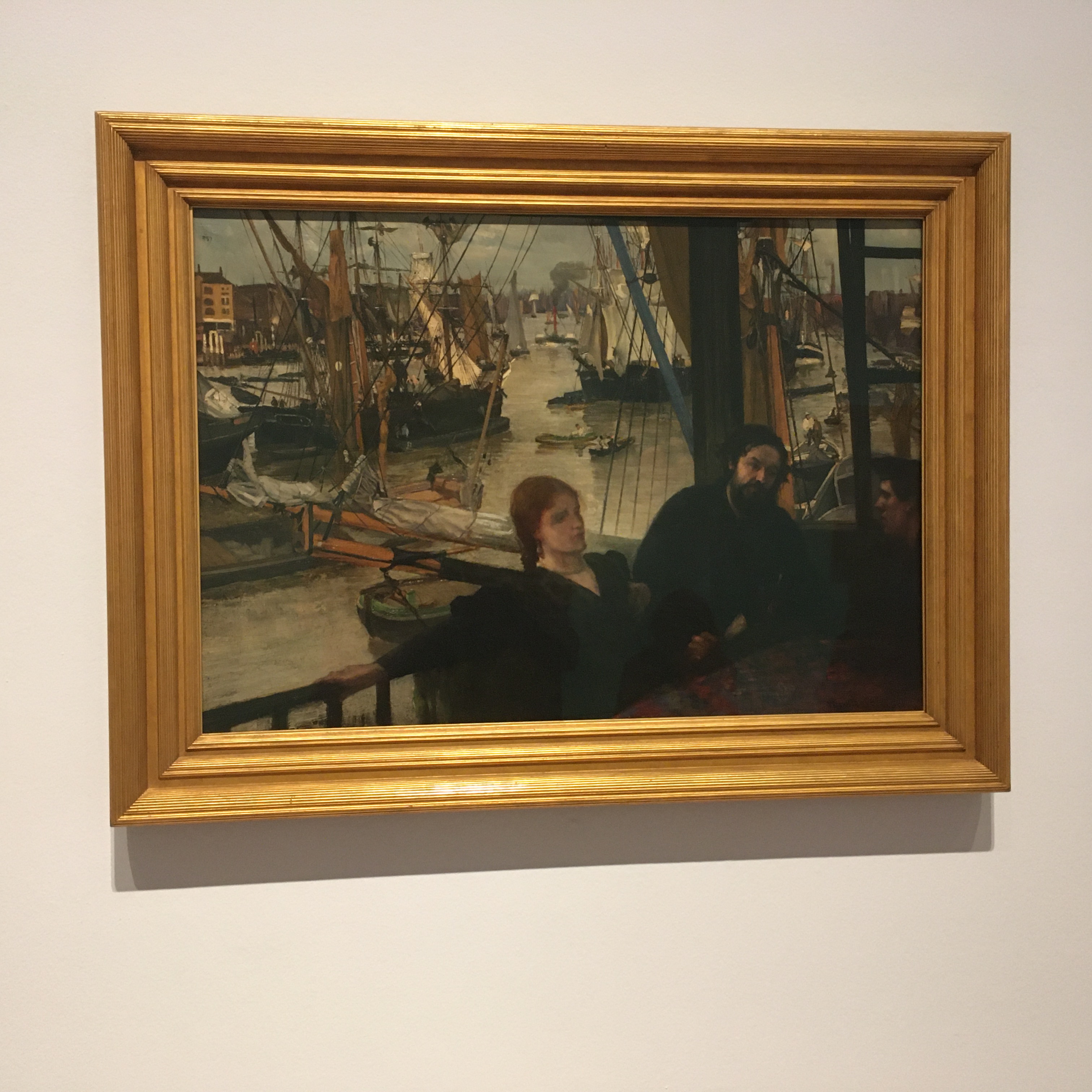
And Joanna features in one of my absolute favourite paintings. We see her in Wapping, leaning back against a pub balustrade at a pub overlooking the murky water of the River Thames which is crowded with ships, boats and the stuff of commercial river life. She’s with two men, at ease, confident and holding forth in conversation in her dark dress.
Whistler’s Woman in White: Joanna Hiffernan is on show at the Royal Academy until 22nd May. It’s glorious.
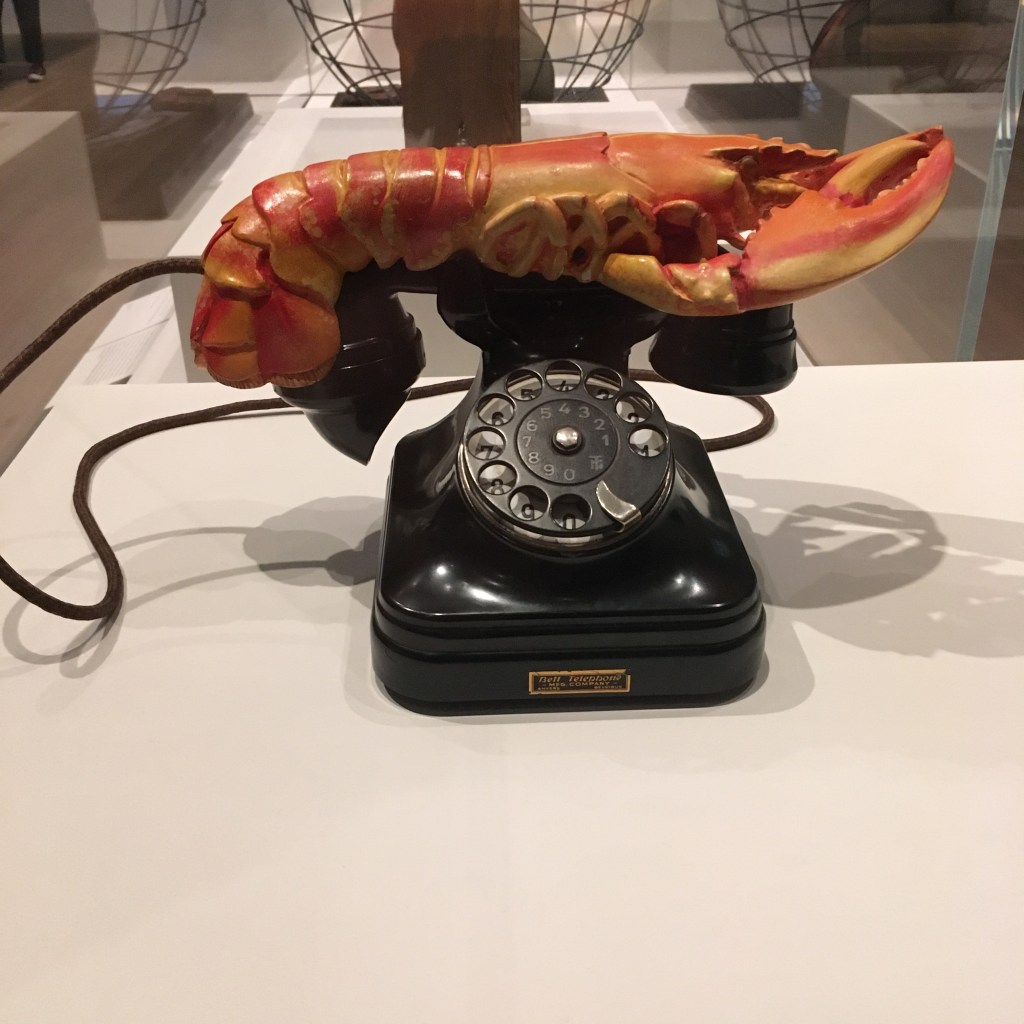
Salvador Dali – Telephone Homard Lobster Telephone 1938
Could the strange Lobster Telephone by Salvador Dali be the most famous example of surreal art? It’s probably the piece that springs to mind ahead of all others. It’s just so weird but, by dint of familiarity, feels almost normal. This new show at Tate Modern, Surrealism Beyond Borders, spreads the net pretty wide and scoops up examples of surrealist art from all over the world.
It’s suggested that surrealism began in Paris in 1924 but, I’d argue, we’ve seen elements of it in art for centuries. Think of those strange artworks by Heironymus Bosch or William Blake. Maybe the works by those artists were based on dreams or visions? I wonder whether surrealism is the ‘ism’ which many artists choose to adhere to when they stray from conventions of inherited art styles or the familiar and enjoy a sense of ‘permission’ to explore an interior world of their own.
I really enjoyed the words of Grace Pailthorpe who spoke on a radio programme- Mirror for Women – about Surrealism and Psychology in 1944. She suggests that everyone is an artist, in some sense, because we all have ideas and dreams and strive to find ways to realise these dreams. The surreal, she argues, is a means of experiencing personal freedom, the ultimate in self-expression, and the most humble doodle, made when the mind is pausing (for example, when a phone call is on hold) is when the human creative experience is at its most natural and uninhibited.
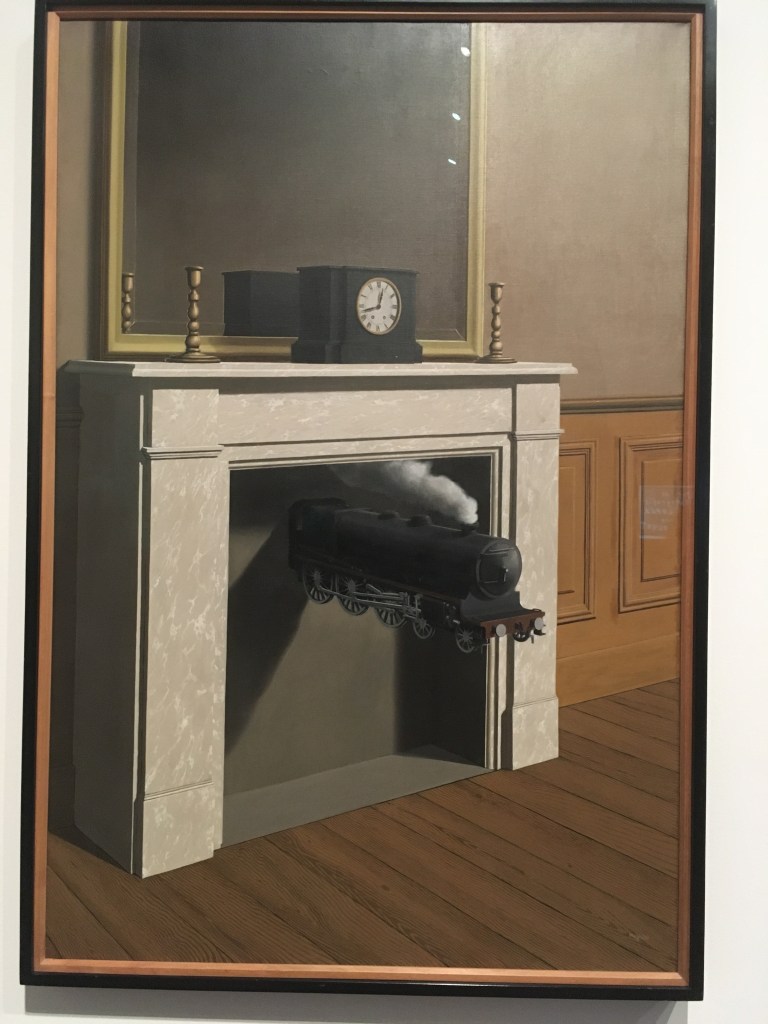
As a collage artist I was very encouraged to see many examples of collage as a form of surrealism. I totally relate to the idea of assemblage, of creating uncanny relationships between objects or creating visual jokes or challenges. Think of Henri Magritte and the smoking steam engine rushing from a fireplace.
Rene Magritte Steam engine in Fireplace 1928
Surreal art can take so many forms. I think the viewer can’t help but try to make ‘sense’ of the image but the point is that these artworks are nonsensical or capture some interior narrative which is peculiar to the artist.
Generally, I think it’s very healthy to embrace the strange and celebrate the weird. In all aspects of the arts this is the place where humans can, metaphorically, ‘let go’ and enjoy flights of fancy, the impact of religion, spirituality, magic and all the inexplicable things which exercise us. This is a good show to look at if you’re in mood to find out what you think about representing all that is odd.
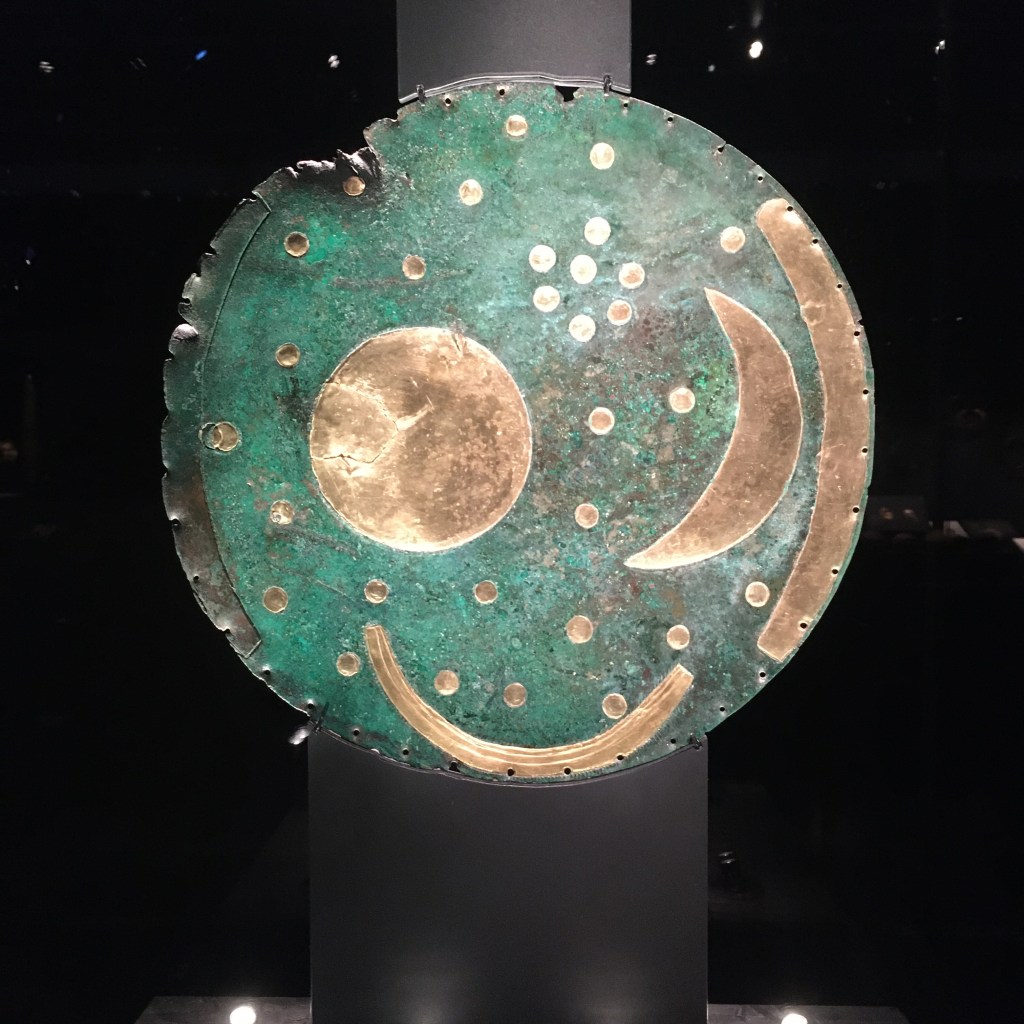
My photo doesn’t really do this piece justice. It absolutely glows with antiquity and mystery. It’s the Nebra Sky Disc. It’s 3,600 years old and was found in 1999 in east Germany. It depicts the sun, moon, stars and solstices and it absolutely shines a light on the sophisticated people whom we tend to dismiss as ‘prehistory’ humans. In fact, this incredible show at the British Museum really brings the ancient prehistoric world up close and personal with the presentation of household artefacts from the time of Stonehenge.
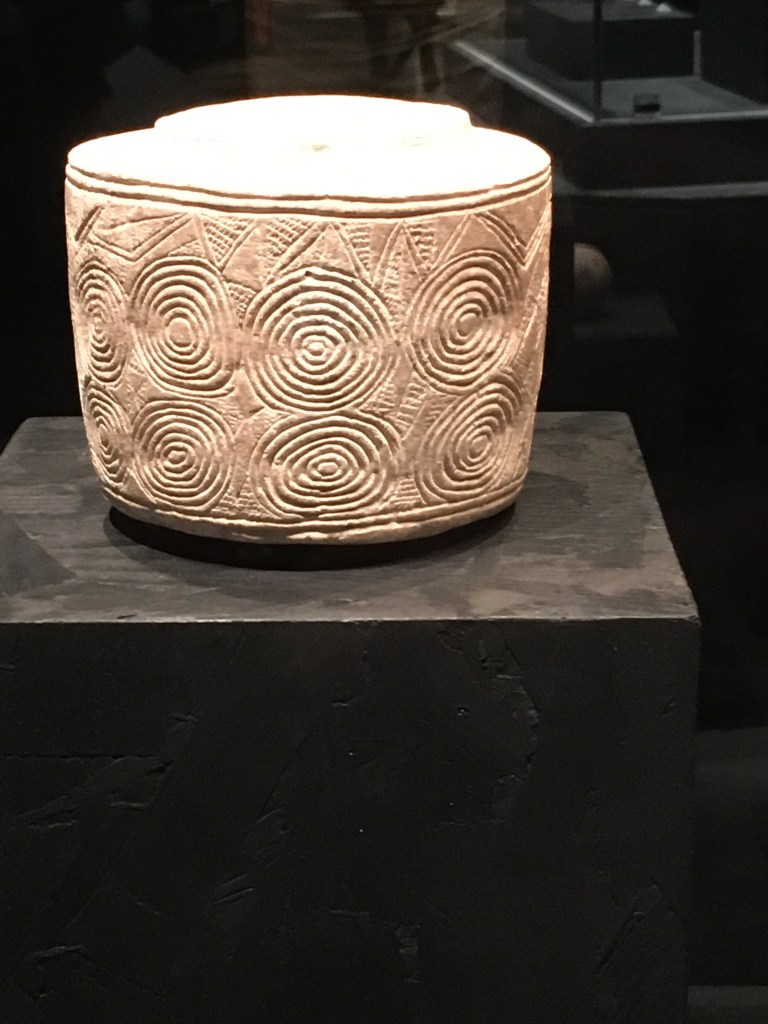
You cannot help but be moved by the sight of the ‘chalk drums’ – objects found carefully placed in the tombs of children, two clasping each other and an older one also within the grave. You are left convinced that only loving adults would have laid their infants to rest so carefully. Likewise, there’s a burial of an archer, within sight of Stonehenge, done with equal care and surrounding the body with the tools of his trade.
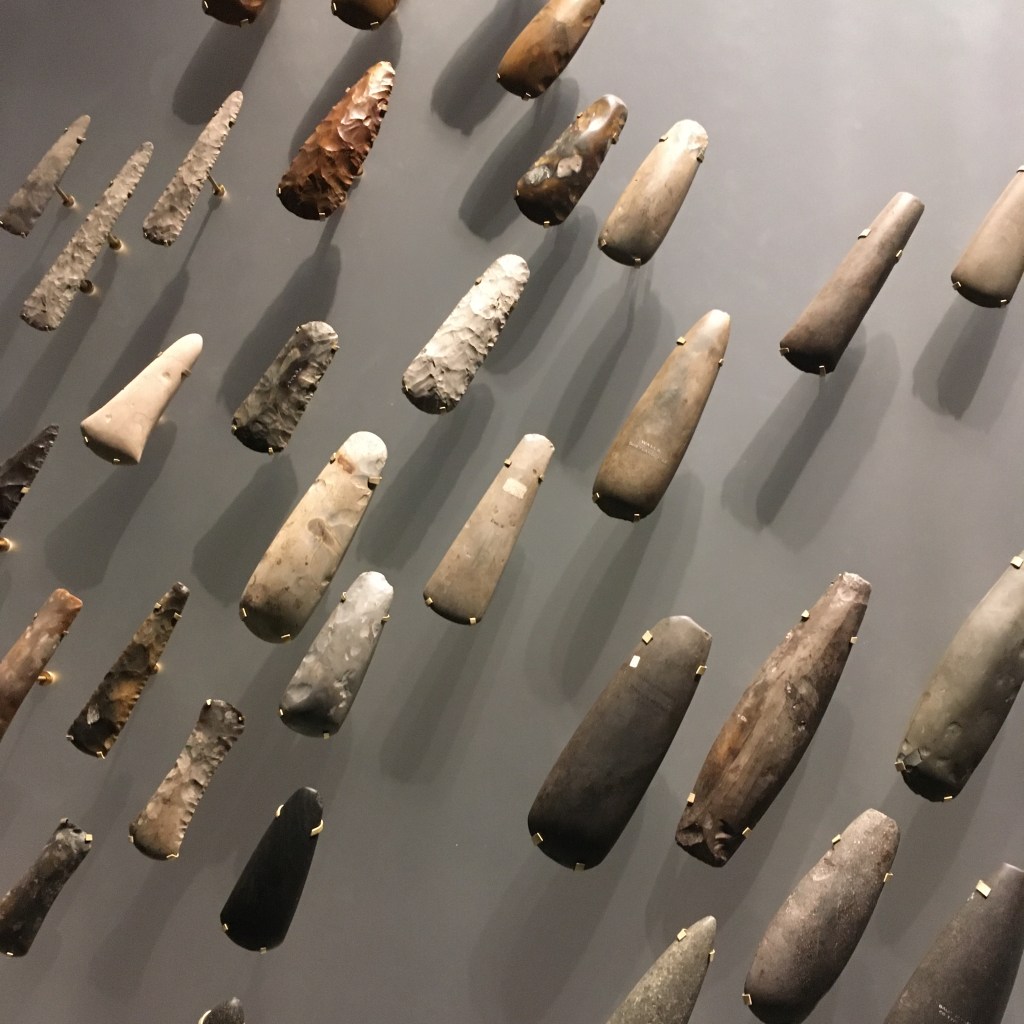
This exhibition definitely gives lives from so long ago a truly human perspective. Not only do we see tools which were carefully crafted by hours of skilled work, such as the stunning display of axeheads, but we get to see the hard stone that was used to smooth these axes and a real sense of the dedicated hands which spent time laboriously pushing the flints back and forth to create the required shape. These were useful and valuable tools, important for the hunting of animals, the preparation of food and creation of safe homes to live in.
The curators have referenced Stonehenge as the starting point but this exhibition is more about the people who lived in England and Europe before the great monument was built, those who worshipped within in, expanded it and those who were buried close to or within sight of this important site. It’s fascinating to understand that there was an indigenous race living in this island who were, most probably, overwhelmed by ‘visitors’, the hunter-gatherers, from Europe who arrived with radical ideas about farming, enclosing animals and managing their lives in a more proactive, organised and efficient way. Life was never the same for these people.
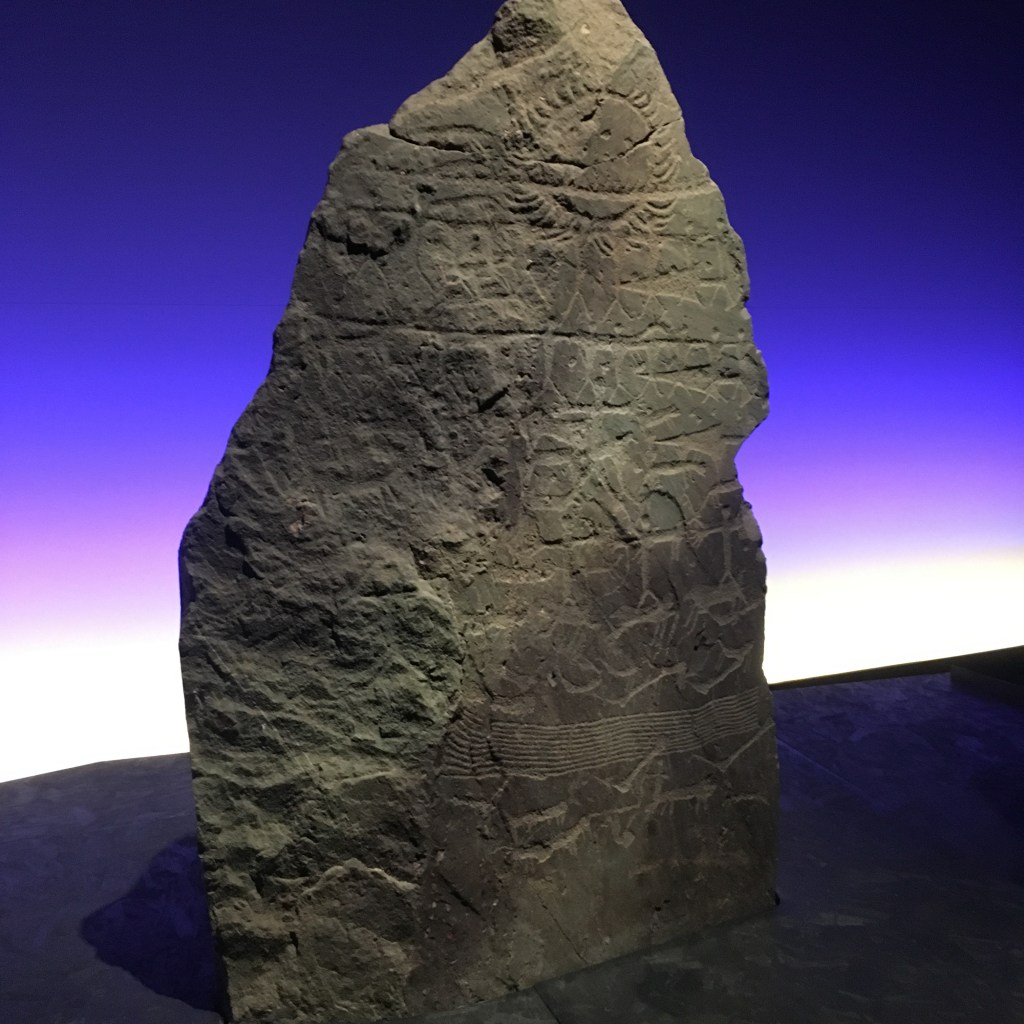
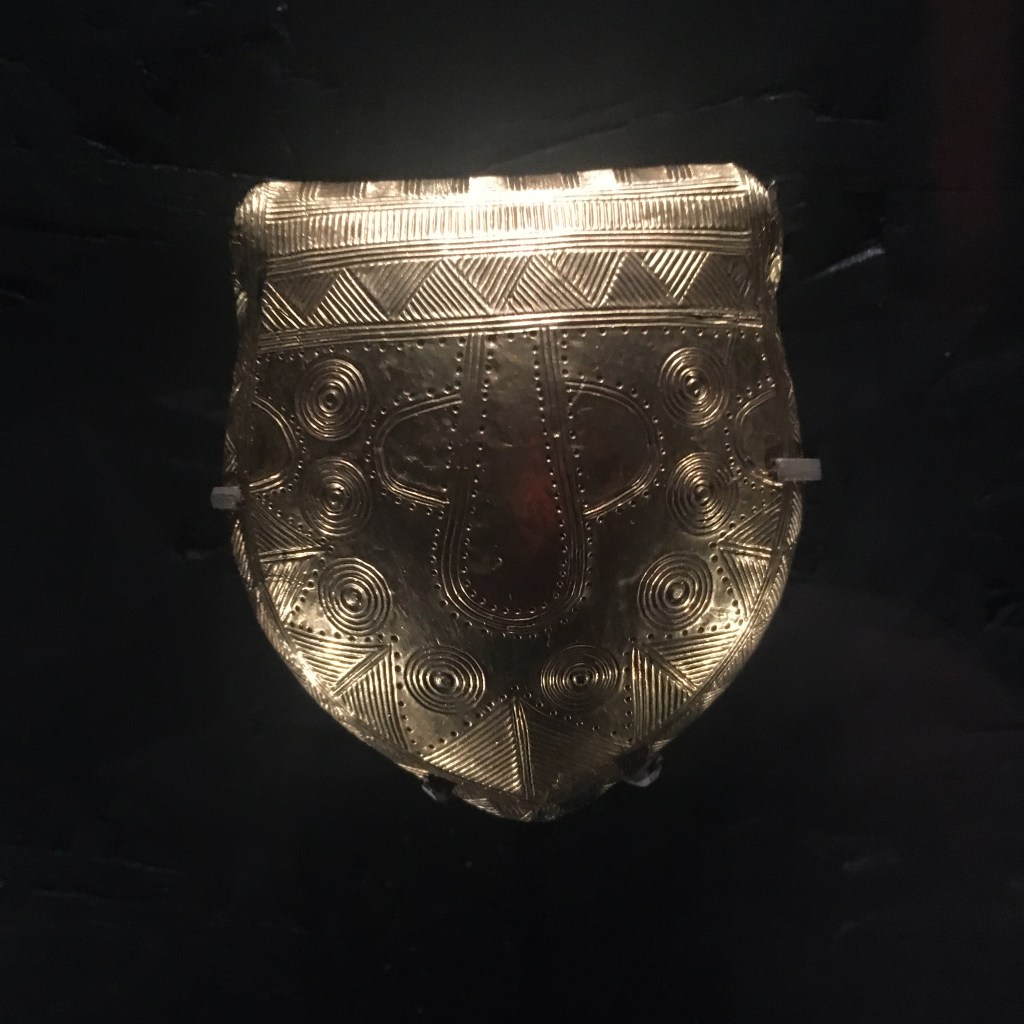
The worshipping of the sun was paramount to these people. Images of the sun, the rays of light emanating from the star appear over and over. But looking at these pieces I tended to see faces too – call me fanciful, but I am willing to believe that there might have been an element of human representation within the depiction of the sun.
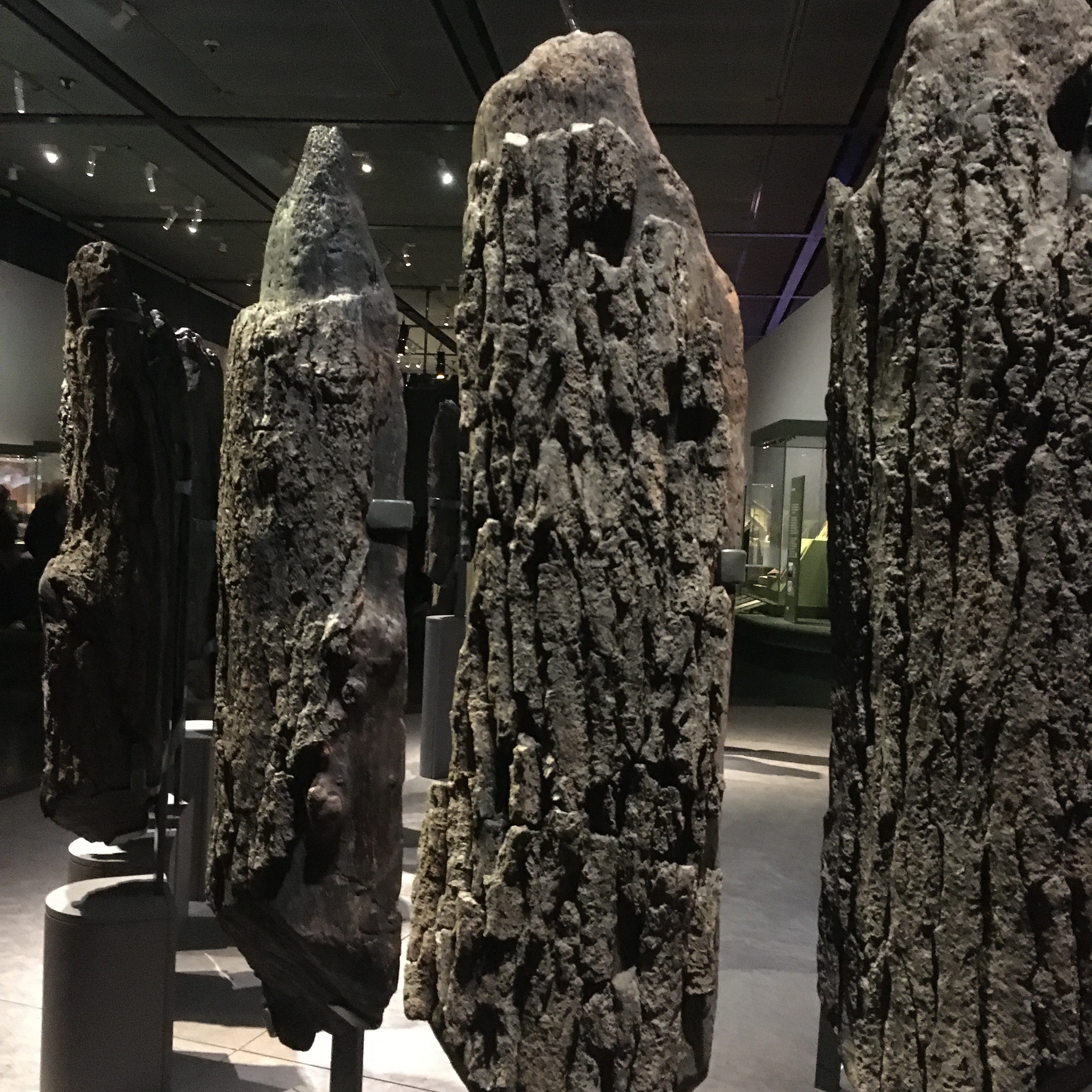
The highlight of the exhibition is the display of a 4,000 year-old Bronze Age timber circle, known as Seahenge, which reemerged on a Norfolk beach in 1998. it consists of a large upturned tree stump surrounded by wooden posts made from oak. The posts would have been tightly packed. I liked the artwork created by Rose Ferraby, one of the archaeologists who discovered the monument and contextualised it with her own artwork.
Rose Ferraby’s artwork Seahenge, painting and collage layer elements of the monument\s archaeology and landscape.
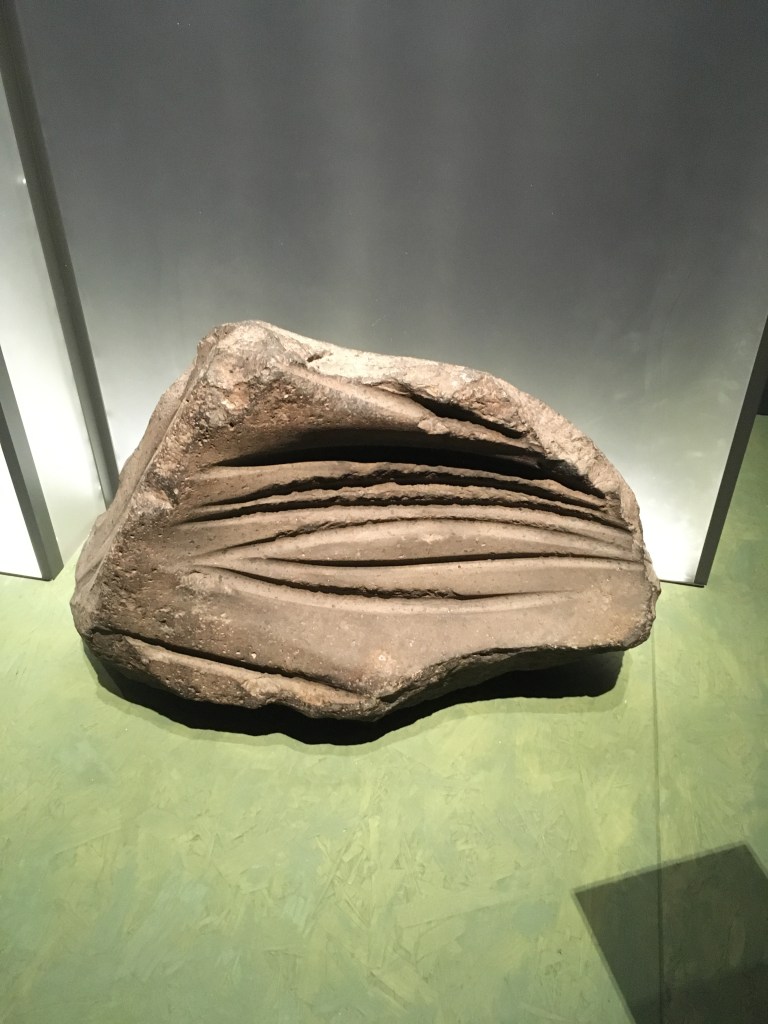
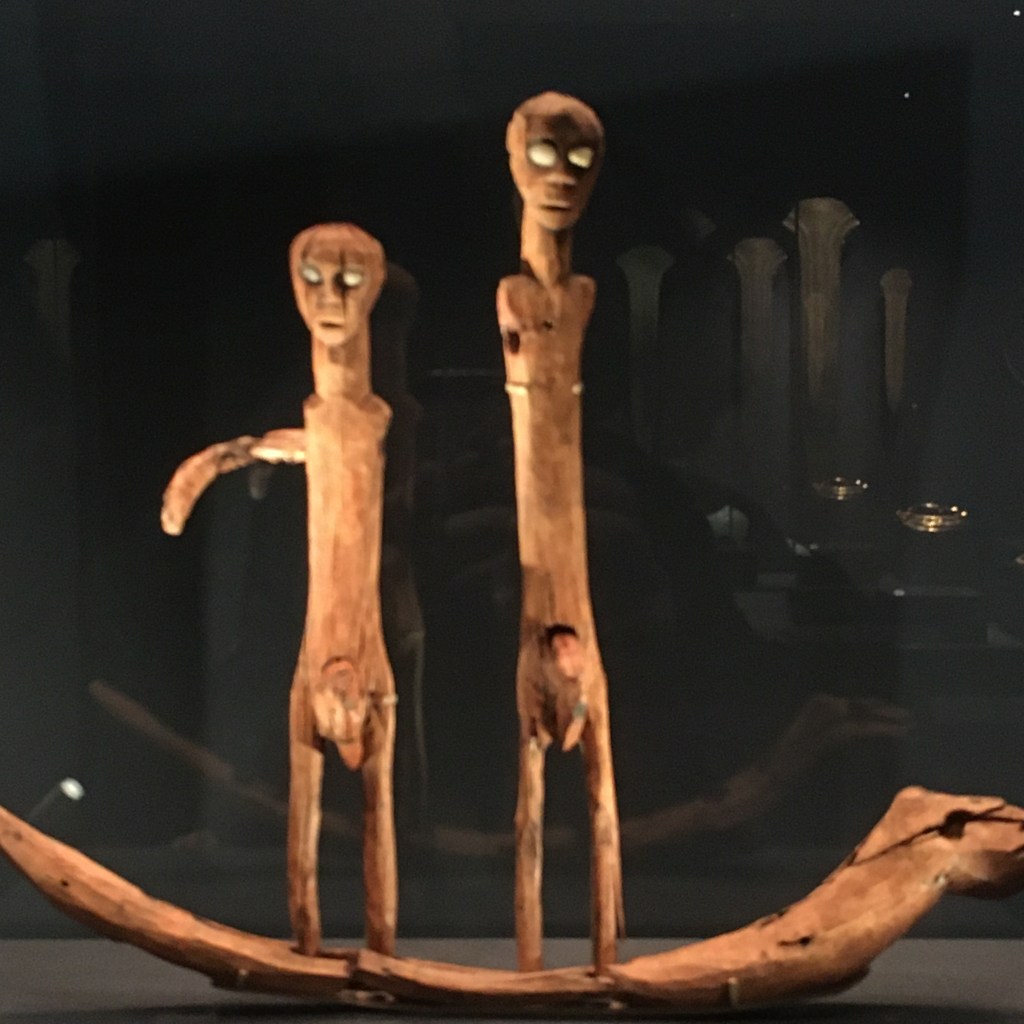
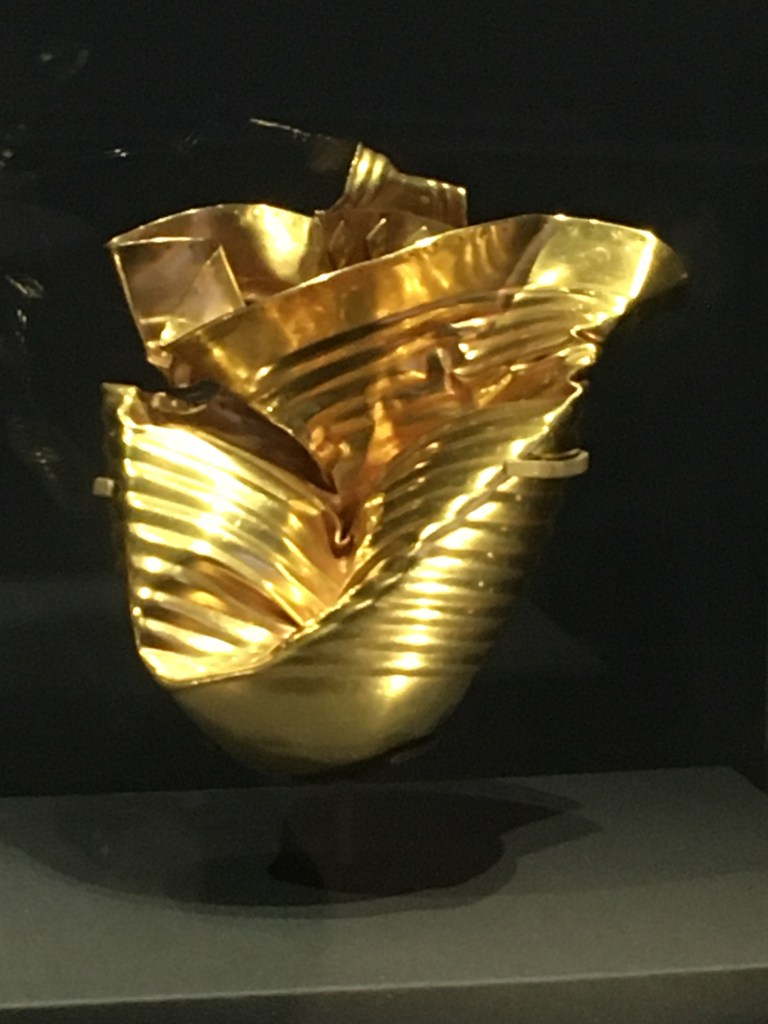
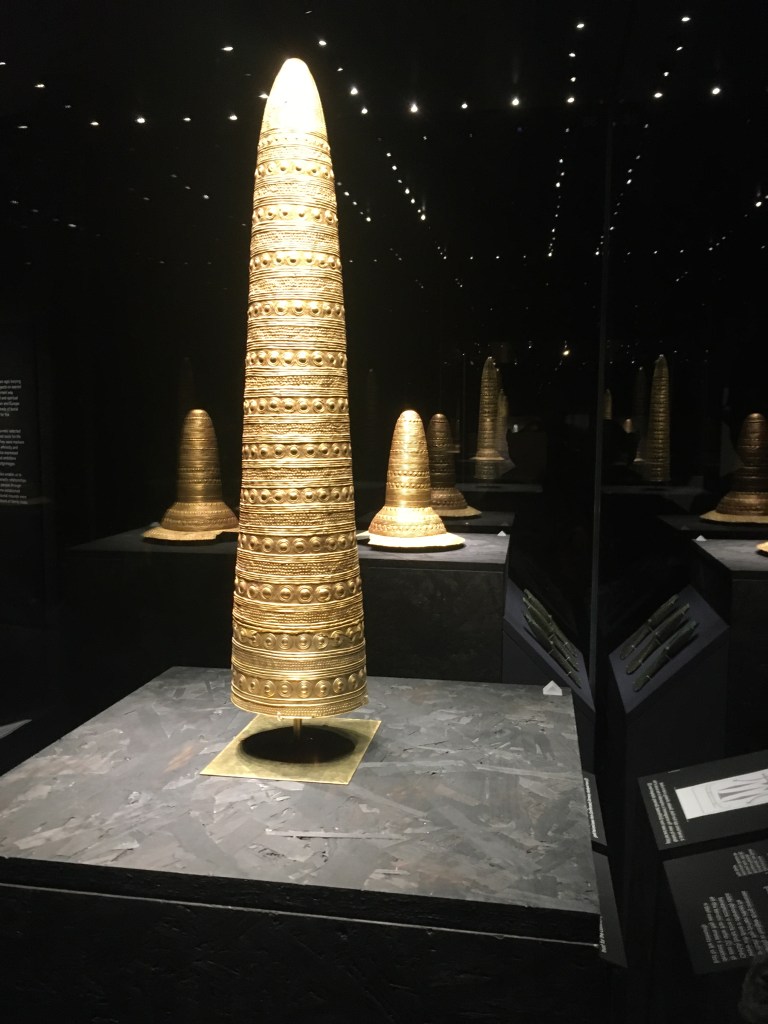
I’ll finish with a little gallery of images which caught my eye. There are so many astonishing elements to explore within this show but you certainly do emerge with a sense of the people who created the pieces and that the humans who lived all those thousands of years ago were not vastly different from the people we are today.
The World of Stonehenge is on at the British Museum until 17 July 2022.

































 Paper Places