

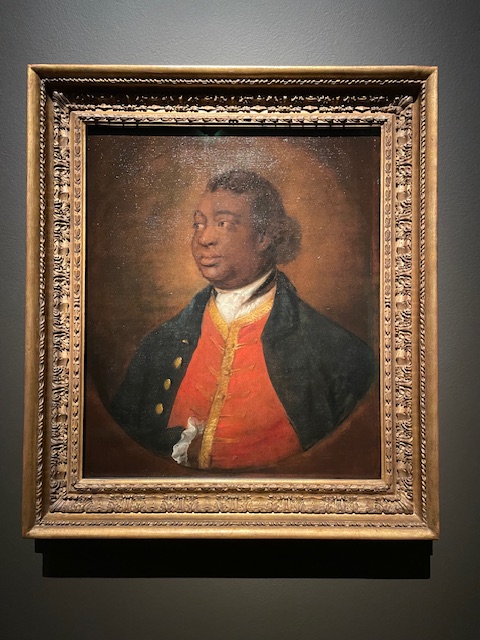
Starting with the late 1700s, the first gallery is filled with charming and sensitive portraits of black sitters. Above, I’ve selected a Portrait of a man in a Red Suit by an unknown artist and a wonderful portrait of Ignatius Sancho, the first man of African descent to vote in a British election. He was a musician, shopkeeper, man of letters and friend of artists. Apparently this portrait by Thomas Gainsborough was completed in one sitting in 1768.

This painting is quite familiar because the subjects, Dido Elizabeth Belle and Lady Elizabeth Murray were bought up together at Kenwood House in London and have been the subject of a film. Painted by David Martin in 1779 this painting is beguiling because Lady Elizabeth appears in a conventional pose, with her book, but she’s affectionately connected to her second cousin, Dido (the illegitimate child of an enslaved woman and a Royal Navy officer) who is depicted in a rather mischievous pose as if she’s about to dart away with her collection of fruit and flowers. Lord Mansfield, who owned Kenwood House was Lord Chief Justice in England and instrumental in the abolition of slavery.

This magnificent bust by Francis Harwood, made in 1758, is placed at the centre of the first gallery and gives a wonderful gravitas and graciousness which sets the tone of the the exhibition.
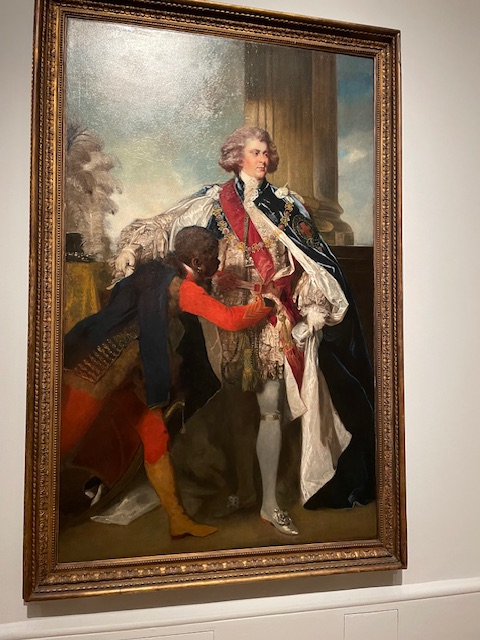
Inevitably we see the role of the black servant in aristocratic homes. And this painting by Joshua Reynolds shows George, Prince of Wales (later King George IV) by Joshua Reynolds. The pose of the attendant – who is intimately arranging the prince’s clothing, caused a stir amongst audiences who first saw it at the RA Annual exhibition in 1787. No identity is given to the attendant but he is described as ‘Black’ by Reynolds.

The shadow of slavery continues with Edwin Longsden Long’s The Balylonian Marriage Market. Young women are selected by male spectators for marriage. I get the feeling he used the same model for most of the young women but darkened their skin colour.
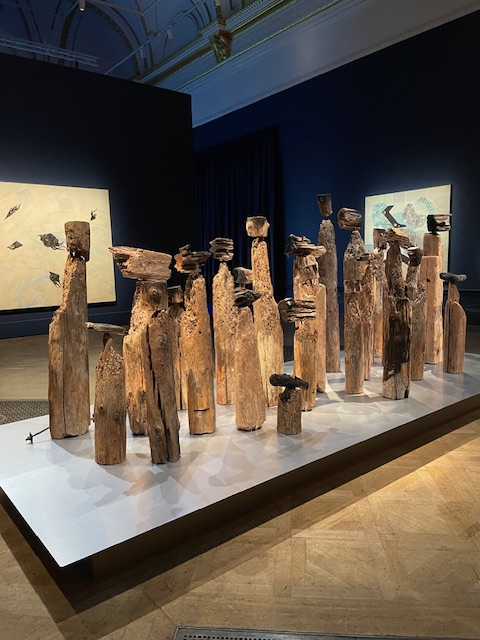

The later galleries leave the iniquities of slavery behind but still reference the engagement of the British Empire with indigenous peoples and leave us a bit troubled by the lack of respect which travelled with the expansive ideas of British Imperialists. For example, the found wood and metal sculpture by El Anatsui called Akua’s Surviving Children is very powerful. Primitive Matters: Huts (2010) depicts the plain, sparse slave huts which contrast with the dwellings enjoyed by Europeans in Trinidad.
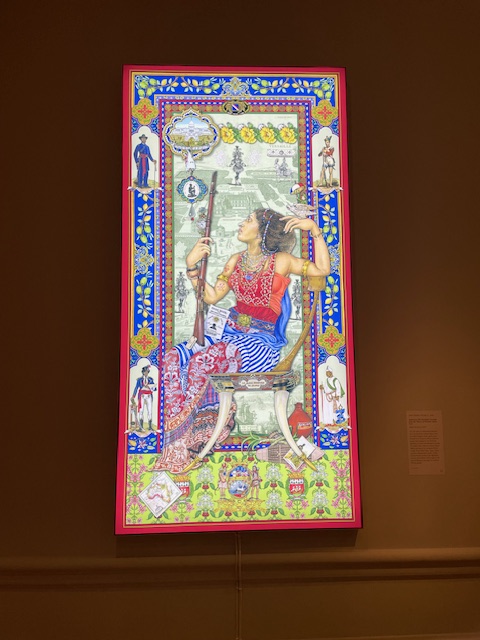

It’s good to see females well represented in the show. On the left you can see a work by The Singh Twins which references the ‘triangular trade’: goods were shipped from Europe to Africa, enslaved people were shipped to the Americas, plantation produce was shipped to Europe. The model featured is Fanny Eaton and you can see a sketch of her by Frederick Sandys on the right.
The show runs at the Royal Academy form 3rd February until 28th April 2024.

This fabulous sculpture placed in the courtyard of the Royal Academy is by Tavares Strachan. Made of bronze, black and gold leaf it’s called The First Supper (Galaxy Black) made in 2023.
 Paper Places