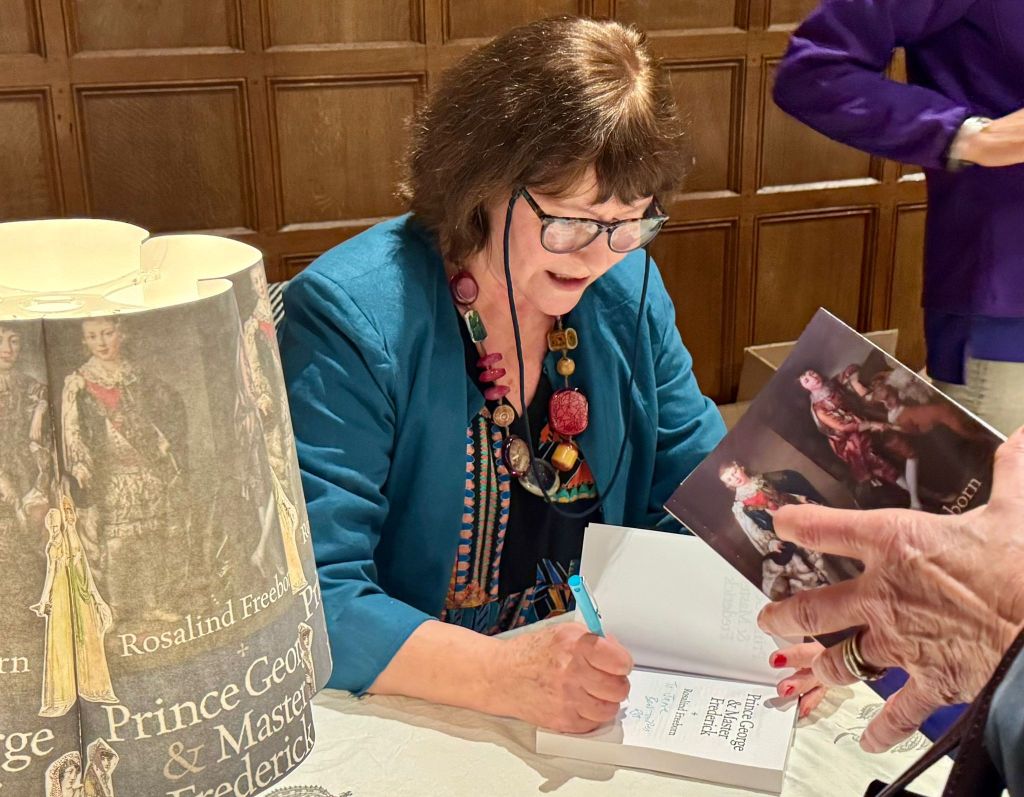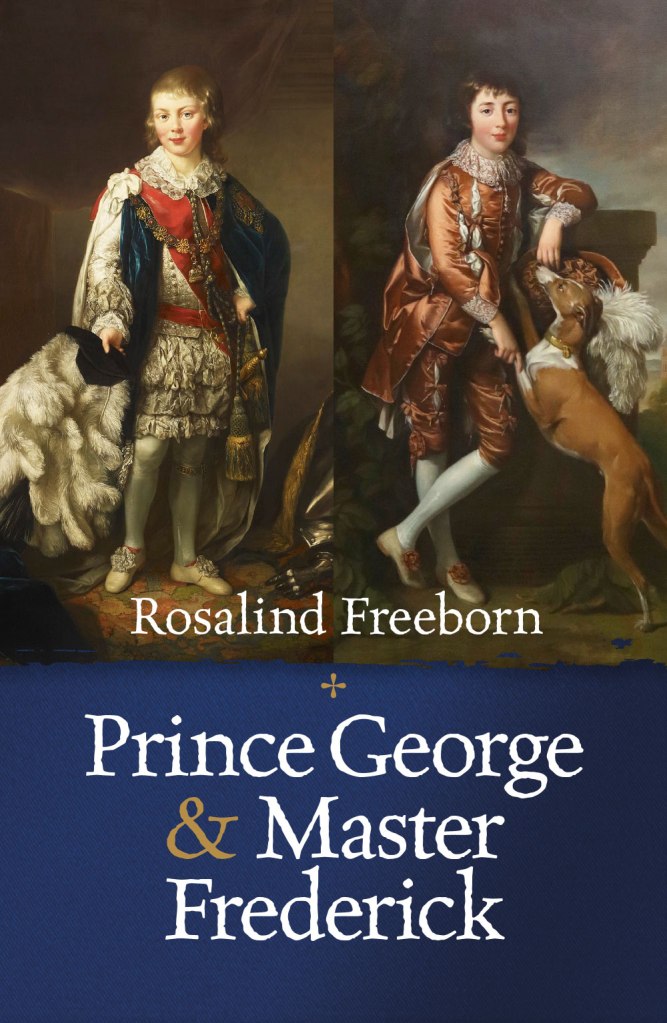
Prince George & Master Frederick has been published! Yes, my historical fiction novel was launched in style with an event at St Giles’ Church, Cripplegate. A huge crowd braved a chill January evening and gathered to buy signed copies and listen to speeches about the book

I’ve always loved book launches but this one was the best ever! It’s an amazing feeling to publish your debut novel. But quite daunting to stand up in front of a large audience and explain how researching a family story turned out to be so fascinating that I simply had to write the story of Frederick Blomberg, the secret son of King George III. Having been introduced to the gathered crowds by my publisher, Janet Weitz of Alliance Publishing Press, I stood up and gave a speech.

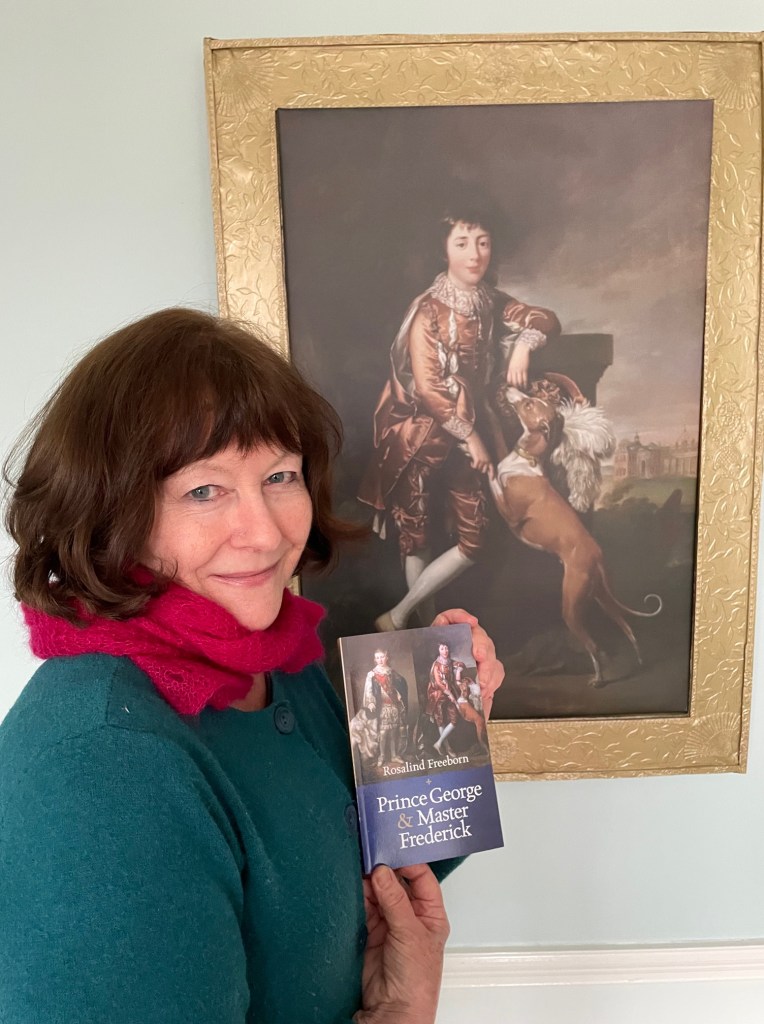
In this picture I’m standing in front of a print of a portrait of Master Frederick Blomberg, painted by court artist Richard Brompton in about 1770. The painting was commissioned by Queen Charlotte and it’s a companion piece to two other portraits of her royal sons: Prince George, Prince of Wales and Prince Frederick, Duke of York which now hang in the 1844 Room at Buckingham Palace. I was delighted to put this painting of Prince George in Garter robes next to his ‘adopted’ brother, Frederick Blomberg on the front cover of my book.

And what fun it was to welcome so many lovely friends to the book launch, sign books and chat. And for all those who could not be there, you can order a signed copy through my author website: http://www.rosalind-freeborn.com Otherwise, you can buy a copy through Amazon, (on Kindle, print or Audible) and through bookshops.

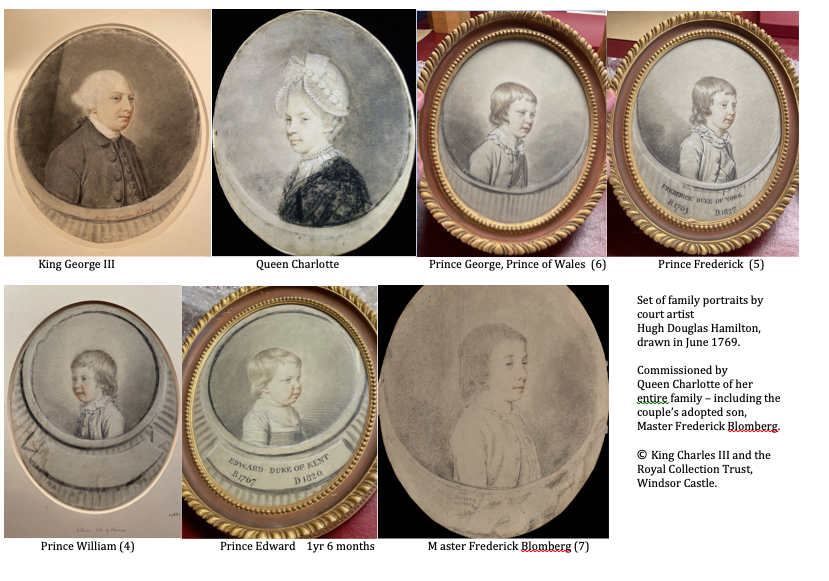
In my talk I showed a display of portraits commissioned by Queen Charlotte in 1769 of her family, drawn as a set by the artist Hugh Douglas Hamilton. The portrait of Frederick was probably given to Frederick Blomberg by Prince George and ended up at his home in Yorkshire, Kirby Misperton. After Blomberg died in 1847 the little portrait remained on the wall, through two subsequent owners, until my great-grandfather bought the estate and my grandmother grew up there. She used to look at the picture of Frederick on the wall of her home and told me that the boy was the son of King George III (wrong side of the blanket, as she put it). That piqued my interest but I did nothing about it for decades. Then, about five years ago, I thought I’d investigate this claim and find out more about Blomberg. Well, what I discovered was so fascinating that I was compelled to write this novel.

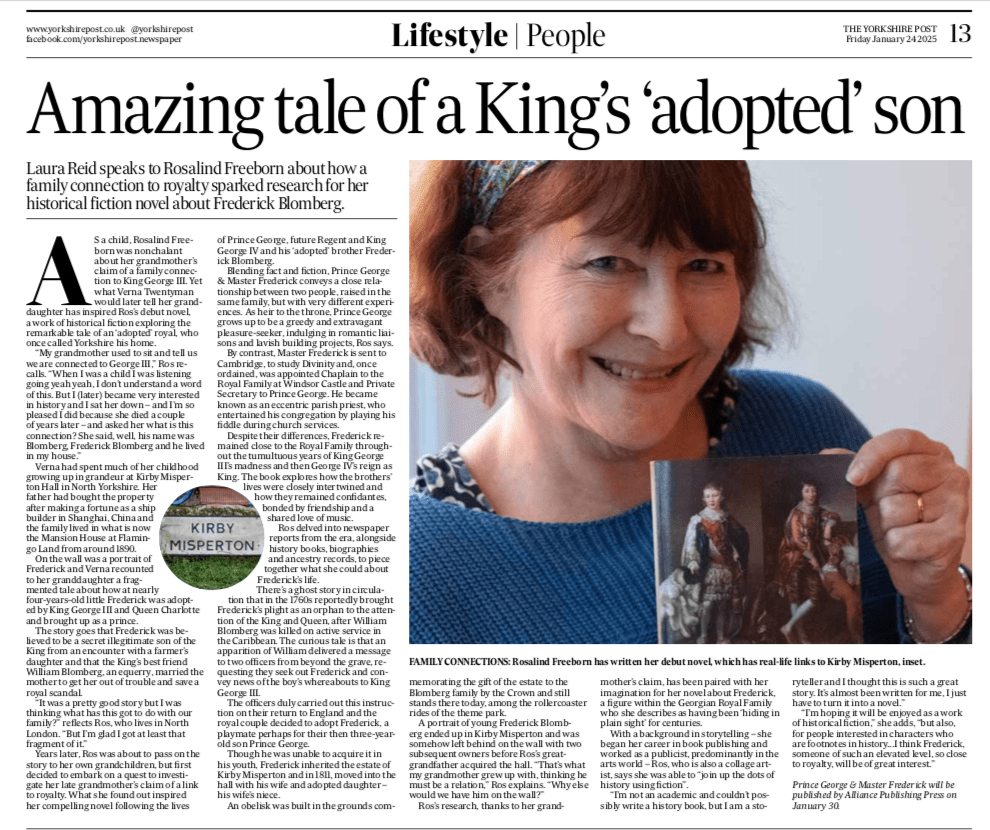
I’ve been so delighted with the quantity of publicity this book has attracted. Above is a feature which appeared in the Yorkshire Post. I’ve done radio and television interviews too. Yes, I feel very published!

Jason and the Adventure of 254. You have to come to this joyous exhibition at the Wellcome Collection to understand the title. And once you enter the world of artist Jason Wilsher-Mills you are quickly immersed in a very personal and affectionate history of his extraordinary life.

I was vaguely familiar with colourful, graphic artwork of Jason Wilsher-Mills but knew nothing of his story. At the press preview at the Wellcome Collection Jason greeted visitors to his show and explained the origins of this very personal show. When planning this show he noticed that the gallery was similar in size to the ward at Pinderfields Hospital, Wakefield, where, at the age of 11, he was diagnosed with a rare autoimmune condition (triggered by chicken-pox) which paralysed him from the neck down.

The sculpture of the figure in the bed is autobiographical. The youngest of eight children he had been an active child and keen rugby player. After the illness took hold he became a child with limited mobility, compelled to a life in hospital. But he was encouraged to develop his creativity. As he said at the press preview, in a strange way this awful condition provided a portal into a very different life from the one he might have anticipated. His father was a miner and, had things followed a ‘conventional’ path, he might have gone down the mines. Spending such formative years in a hospital environment being immersed in education and the freedom to think creatively, he realised that he was, in fact, an artist.

The title of the show reflects the strange serendipity of his life. On the day he was diagnosed – 1 August 1980 at 2.54pm – he was more interested in watching the Moscow Olympics on television than listening to what the medical specialists were telling his parents. He had become obsessed with the rivalry between Sebastian Coe and Steve Ovett. The number on Coe’s shirt was 254.

Life in hospital for the young Jason was filled with Beano comics, action heroes, tv programmes, films and music which all fed his imagination. He began to draw and was fascinated by the work of artists such as Philip Guston and George Baselitz. His work combines a mix of personal memories, impressions of current events, and the influence of people who supported him. His lively, decorative and cartoon style of art is infectious in its joyfulness. Surrounding the main features in the room is a series of nine light-box dioramas which illustrate childhood memories. You press a button and the scene lights up. The one on the left, with the blue background, depicts Jason’s mother as a mermaid in a sea filled with luminescent jellyfish. It’s based on an early childhood memory of a holiday on the north east coast when she liked to swim at night, rather than be seen by other people on the beach at day. One night all the family went to the sea to watch her swim in a north sea filled with jellyfish.

This show is full of visual fun and very lively footnotes on the walls which give you a snapshot of the year 1980, the year everything changed for young Jason. It’s entertaining and thought-provoking. And it’s free. On at the Wellcome Collection, 183 Euston Road, NW1 2BE @wellcomecollection