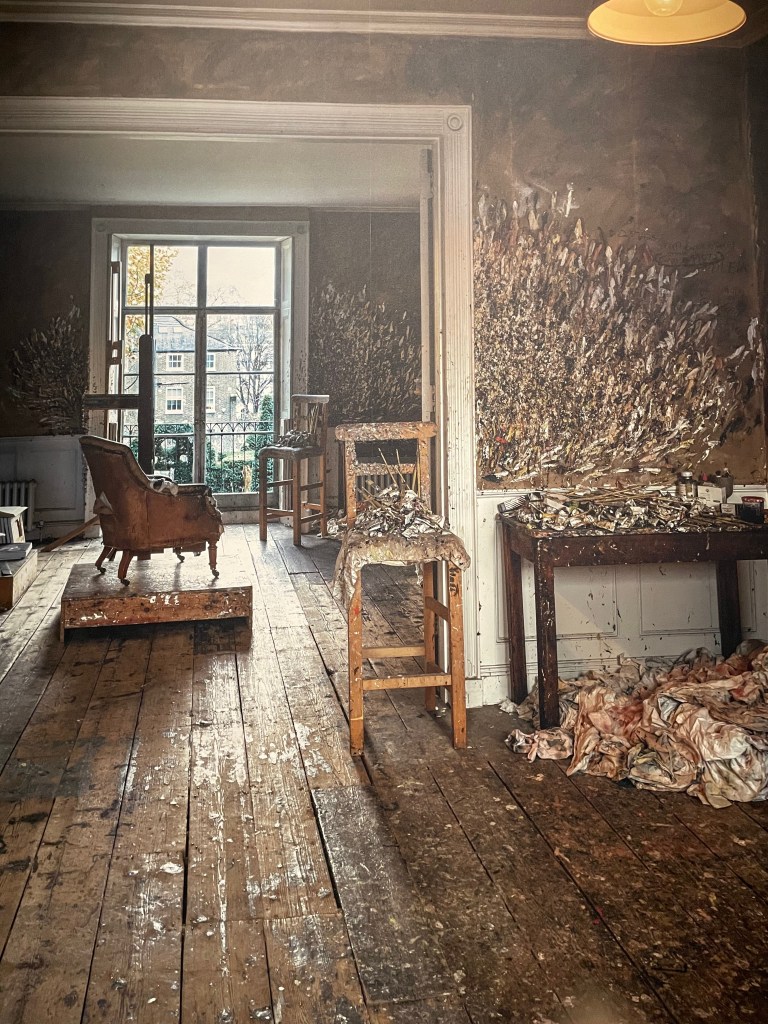
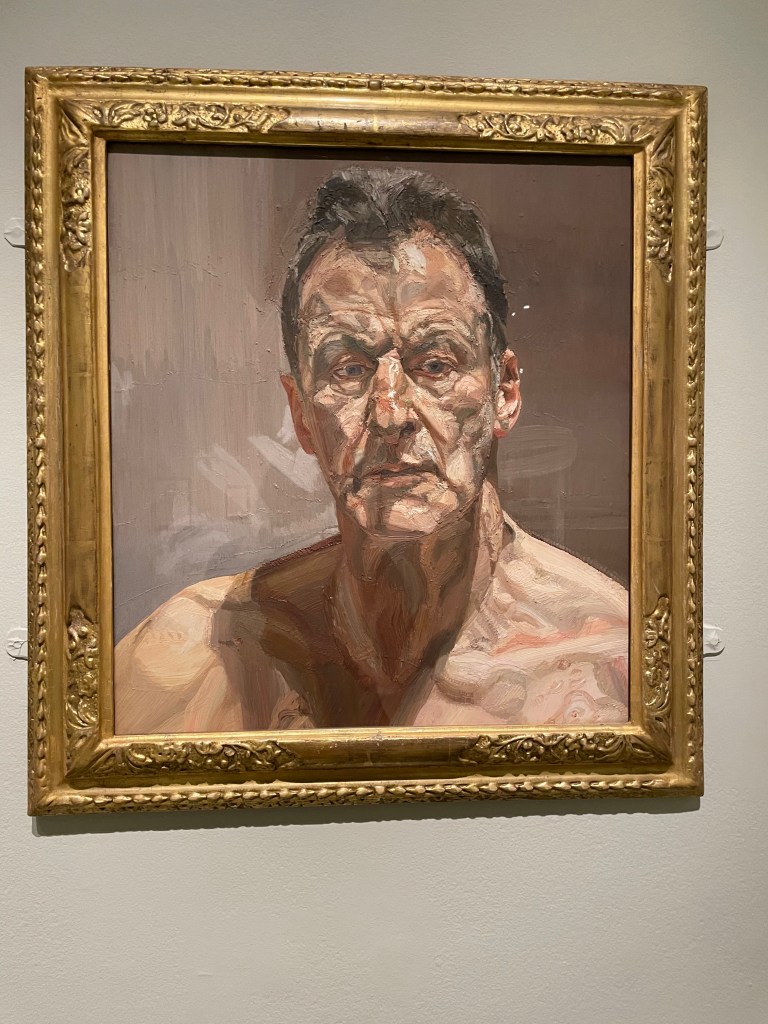
Right at the start of this show we are treated to a huge photograph of Freud’s studio in West London. It has the look and feel of one of his paintings and it’s quite moving to see the way he daubed the walls, furniture and floor with paint. Above is the picture and one of his later self-portraits.
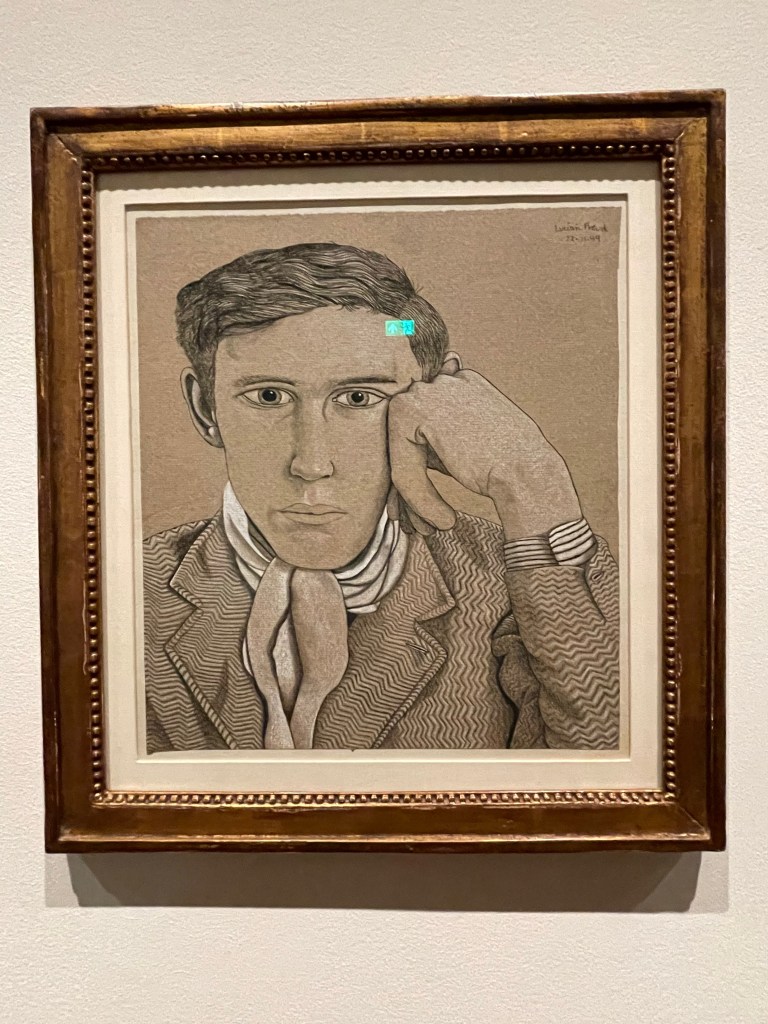
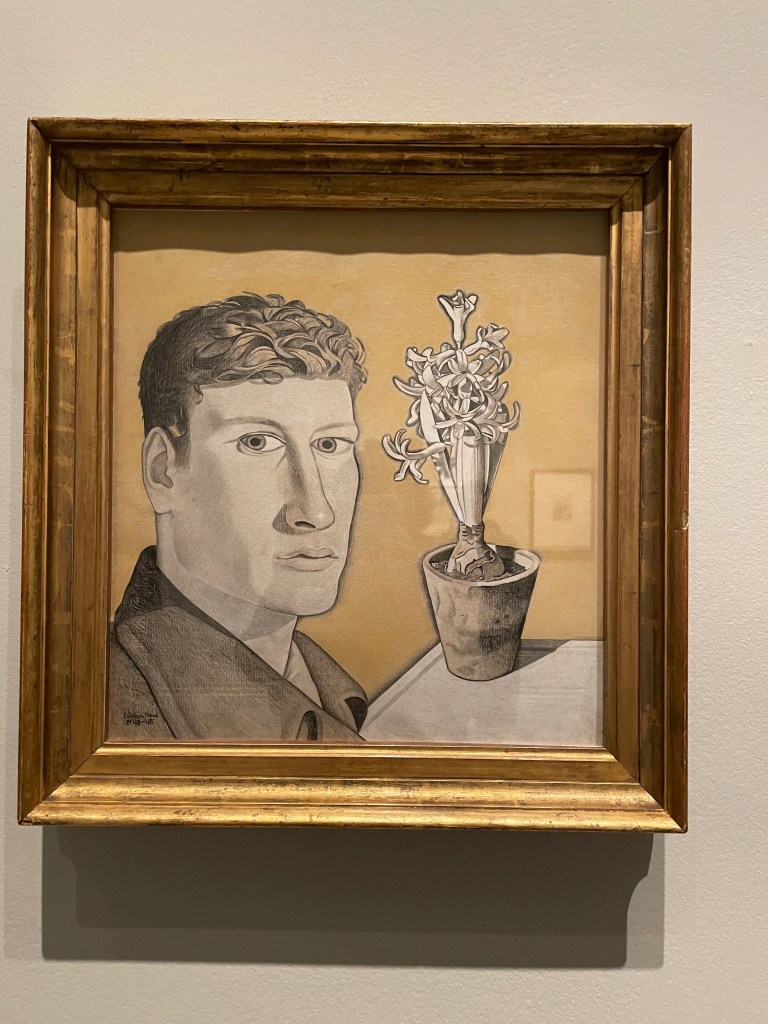
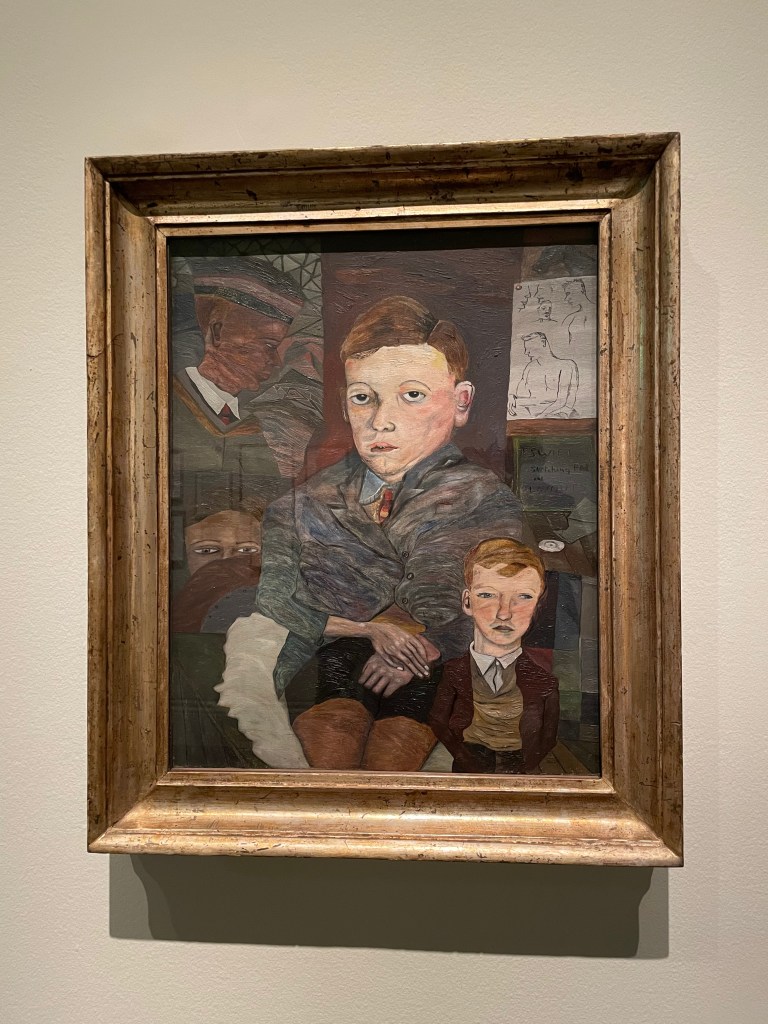
Anyone familiar with Freud’s work will know how he evolved from an artist fascinated by detail and fine lines into a painter who used large, bristle brushes and created his work from bold, expressive brush strokes. I was very intrigued by the early drawings on show. The middle one, above, is a self-portrait with hyacinth drawn with conte crayon on paper. On the left is Portrait of a Young Man and on the right is The Village Boys, which is oil on canvas from 1941 and probably painted when Freud was studying at the East Anglia School.
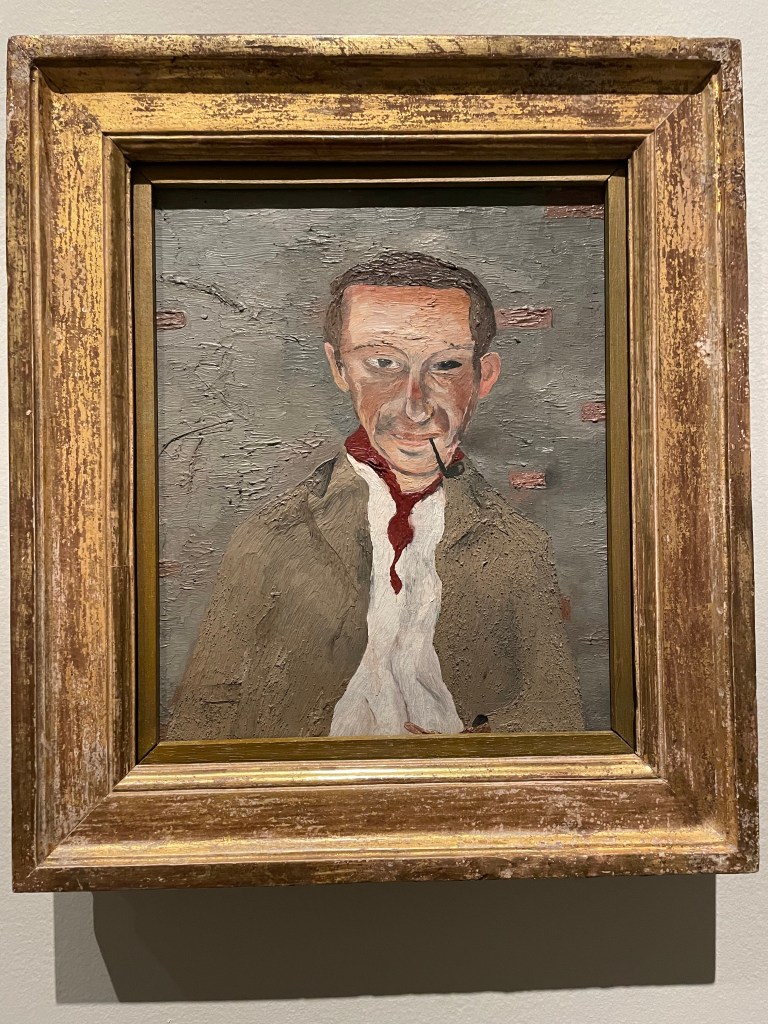
I really liked this portrait of Cedric Morris, Freud’s tutor at the East Anglian School of Painting and Drawing. Made in the summer of 1940 when Freud was only 18. It captures Morris’s character beautifully.
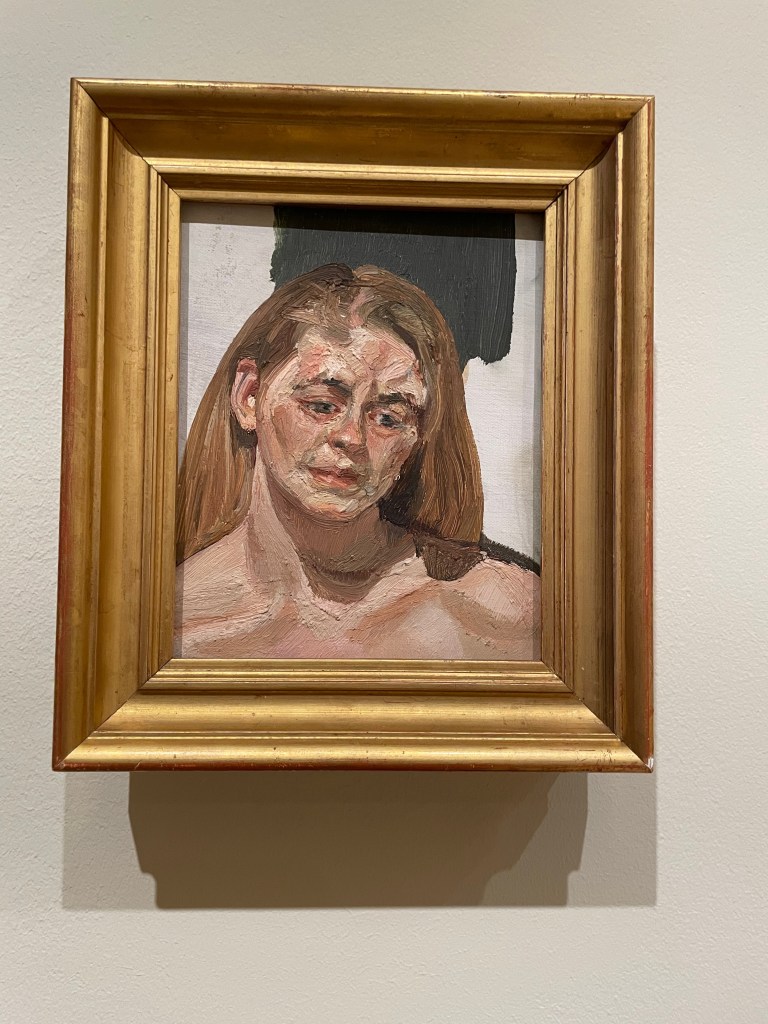
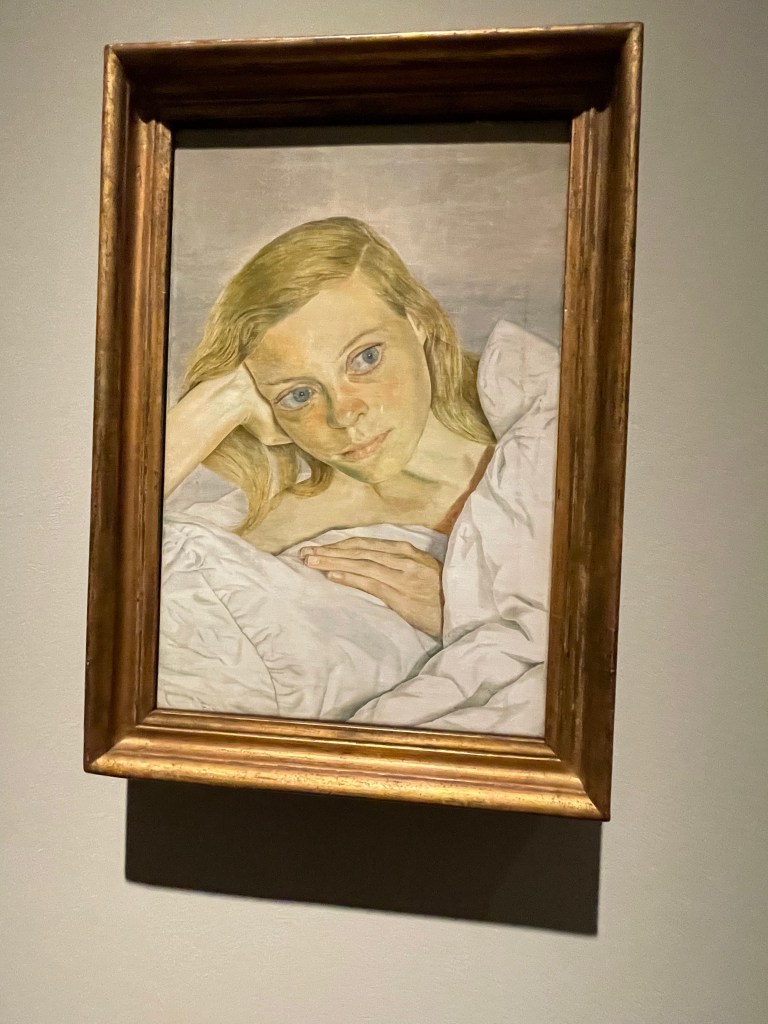
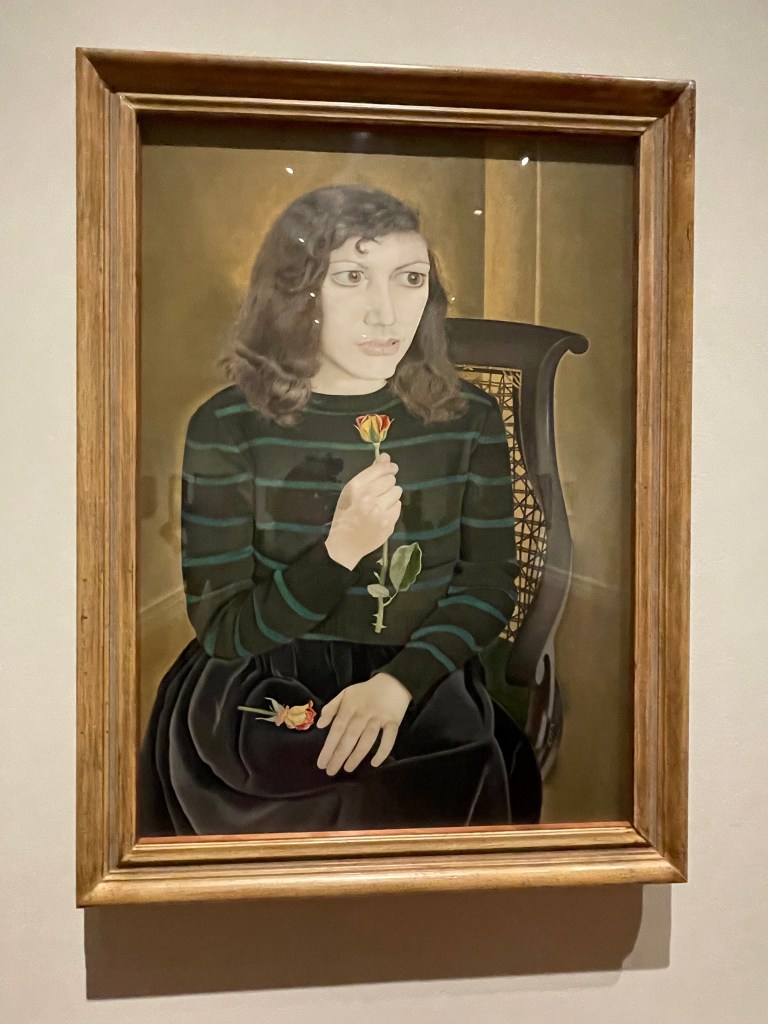
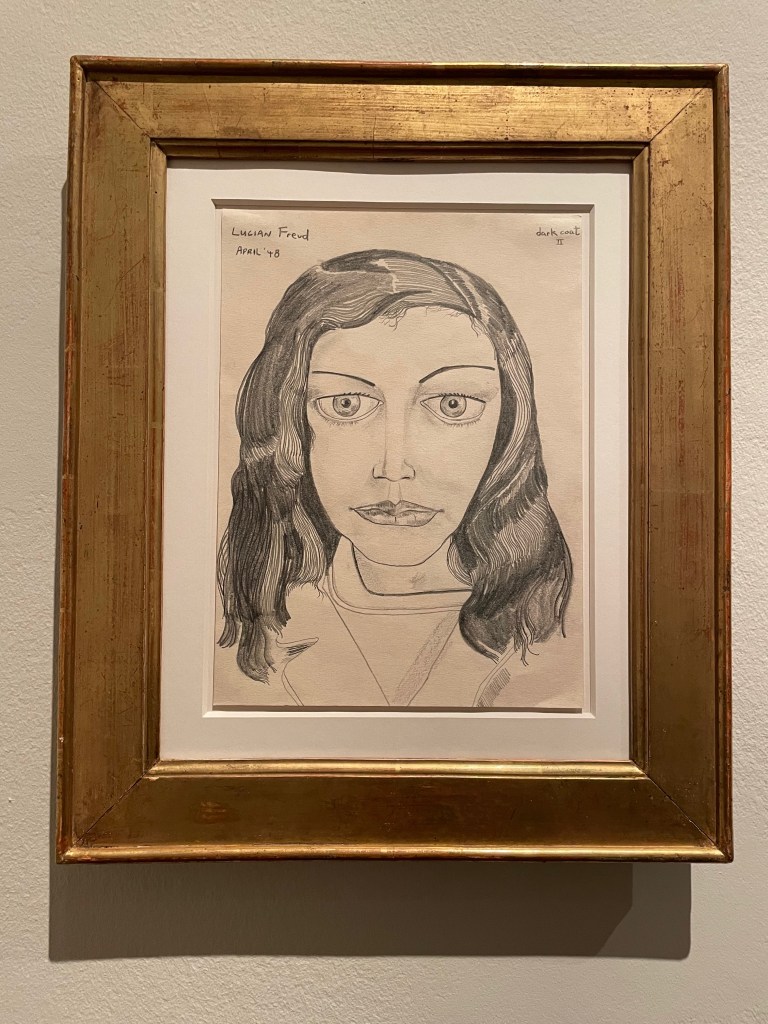
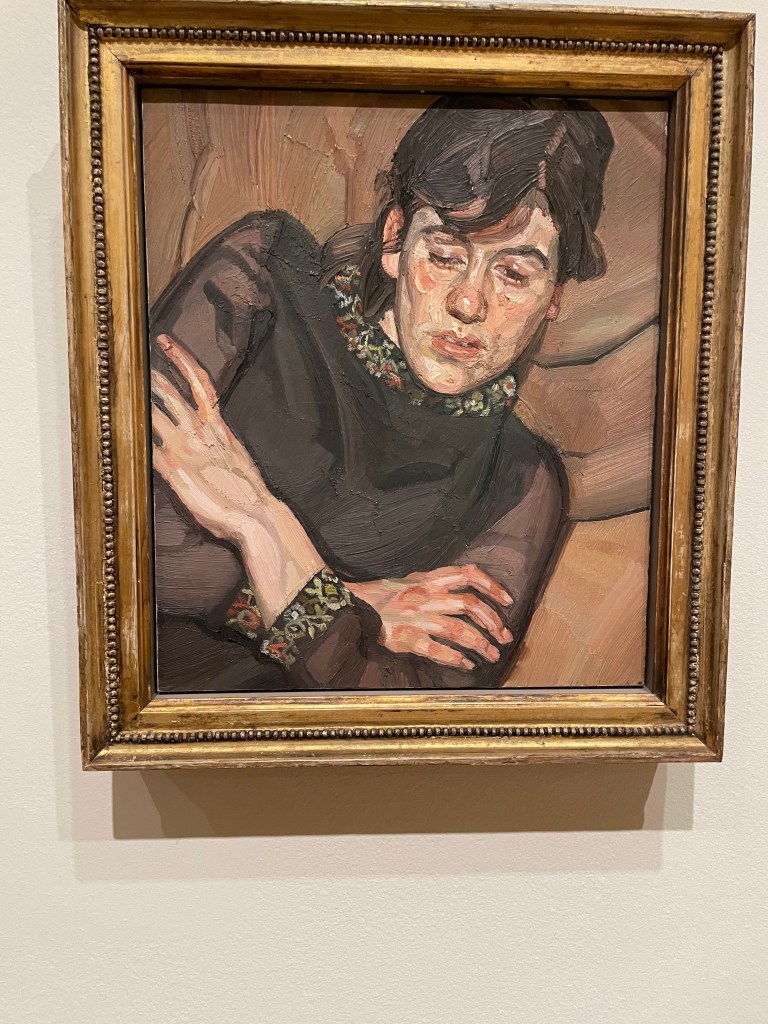
There were a lot of women in Freud’s life. Some were lovers, wives, models or simply friends. Above is a selection of the ones he loved. Above left is Suzy Boyt and centre Caroline Blackwood. One the right and above are two portraits of Kitty Garman. Quite a mixture of drawing and painting – detail and broad brush strokes.
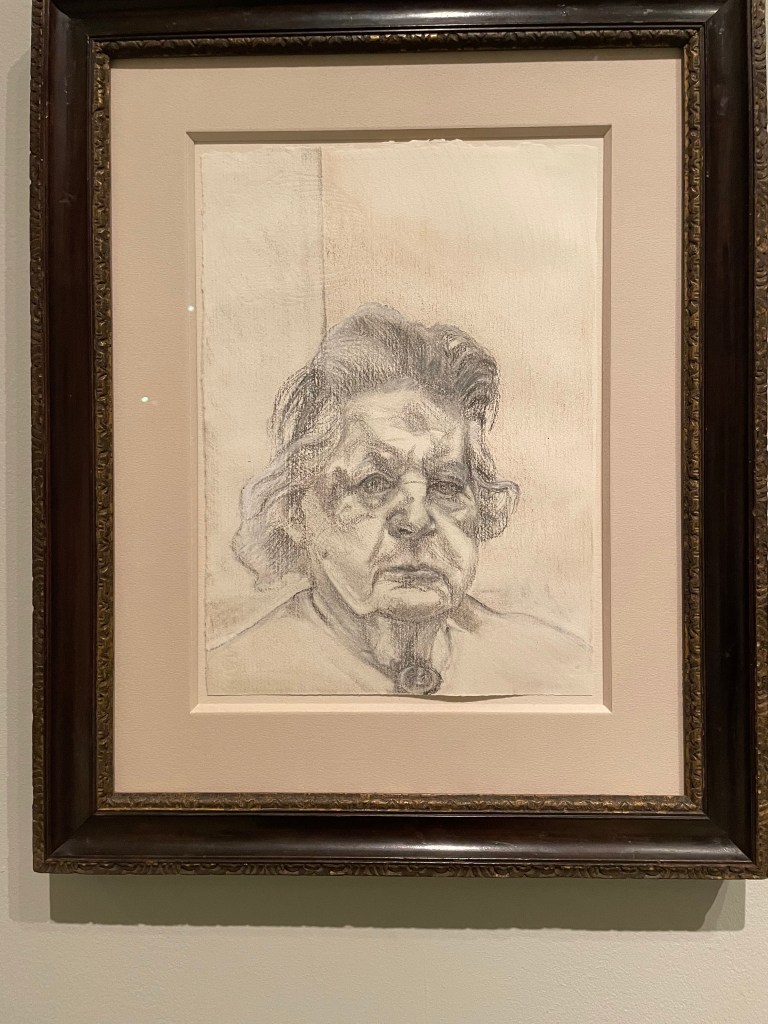
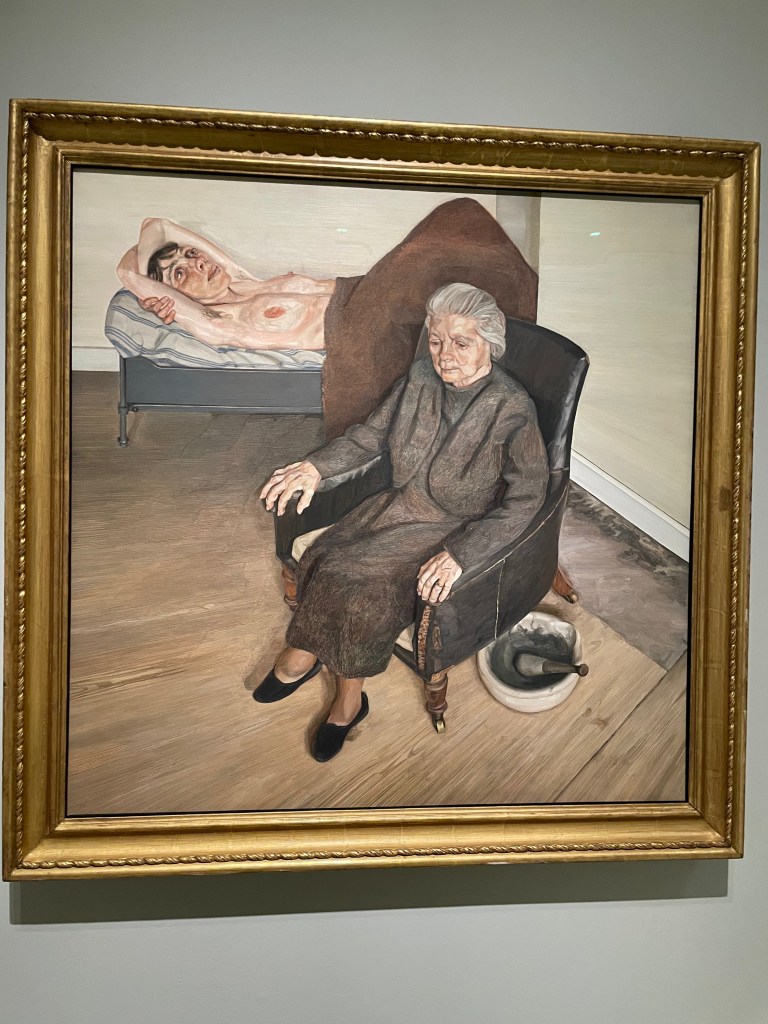
Freud’s mother, Lucie Freud, was also an important model. On the left is a very direct charcoal drawing of her from life and on the right a painting combined with a nude of Jacquetta Eliot.
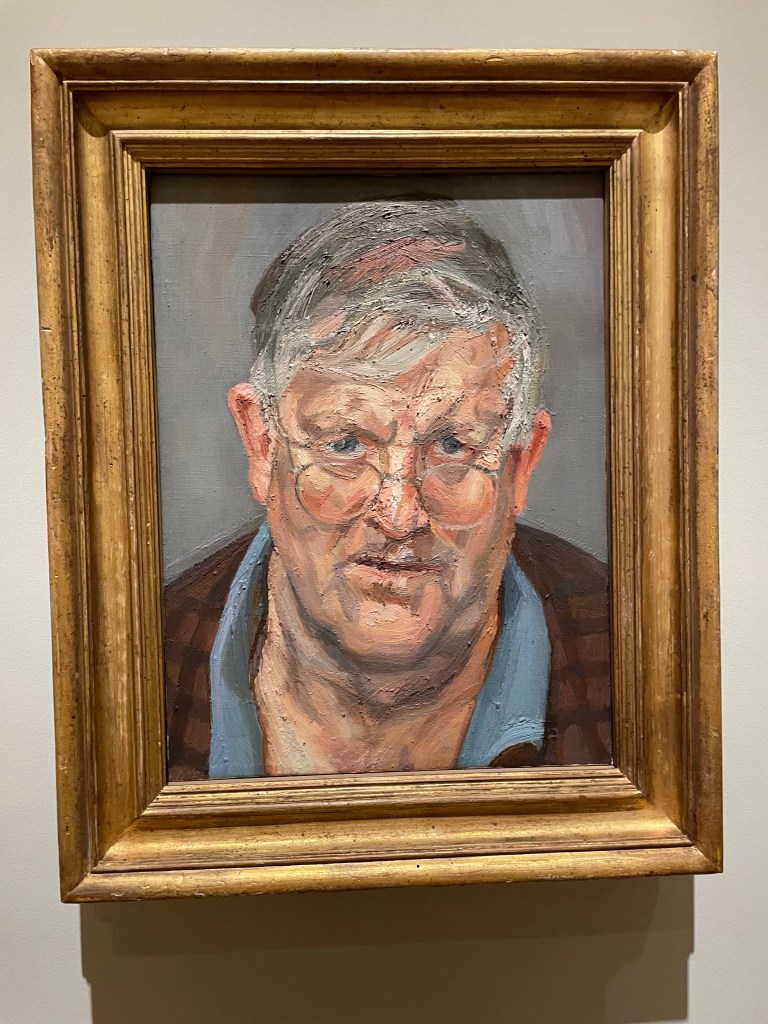
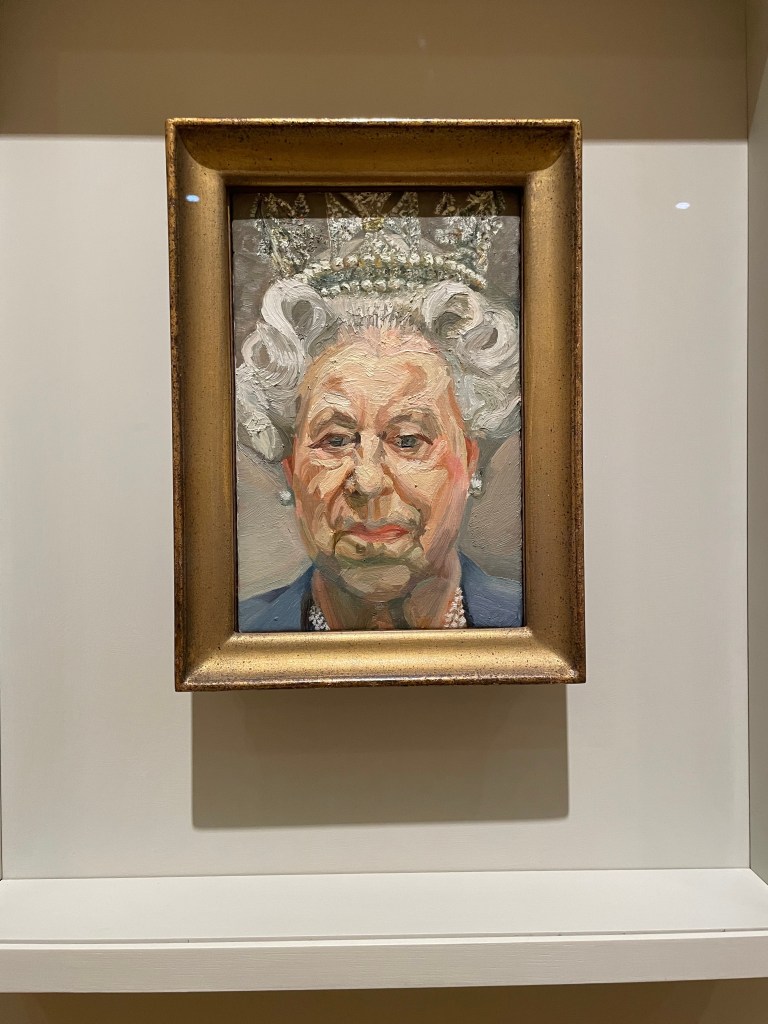
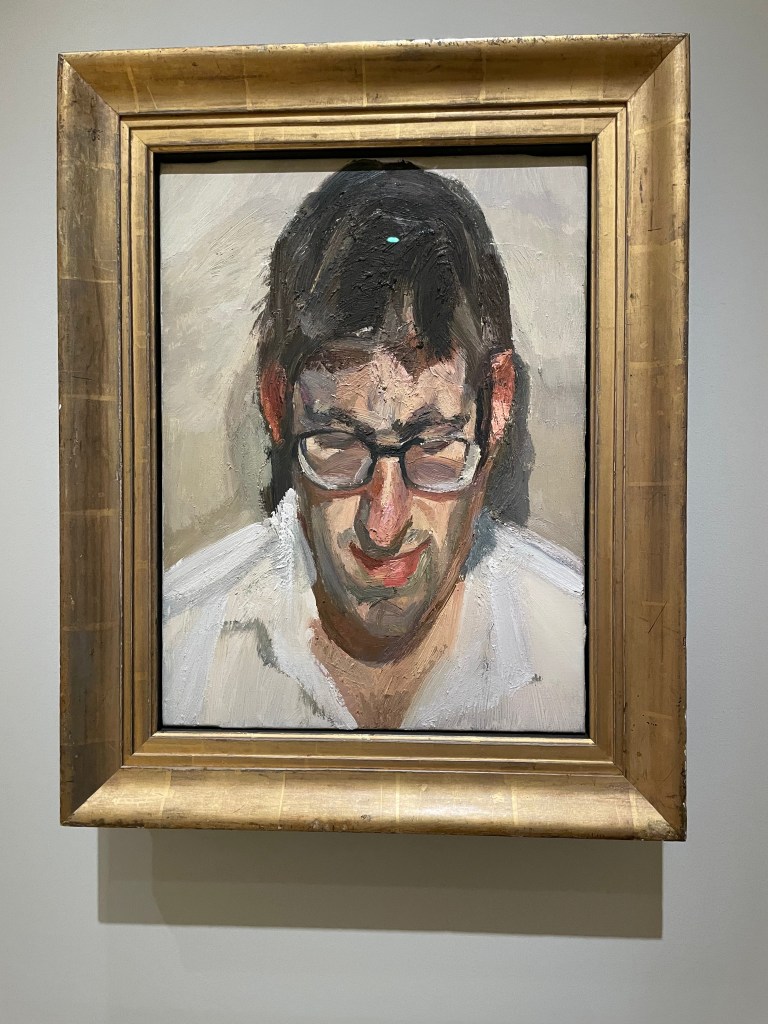
Two faces you may recognise? On the left is David Hockney, centre, the late Queen Elizabeth II and on the right is Frank Paul.
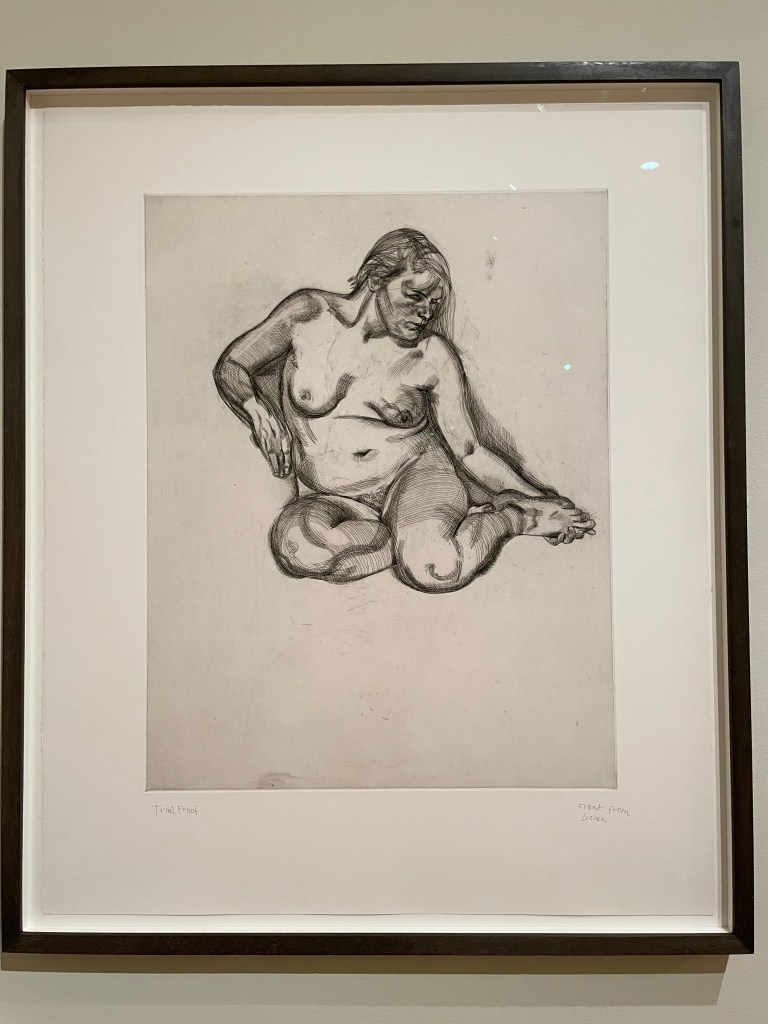
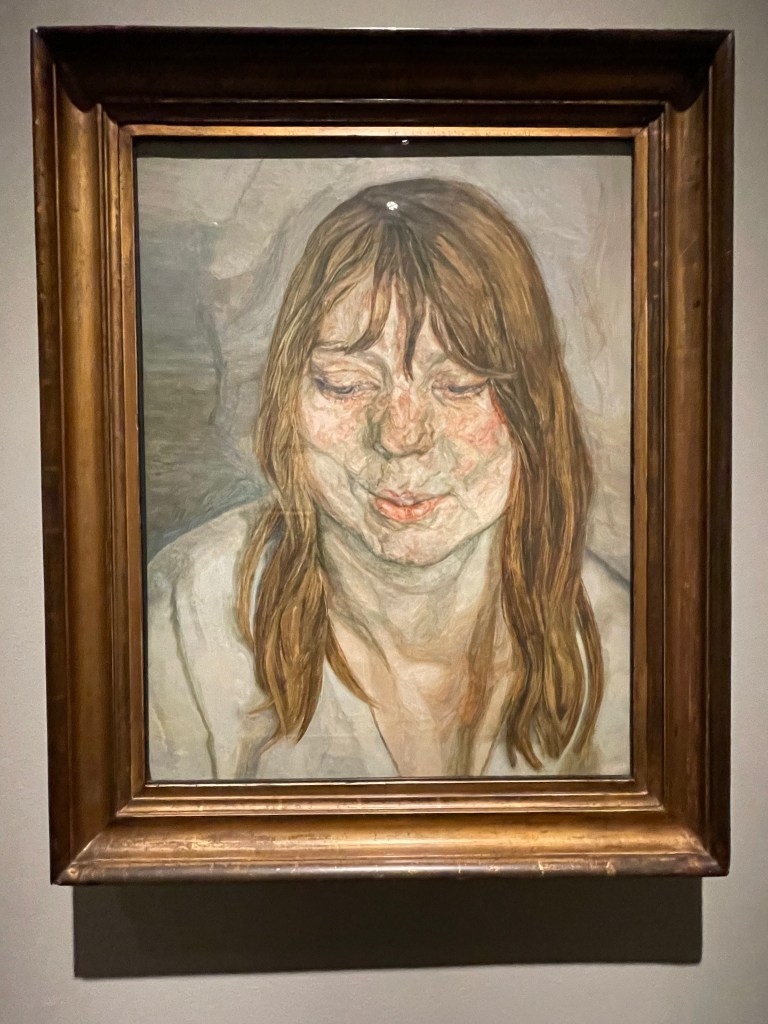
His portraits always seem to capture the sitter’s thoughts. There’s a really contemplative feel to these to portraits. On the left is his daughter Bella Freud, in the centre is a nude etching and on the right is Suzy Boyt – the painting is entitled Girl Smiling.
The show is on at the National Portrait Gallery until 4th May 2026.
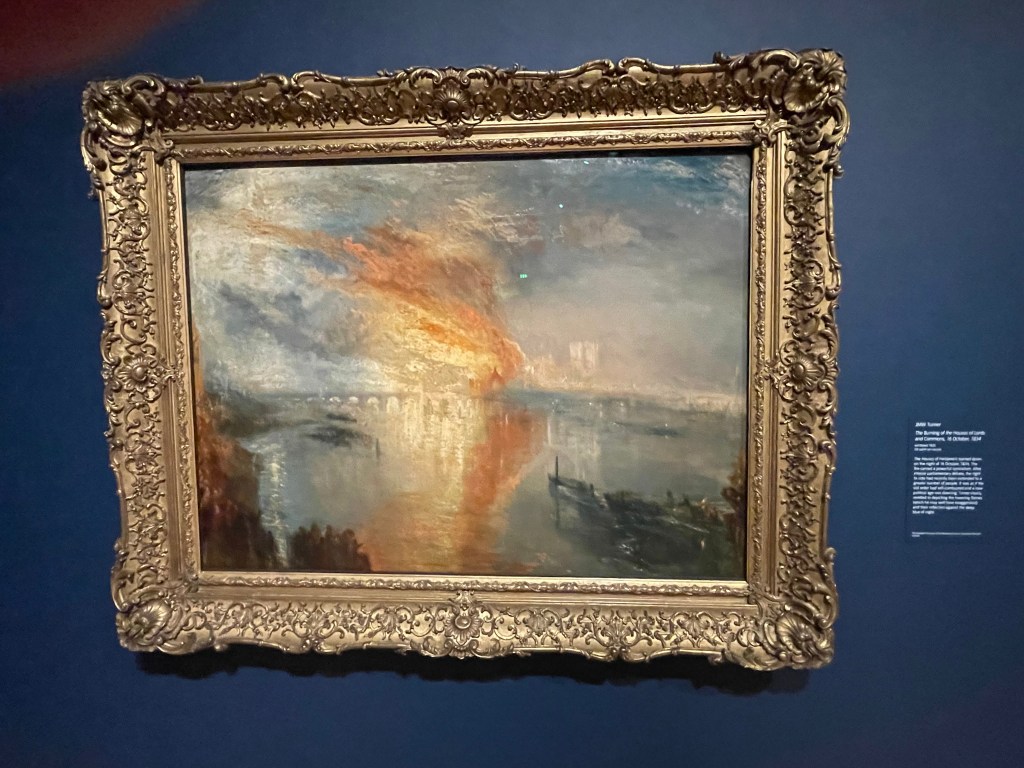
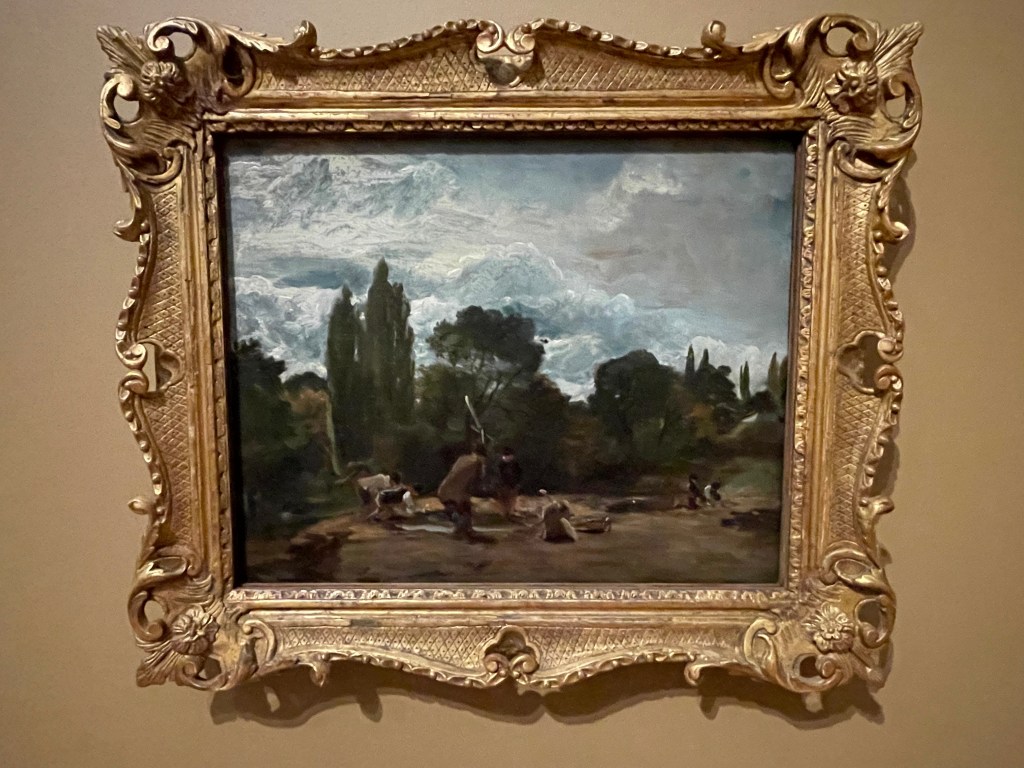
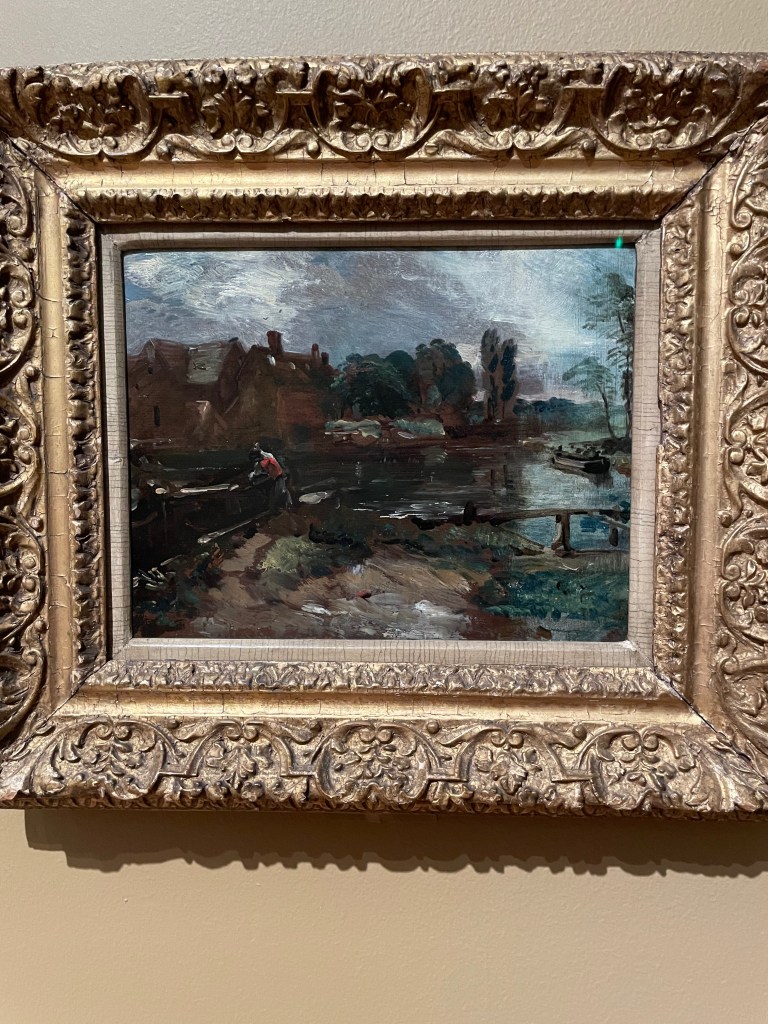
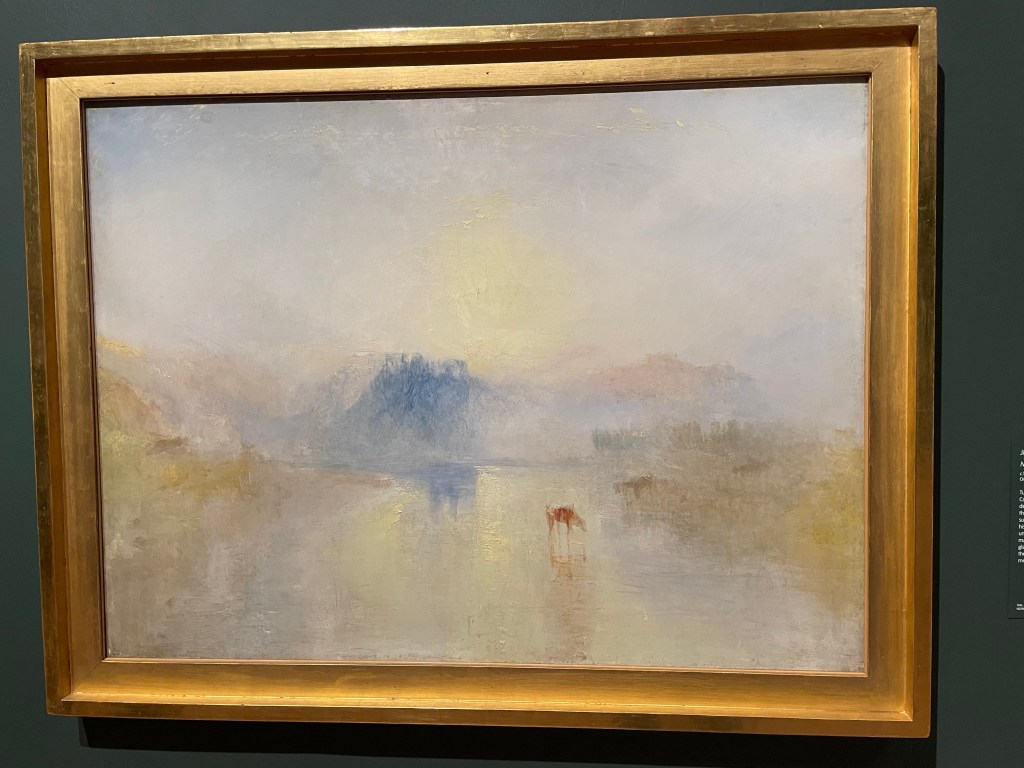
The works of Turner and Constable must be amongst some of the most recognised images in art history. Say the words Flatford Mill or A misty sunset in Venice and most of us will conjure the familiar bucolic image of a Suffolk Mill with a horse and cart or the beauty of Venice seen through a haze of cloud and watery sunshine. These works are amazing. But the history of these two artists is more entwined and their approach more similar than I had realised. This show, entitled Rivals and Originals, charts their artistic development as contemporaries and adversaries.
Both Turner and Constable were dedicated to art from an early age. Turner, you could argue, had the more difficult journey – the son of a barber based in Covent Garden, London, he demonstrated his skills at an early age and his father did his best to support his son’s desire to paint but he was not of the class expected to choose art as a career. Constable was born into middle class comfort in Suffolk and had to convince his family that he did not want to follow a conventional profession but devote his life to art. The pair developed their styles through study of Old Masters and a desire to push a narrative element into their art while recording contemporary life.
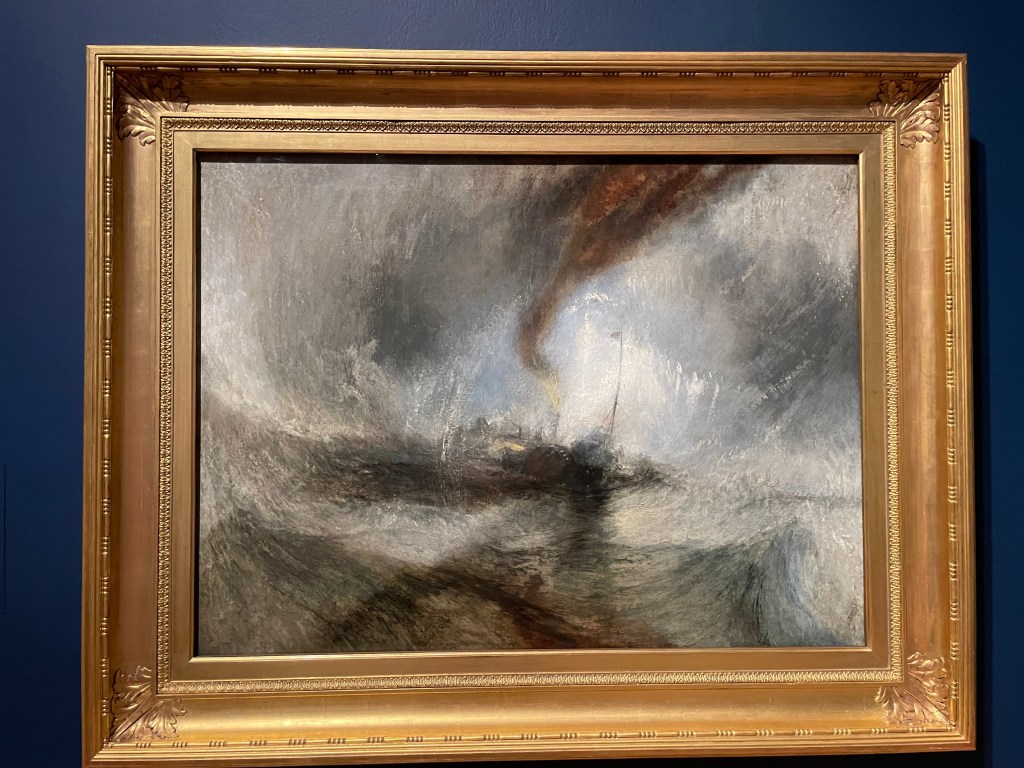
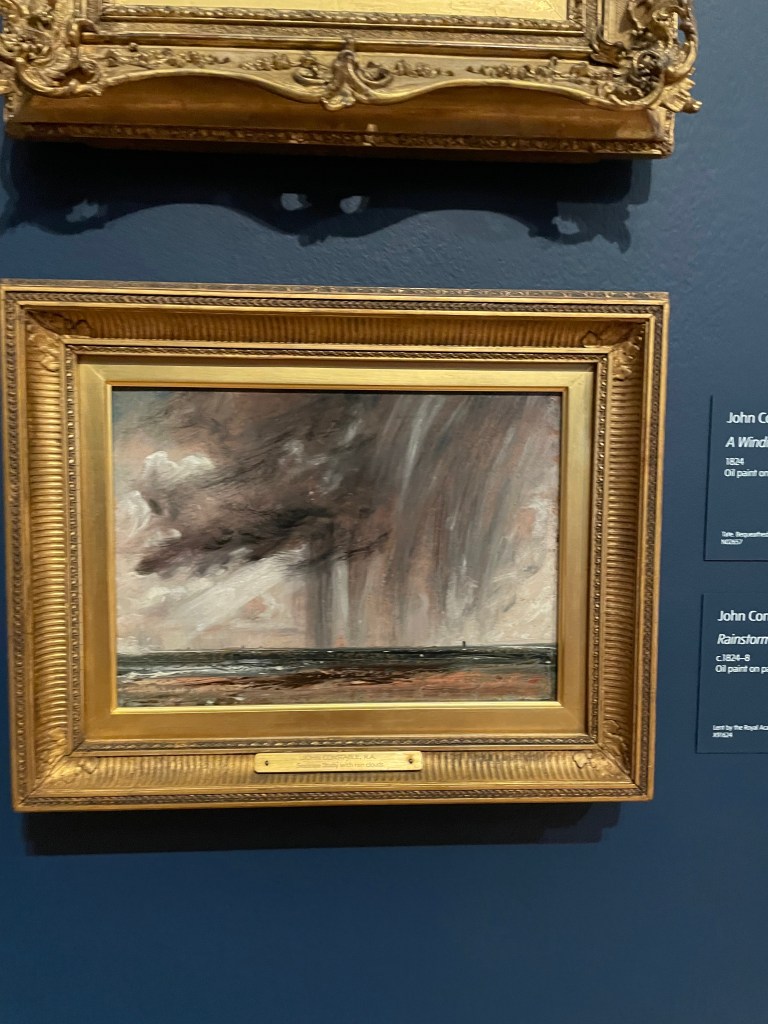
Sometimes it’s hard to differentiate between them – just look at these two, above. On the left is Turner’s Snow Storm – Steam-boat off a Harbour’s Mouth and on the right is Constable’s swift oil sketch called Rainstorm over the Sea. Both of them were fascinated by the power of nature and the constantly changing sky and weather conditions. They spent all their time sketching landscapes and painting the scene directly onto whatever surface they brought with them.
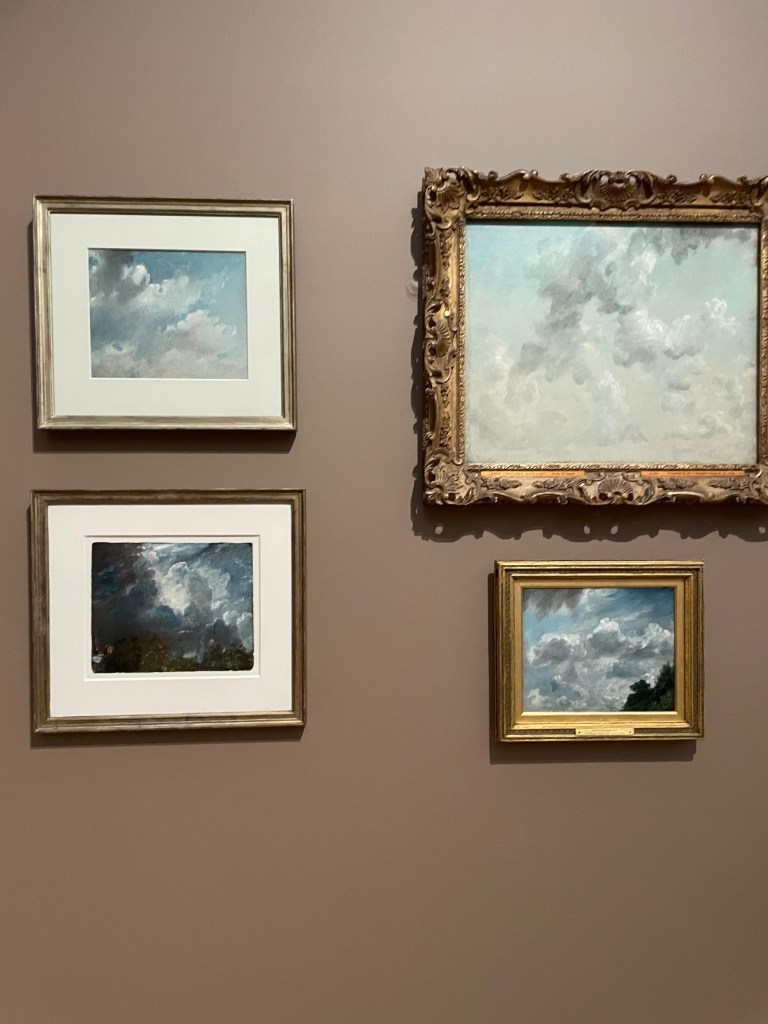
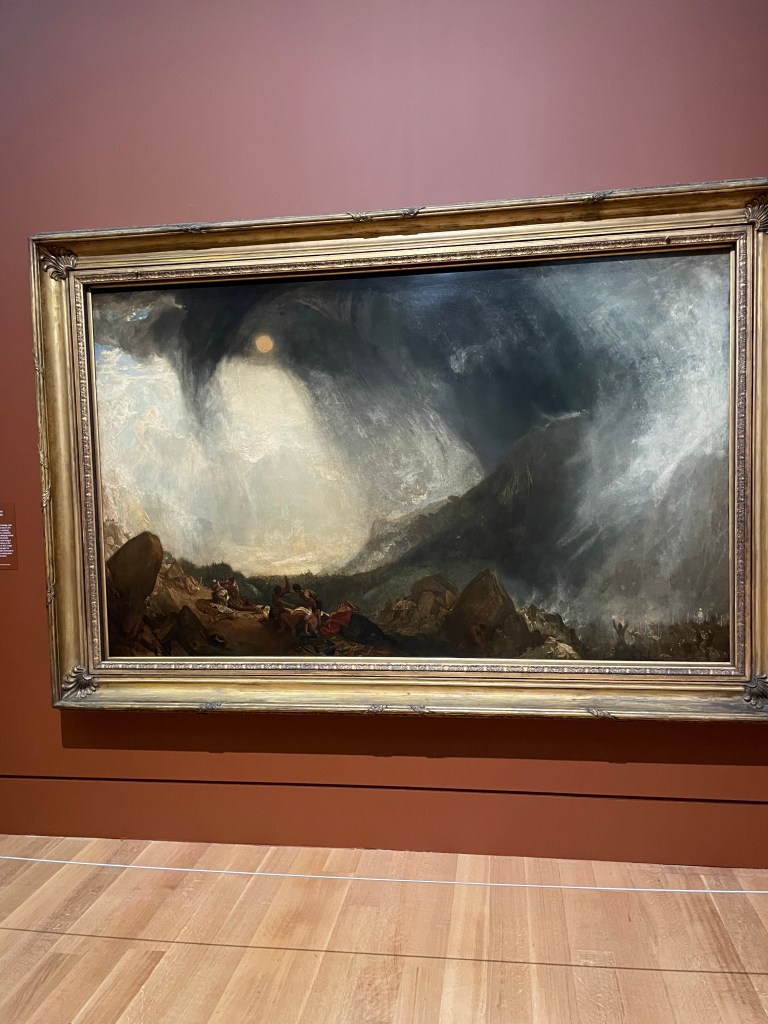
Both must have spent hours observing clouds in their infinite variety and using immediate sketches to dramatic effect. On the left is a selection of cloud studies by Constable and on the right is Turner’s massive painting Snow Storm: Hannibal and his Army Crossing the Alps.
My takeaway from the show, apart from having thoroughly enjoyed it, was the chance to see the evolution of these two artists from detailed work, which might be as literal and accurate as possible, towards a much freer, expressive way of working. Both appear to have created their work at speed, using wonderful gestural swishes of paint or urgent daubs of white and black to denote drama and impact. They are both glorious. This is a wonderful show and well worth seeing.
I had no idea what to expect when I attended the press preview for this show. My knowledge of Indian history is scant. For this exhibition we were introduced to the work generated by Benode Behari Mukherjee, his wife, Leela, daughter Mirnalini and students who lived and work an an idyllic-sounding art school established in Santiniketan in 1919. This was a time when Indian artists might look to the West for influence but were determined that their work would be definitively Indian, and reflect their deep-rooted culture.
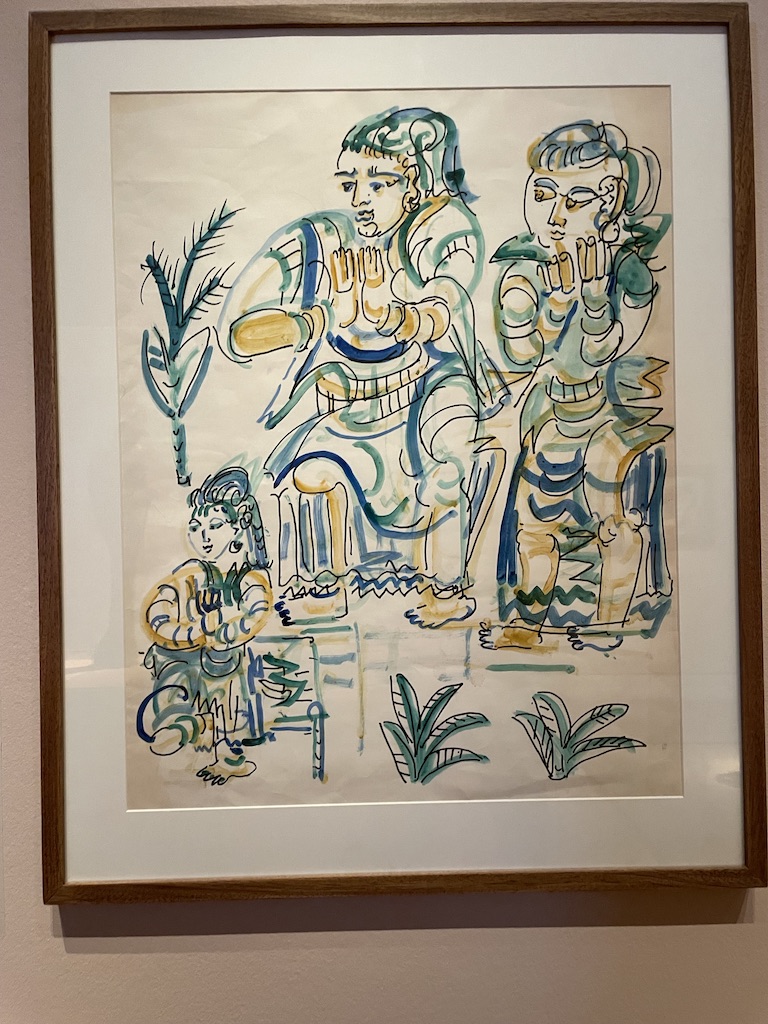
I was impressed by the variety of work and, at times the visceral nature of the imagery. Above is a water colour sketch on paper by Leela Mukherjee demonstrating the influence of Matisse through bold, vigorous brush strokes.
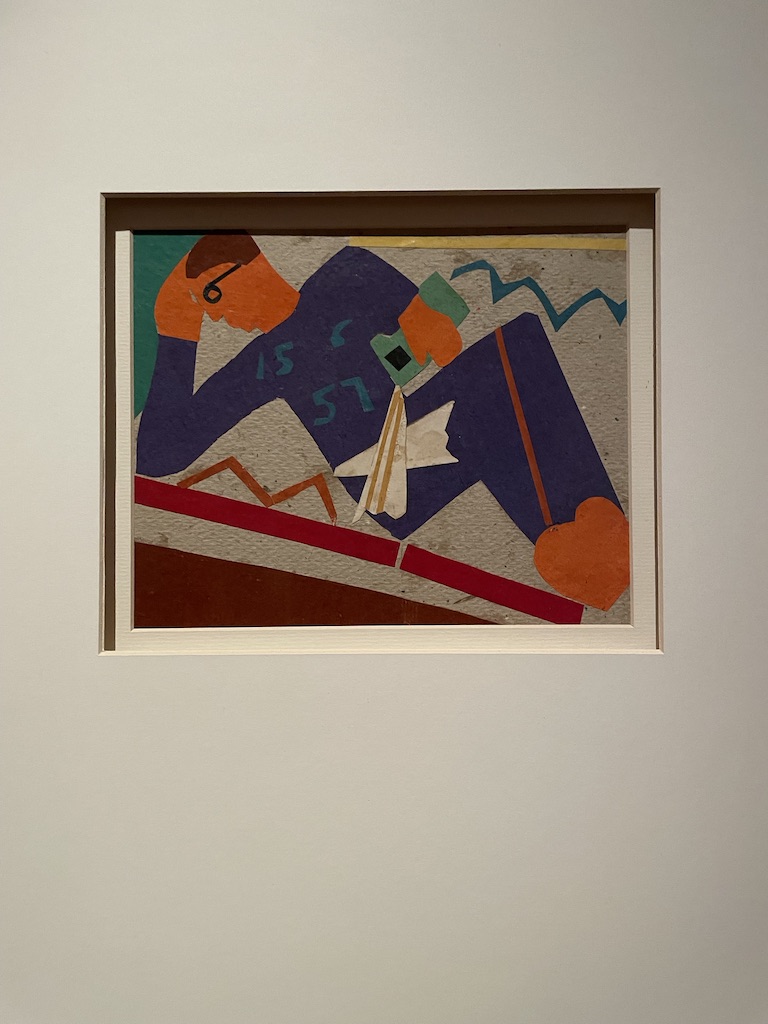
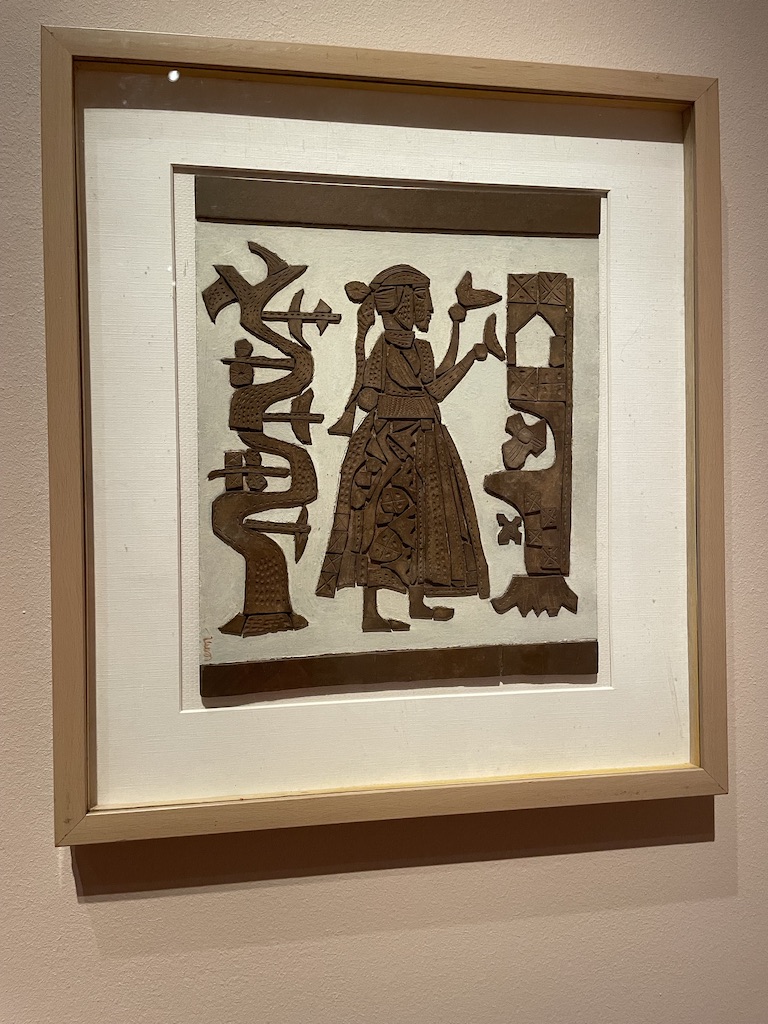
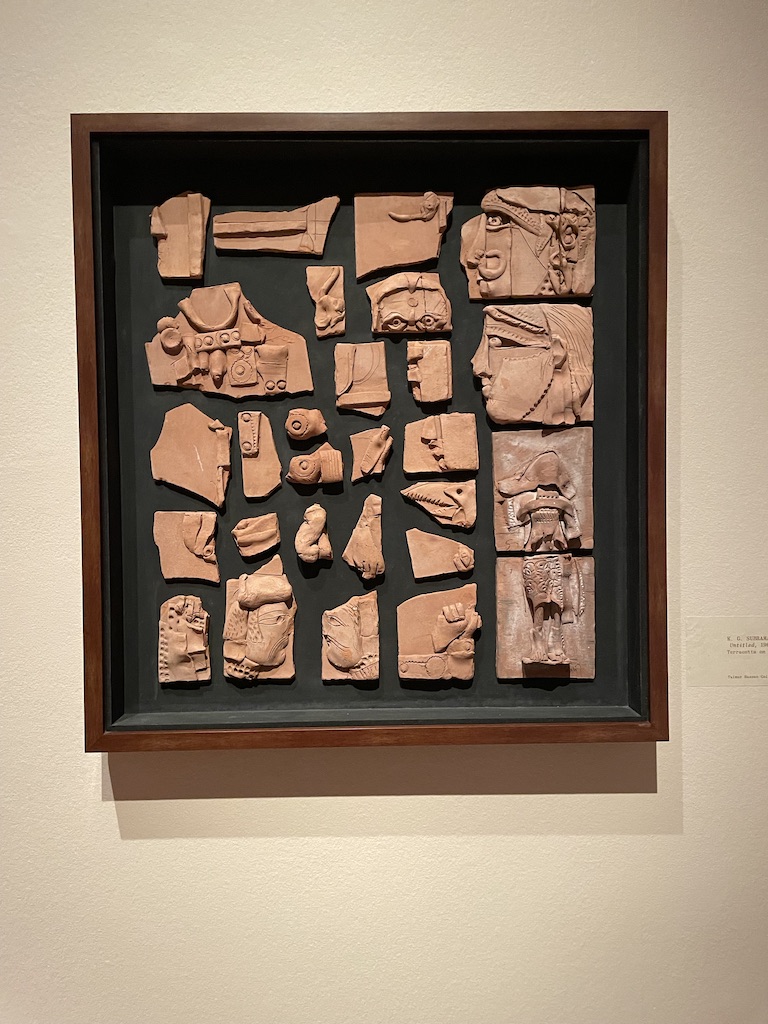
I really liked this trio of work. On the left is a paper collage made with cut outs by Benode Mukherjee. He became blind in his 50s but continued working and teaching. His daughter, Leela, worked closely with him, describing what she could see around them and helping him interpret his art by preparing and cutting up paper for him to collage. He would then, intuitively, ‘feet’ his way into these later works. In the centre is a carved wood mosaic by K G Buramanyan (a student) which relates to a monumental mural commissioned in 1962. The mural stretches some 25 metre and used 13,000 terracotta tiles – examples are shown on the right.
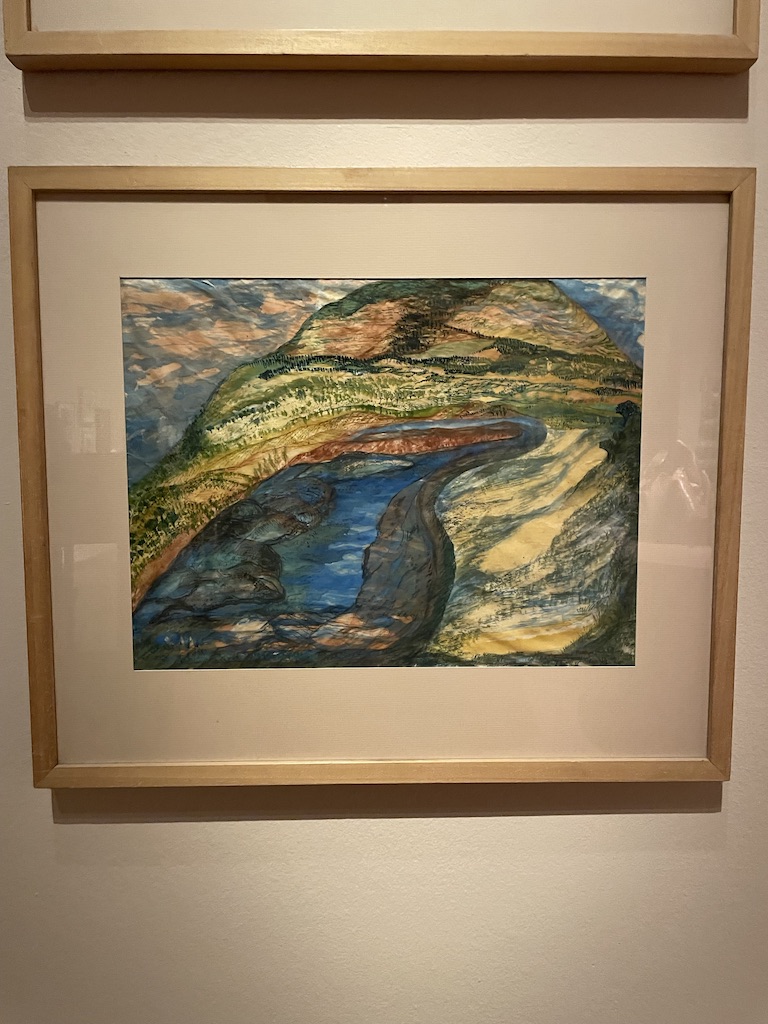
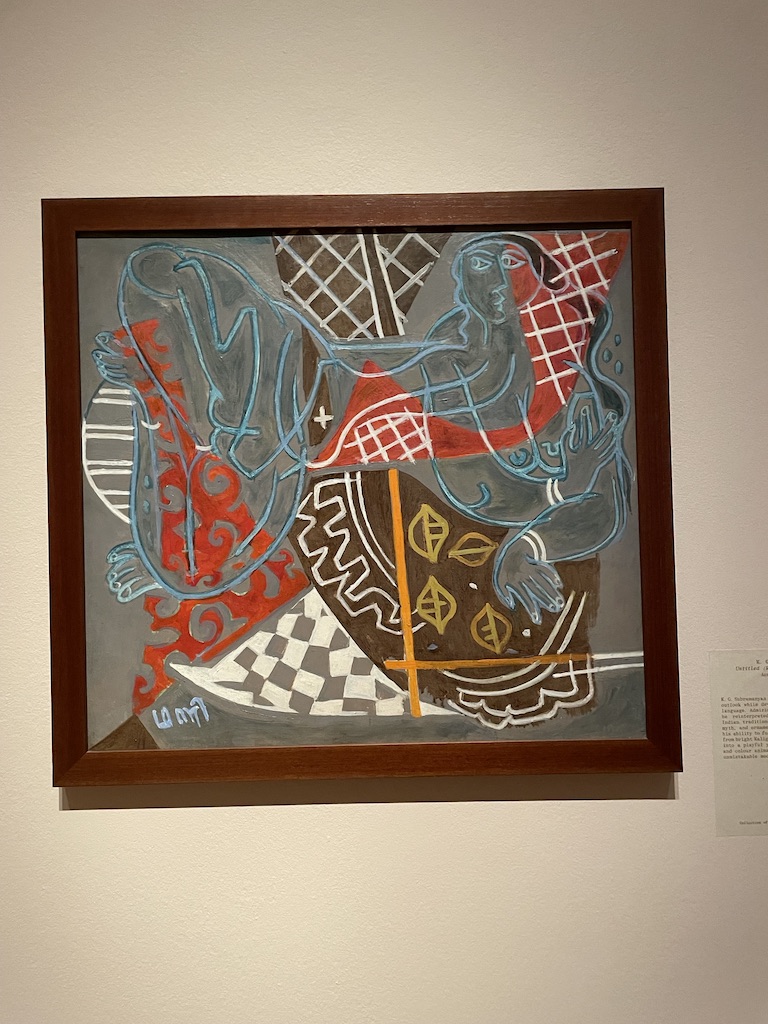
These two paintings caught my eye. On the left is a watercolour by Mrinalini Mukherjee which is like an abstract landscape using great colours. And on the right is a very Matisse and Picasso-inspired ‘Reclining Woman’ by K G Subramanyan.
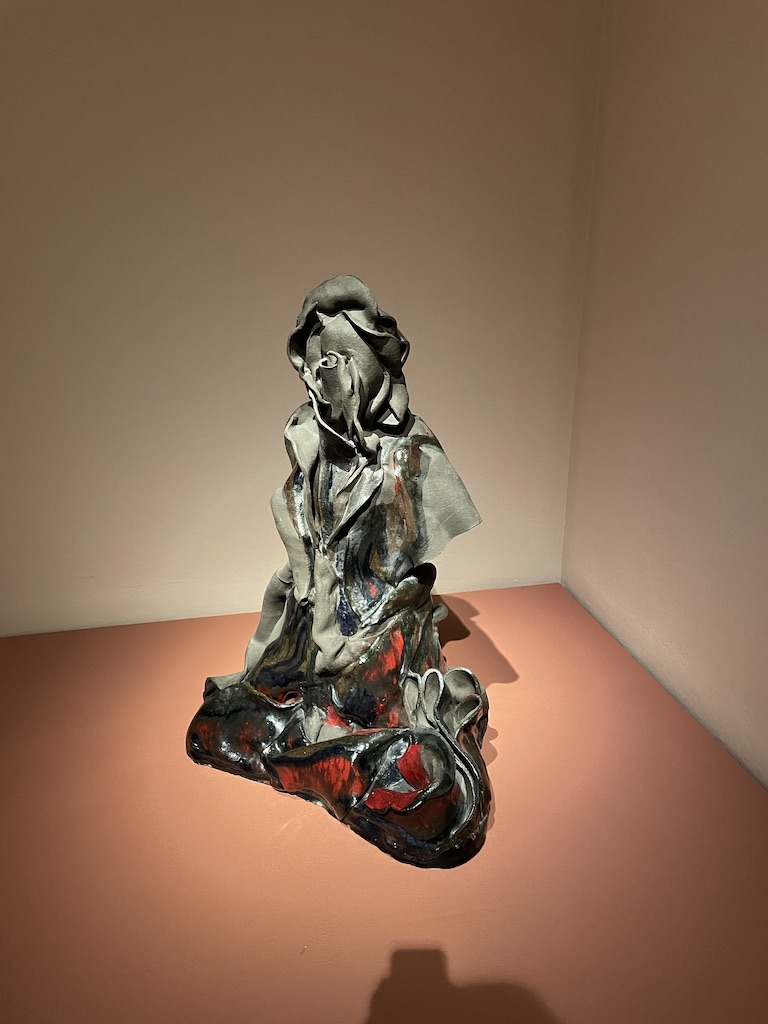
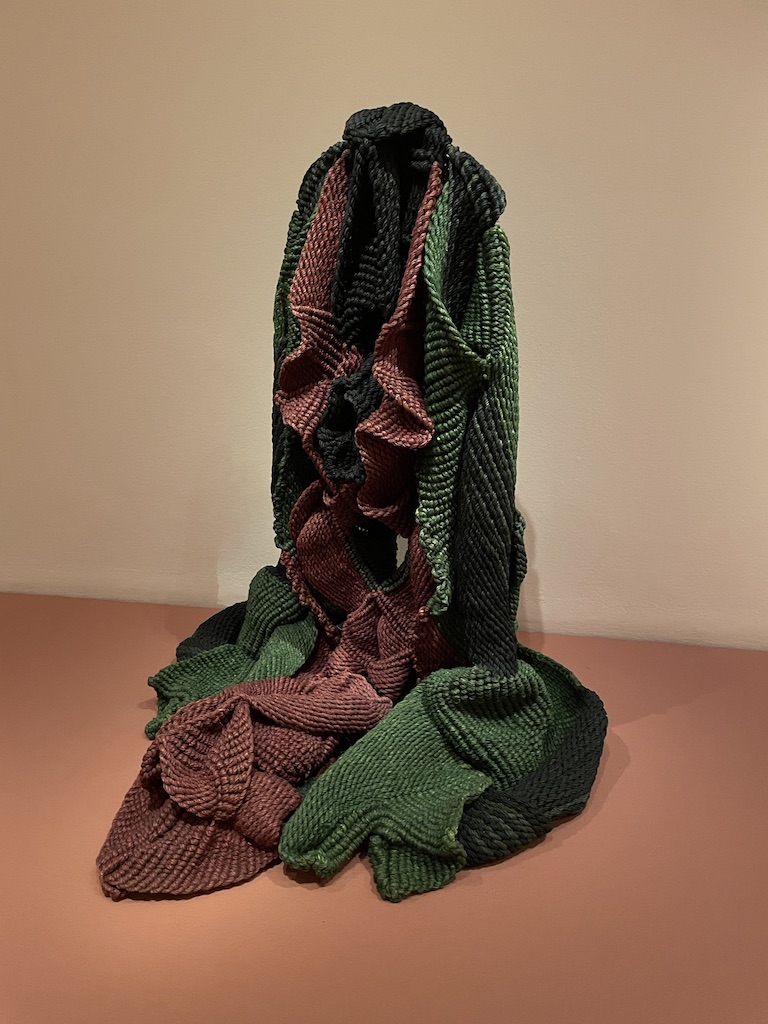
The sculptures are interesting. On the left is Night Bloom II by Mrinalini Mukherjee, a partly-glazed ceramic made with folds of clay which convey the idea of a woman seated in the lotus position. They clay bears impressions of textiles. And on the right is her intriguing sculpture named Jauba, from 2000 made with hemp and steel.
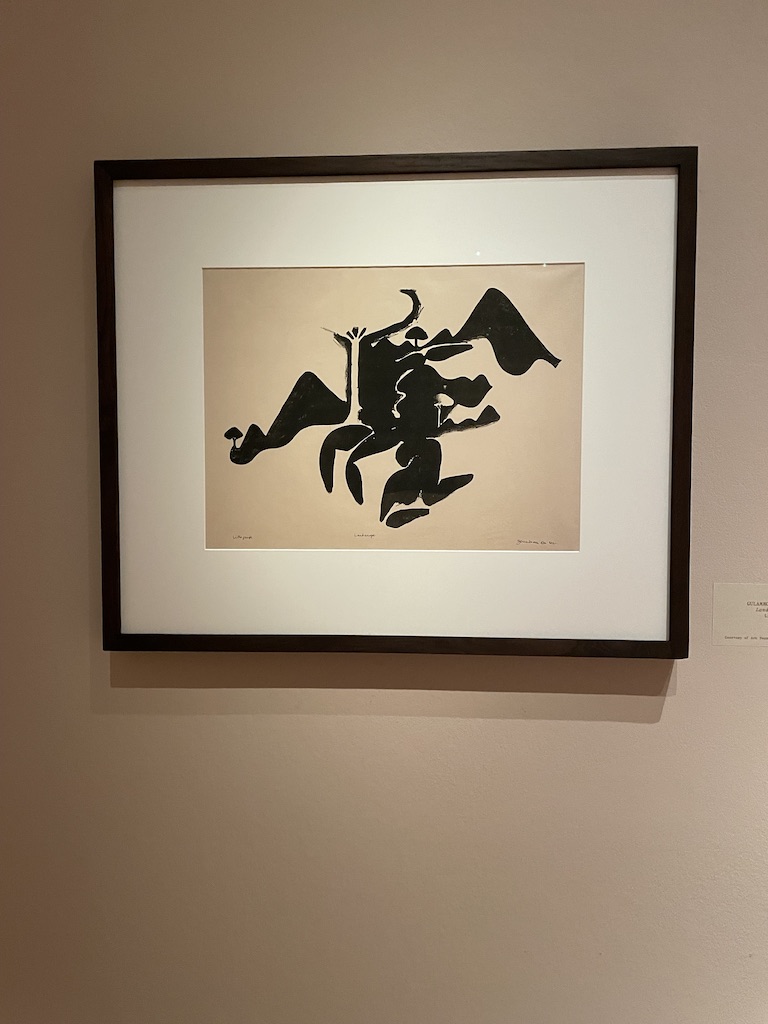
I found this lithograph, Landscape 1968, by Gulammohammed Sheikh quite threatening with intimations of unsettling goings on. And on the right is an etching entitled Riot from 1871 where the violence is evident.
A very intriguing show. It’s on at the Royal Academy until 24 February 2026.
Immortalised in many art forms and still celebrated in fashion and style, Queen Marie Antoinette’s influence is legendary. Mention her names and the words, ‘let them eat cake’ spring to mind, but it’s likely that she simply had no idea of the poverty of the French people in the 1780s which precipitated the country into revolution while she lived a life of palatial splendour with royal funds to indulge her interest in fashion.
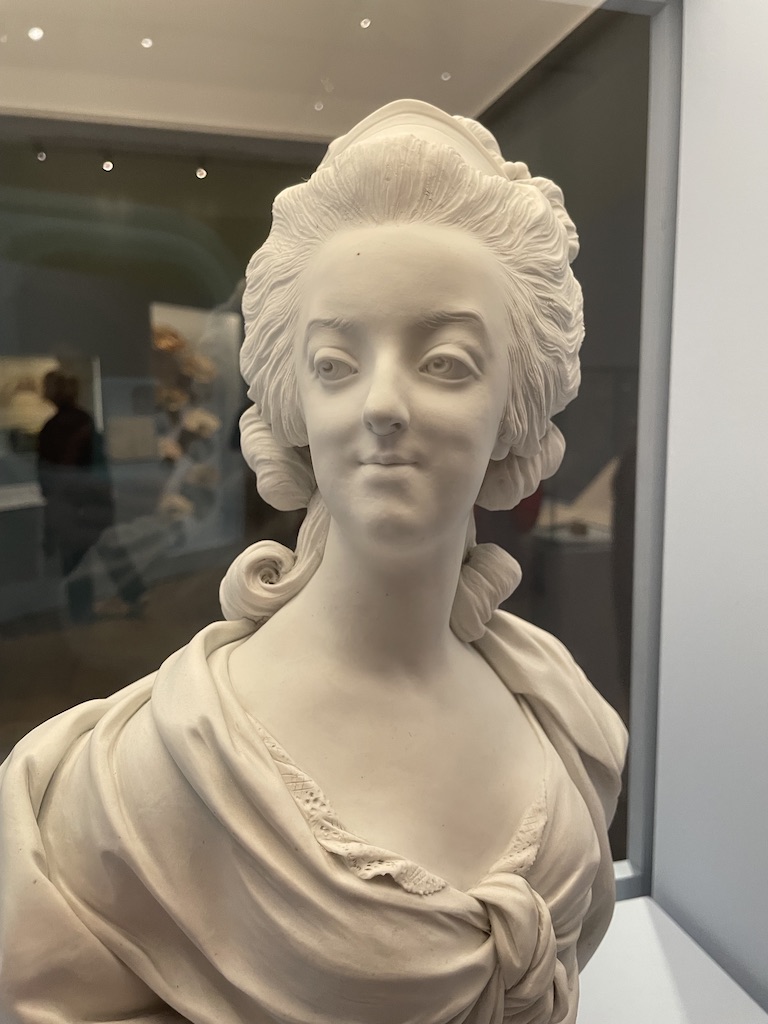
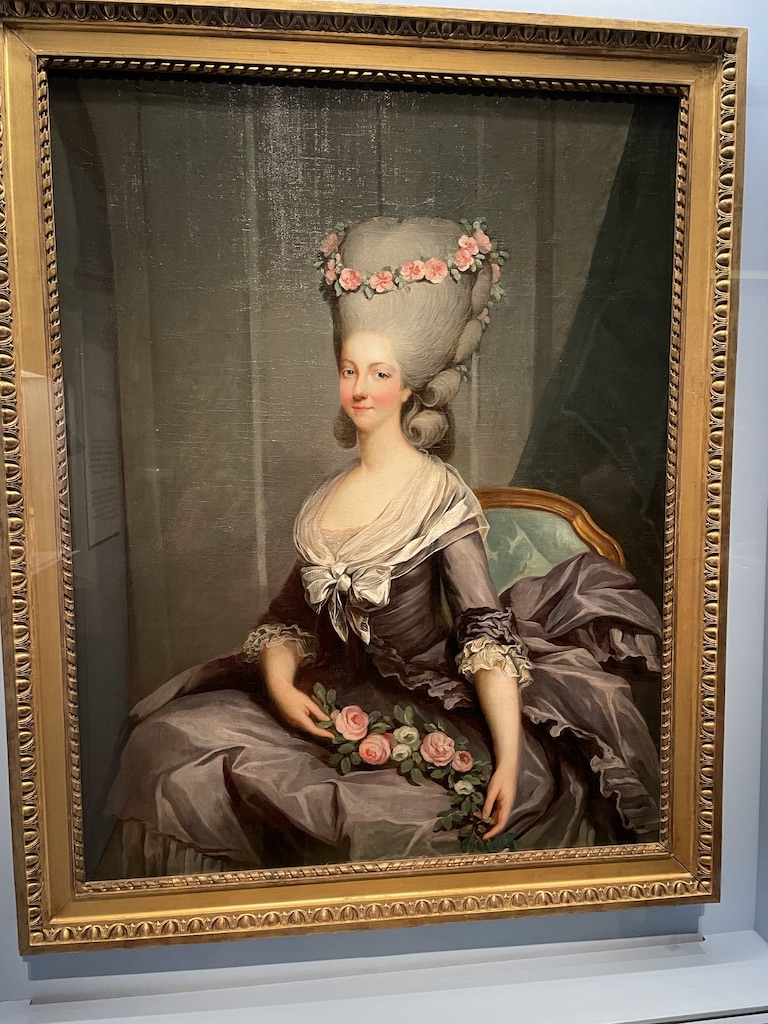
She was an attractive woman who clearly understood the power of image. Judging from the number of portraits and sculptures on show at this brilliant exhibition, she was always eager to pose for artists. And artists clearly responded to her interest in fashion, eagerly capturing the details of her outfits.
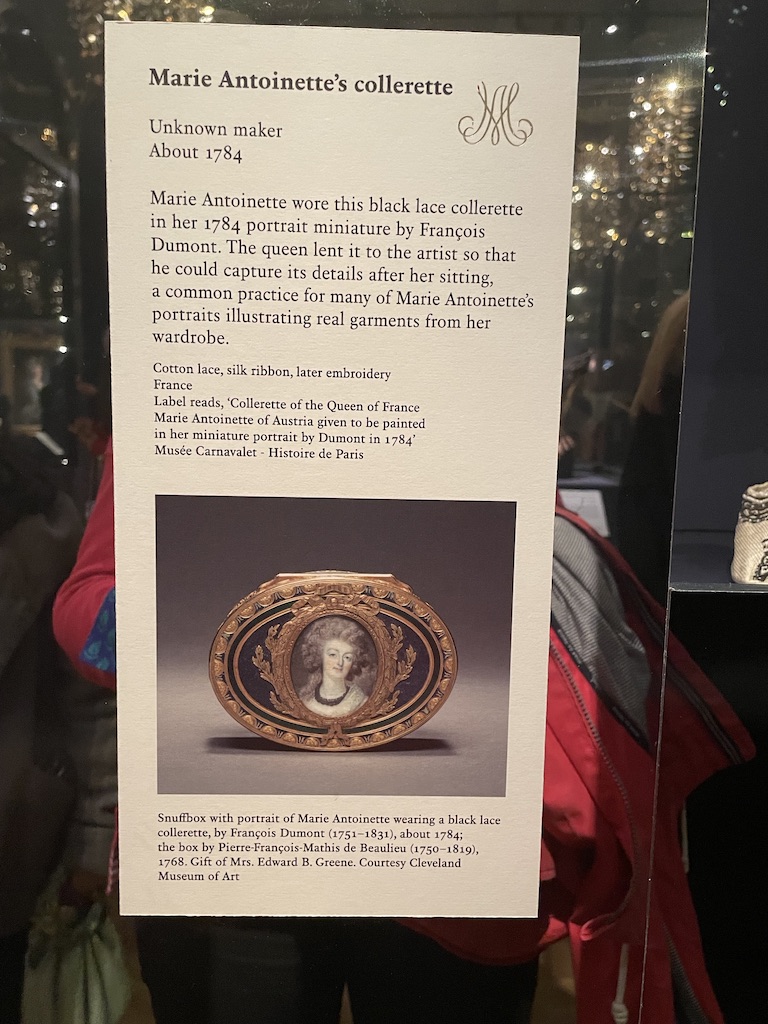
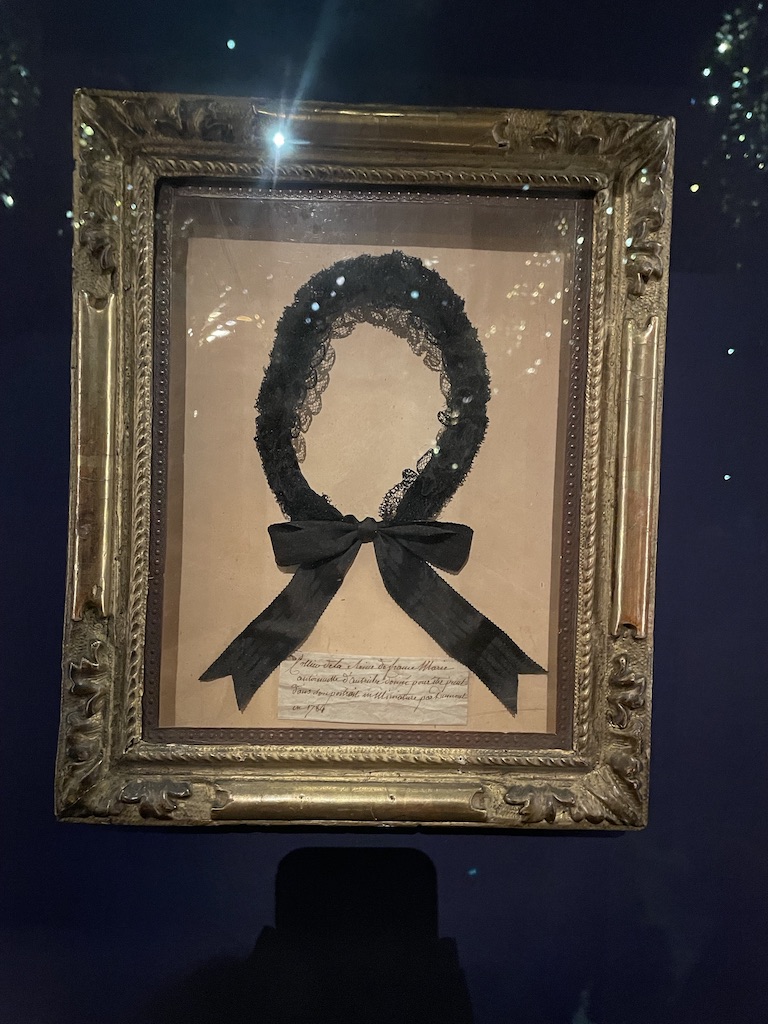
it’s fascinating to see the black lace ‘collerette’ which featured in a portrait miniature by Francois Dumont – and was lent to the artist so that he could capture the details.
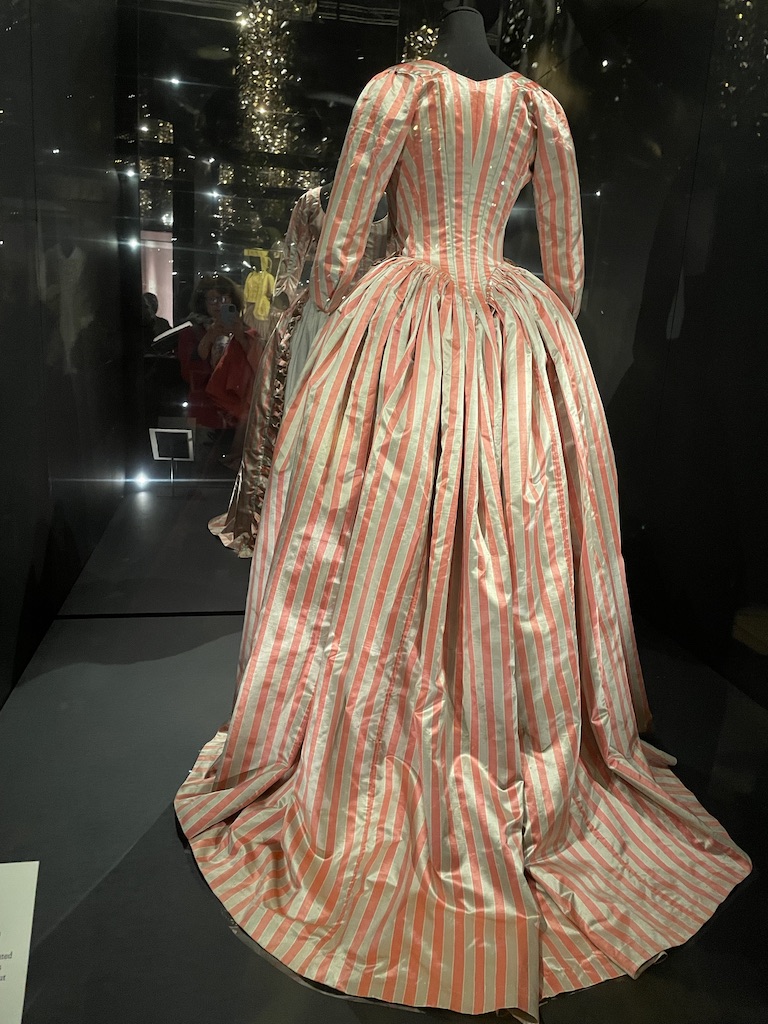
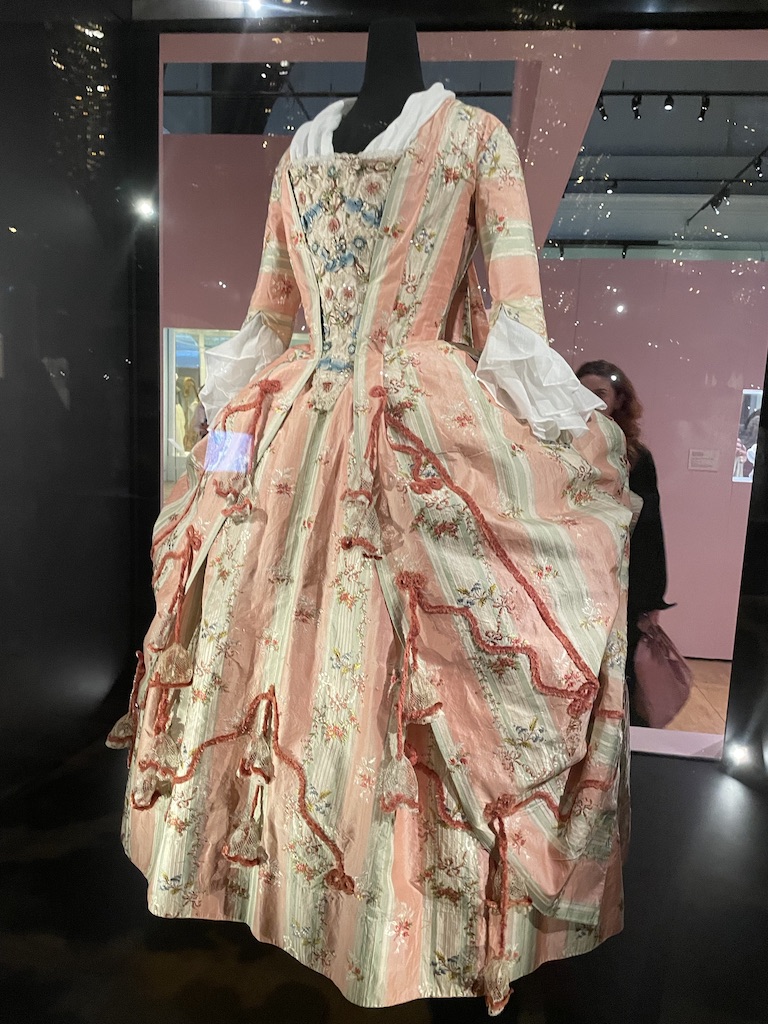
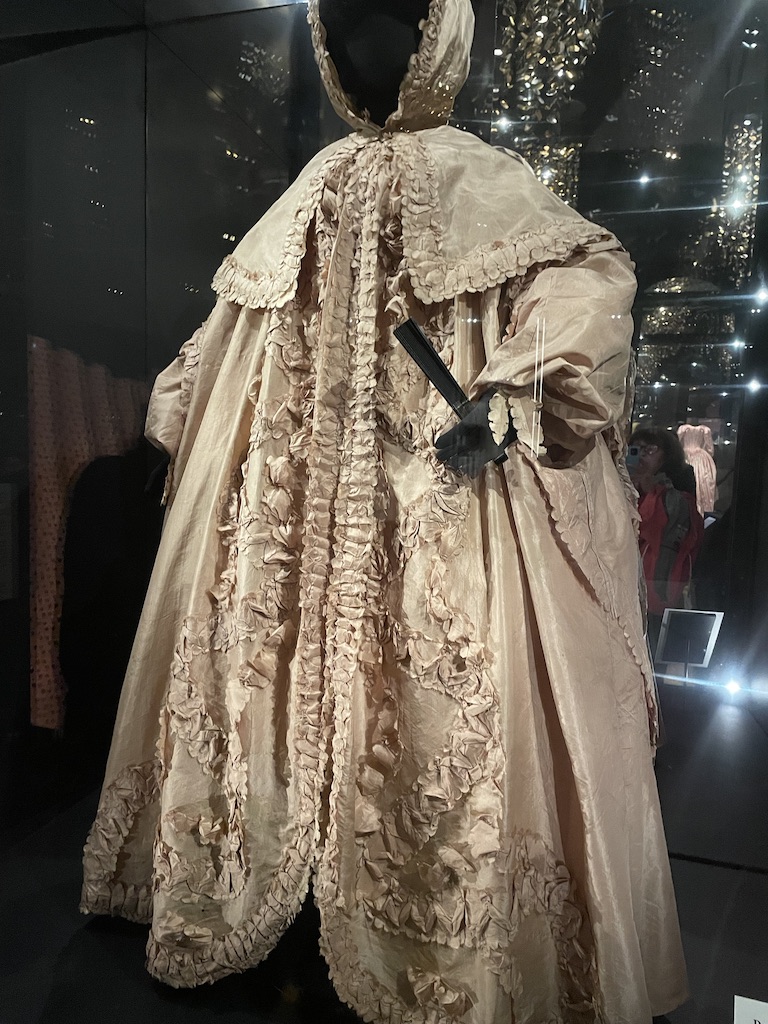
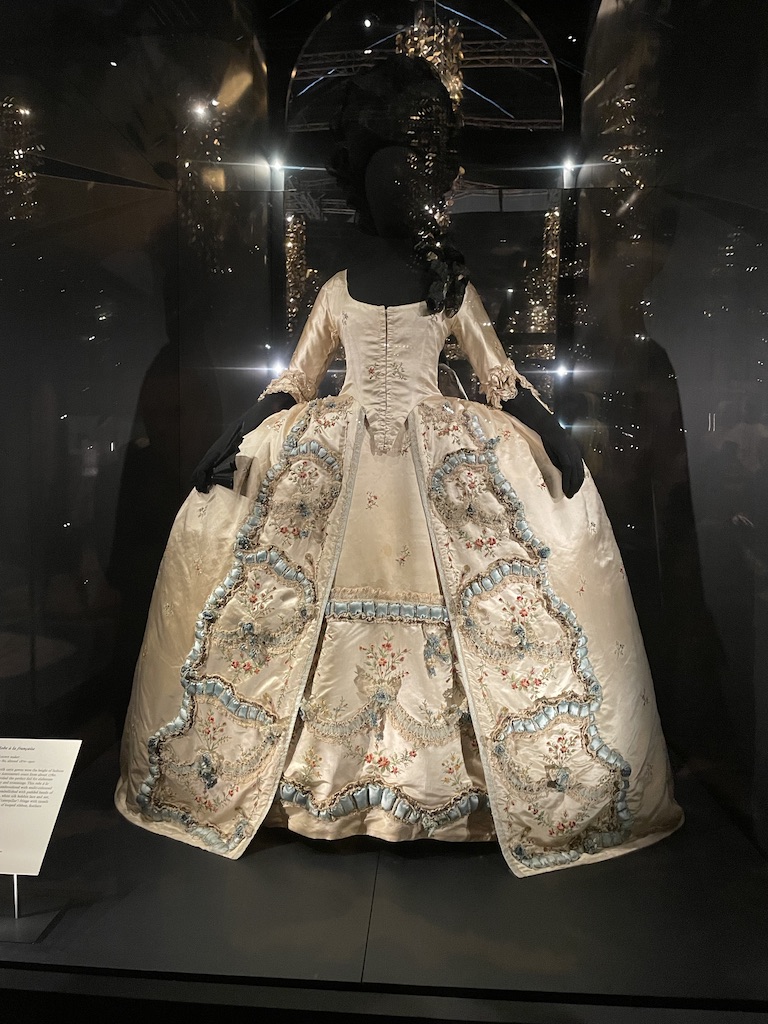
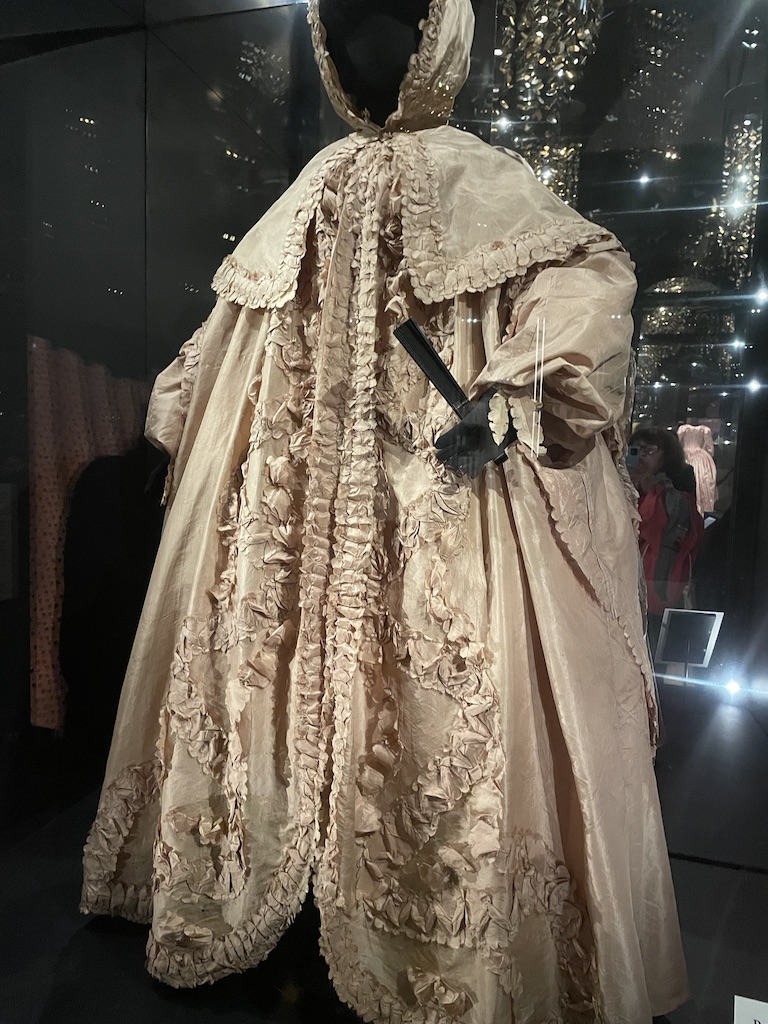
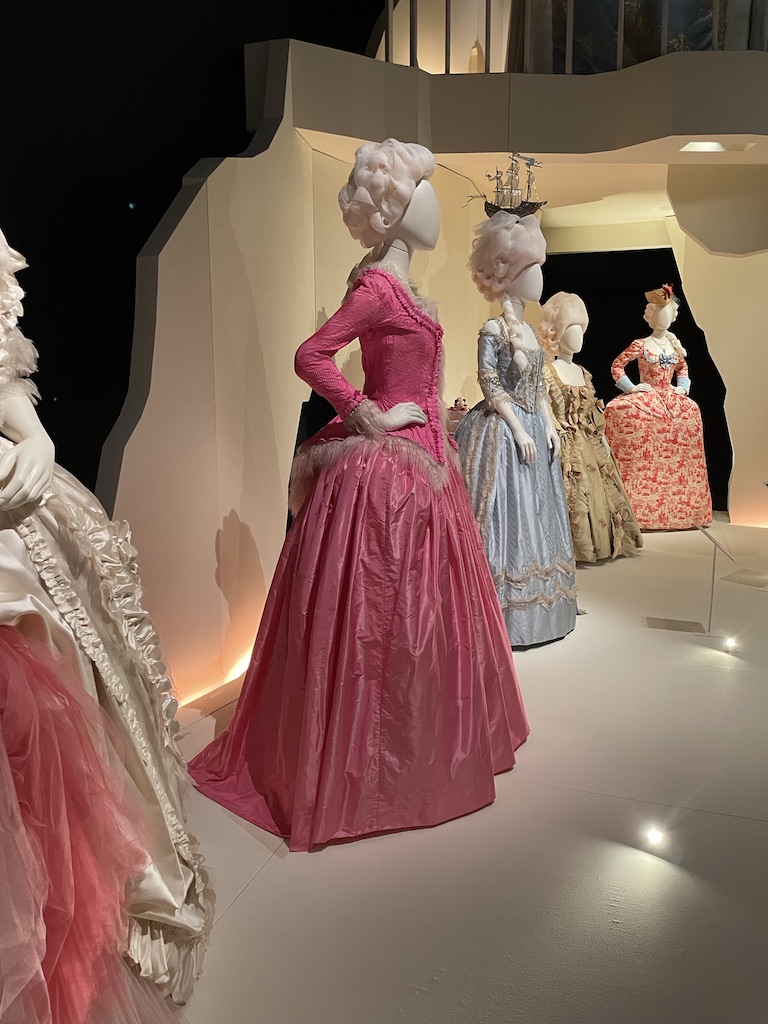
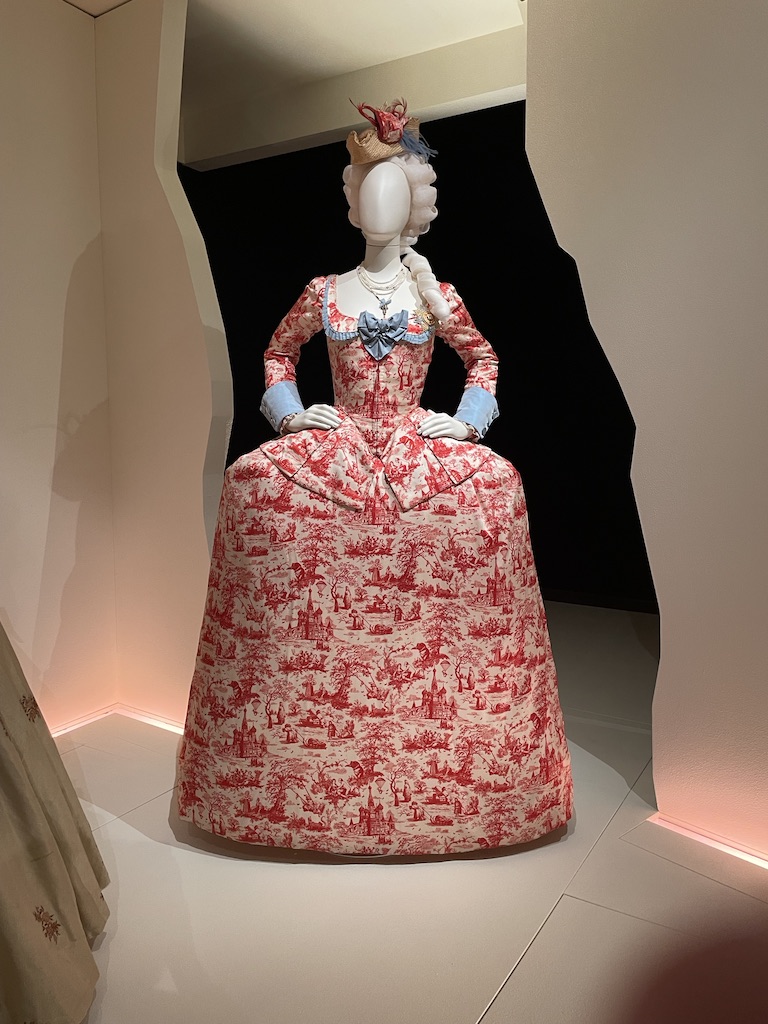
Oh, the costumes! There’s an amazing collection of gowns – not necessarily worn by Marie Antoinette but come from the 1780s and 90s and are very similar to many of the dresses and clothing featured in the portraits. It’s astounding to see the detail in the couture and opulence of these dresses.
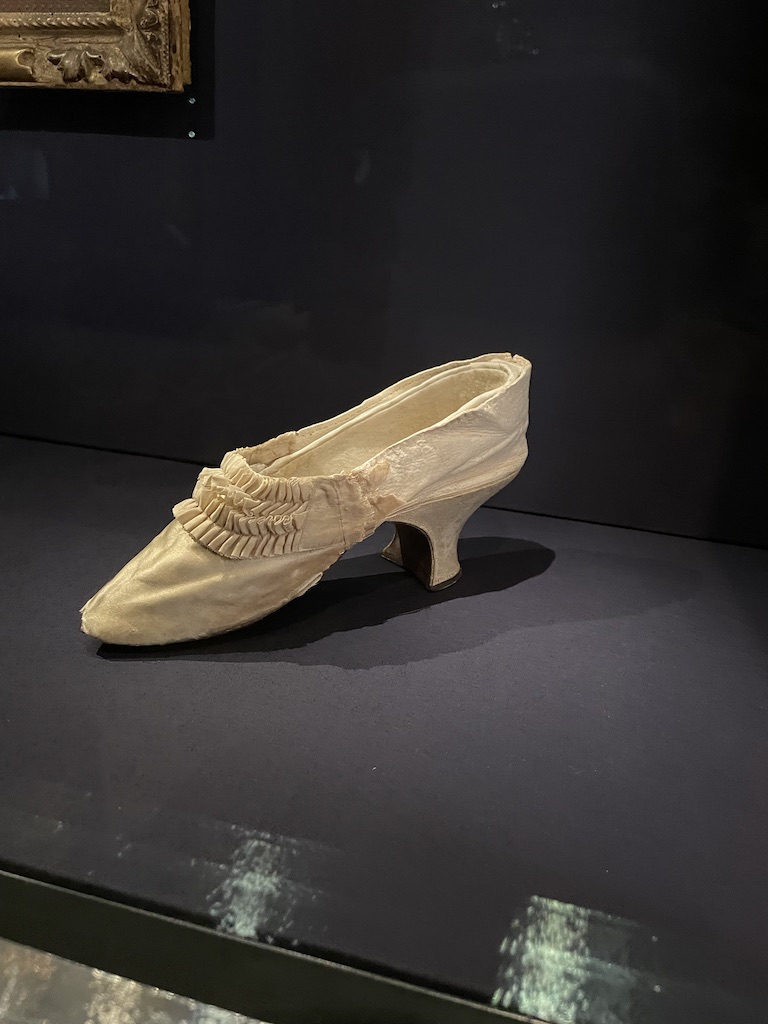
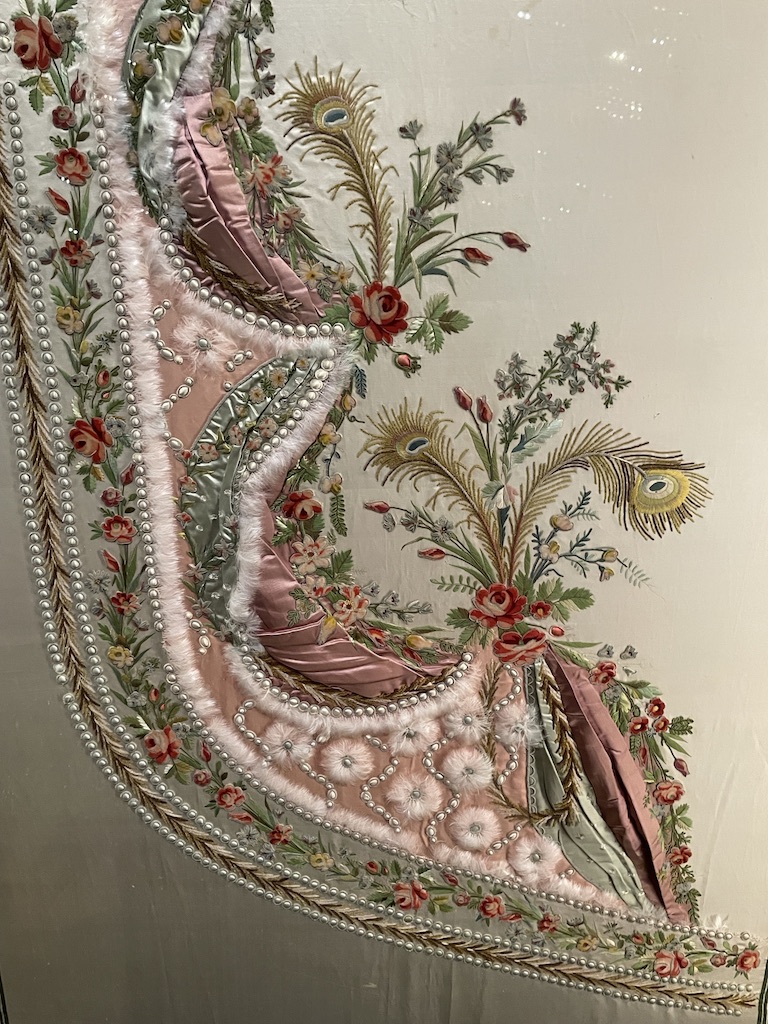
The jewels and the shoe (above) were known to have been worn by Marie Antoinette and the embroidery was, apparently, a sample of an over-dress which a couturier would have presented to her for a potential gown. It’s very fitting that this show has been sponsored by Manolo Blahnik.
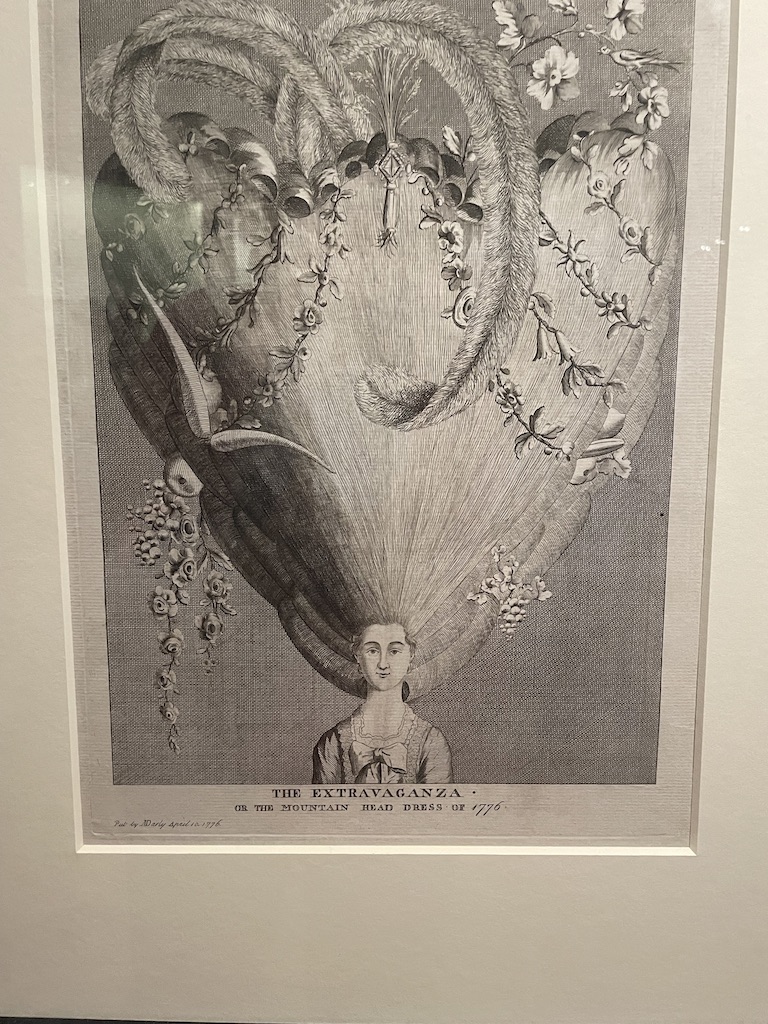
Anyone who watched Bridgerton – the total fantasy version of Regency Britain – will recognise the extreme wigs and hair dos. Clearly things reach heights (literally) of fantasy in the court of Marie Antoinette as hair was teased ever upwards and adorned with fantastical decoration.
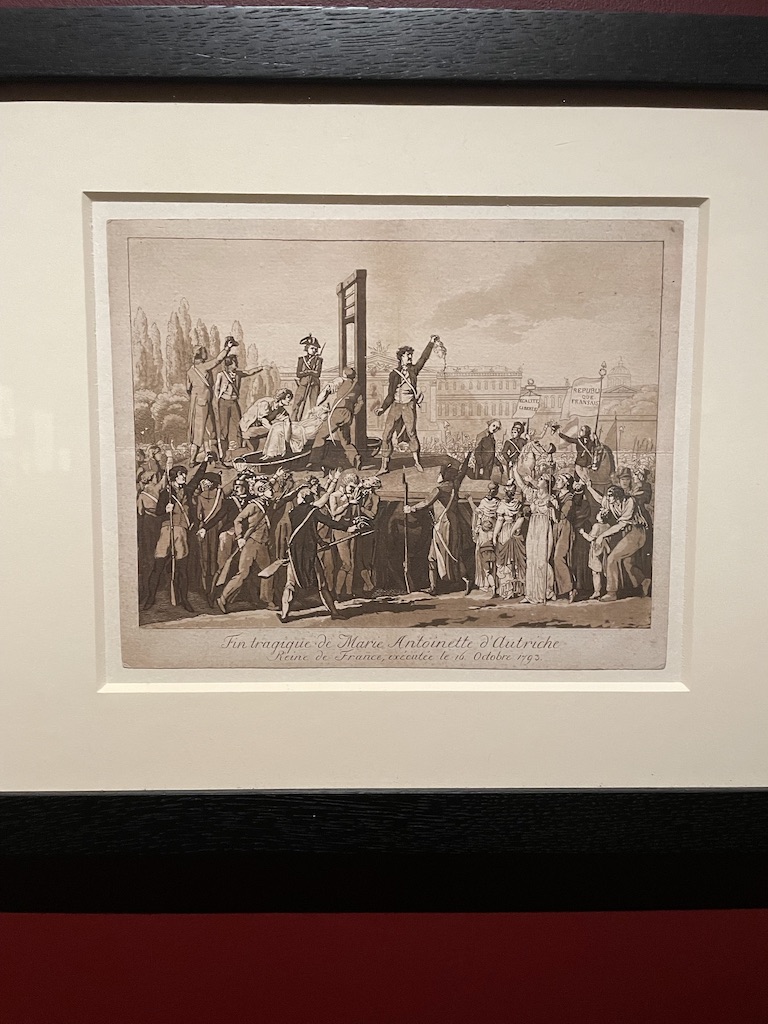
Queen Marie Antoinette’s reign ended badly with the brutal blow of the guillotine in 1793. There’s this very graphic drawing of the crowd cheering as the decapitated queen’s head is held aloft by the executioner. And the death mask, we are told, was taken soon after her death by Madame Tussaud. It’s all such a brutal end and she was certainly not guilty of any crime other than representing an overblown, indulged and superfluous monarchy.
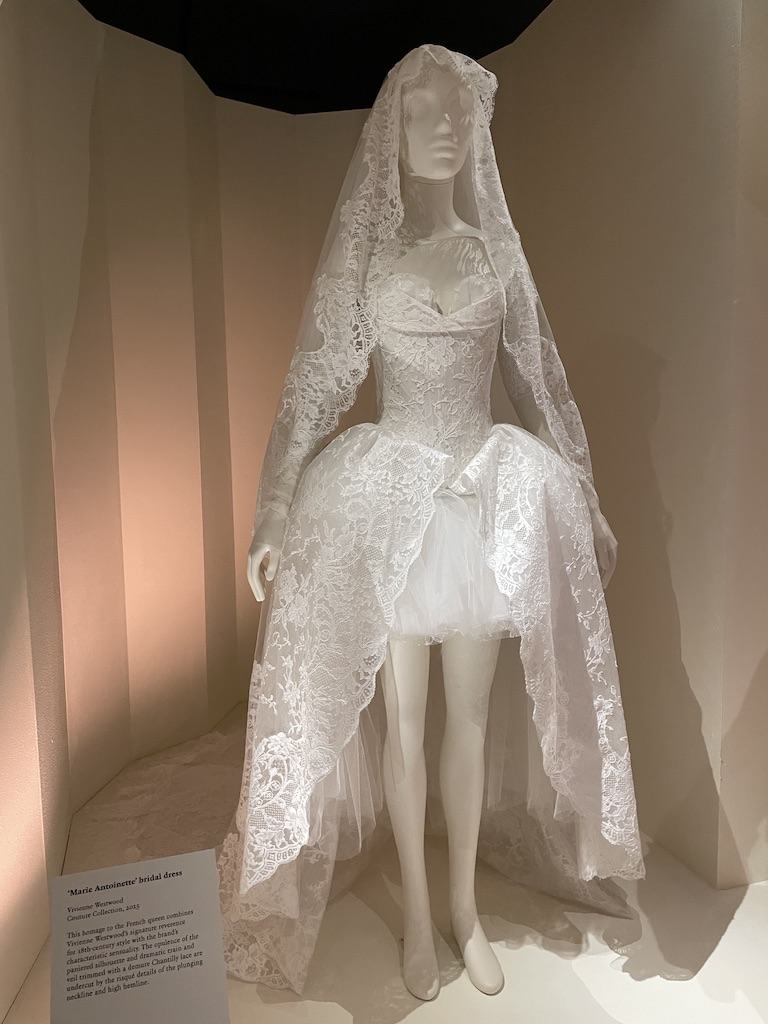
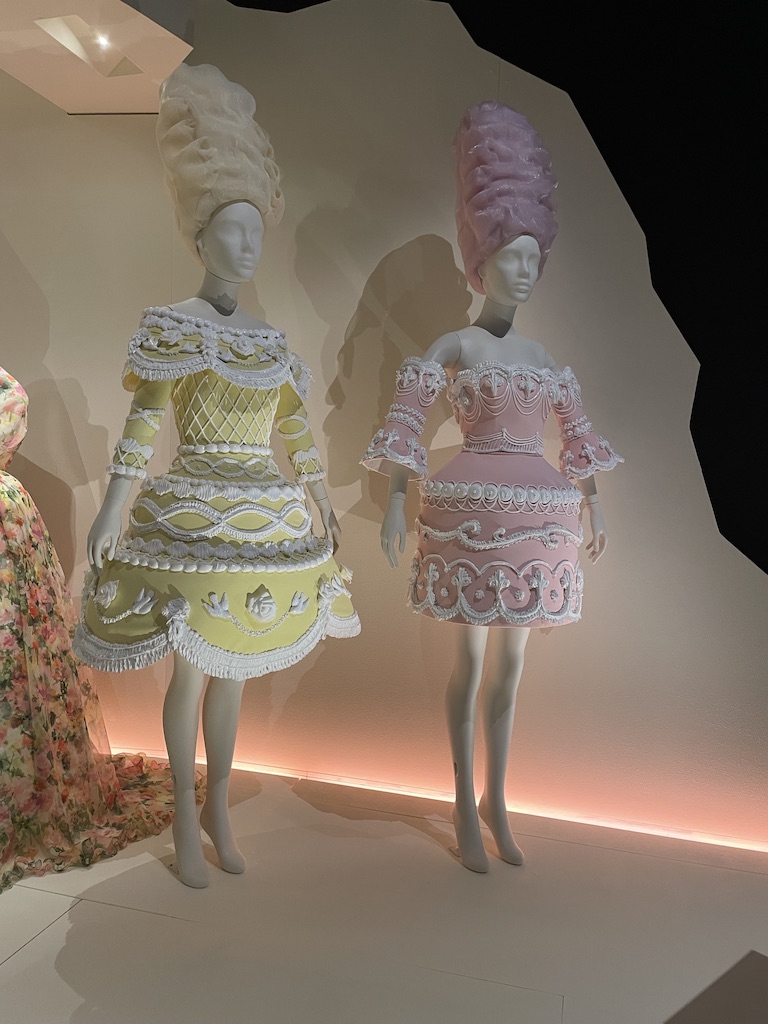
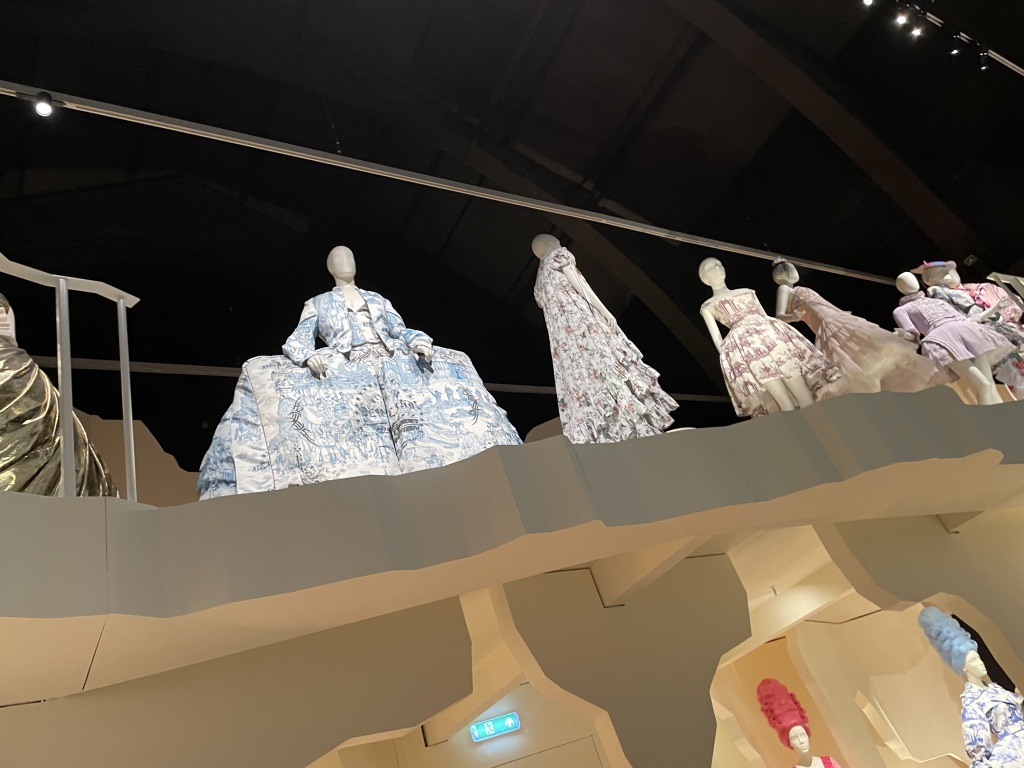
But her style lives on. It’s great to see how contemporary designers, in the years since her death, have found ways to represent her style using modern materials. I did love the Moschino wedding cake dresses designed by Jeremy Scott and Vivienne Westwood’s Marie Antoinette bridal dress.
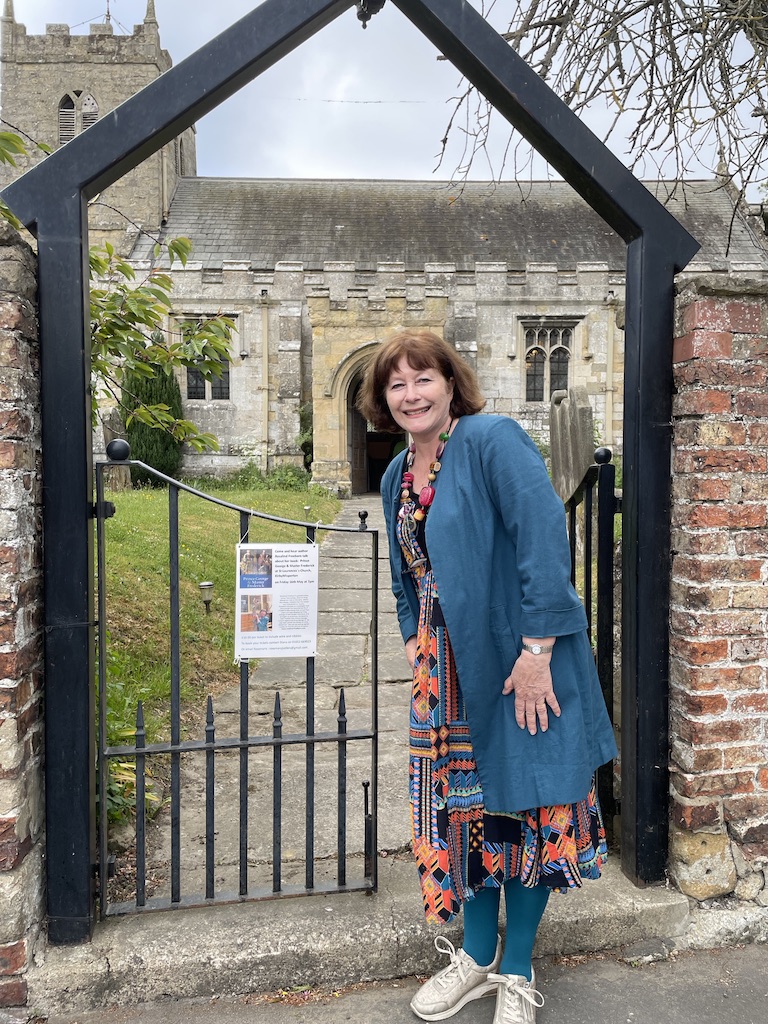
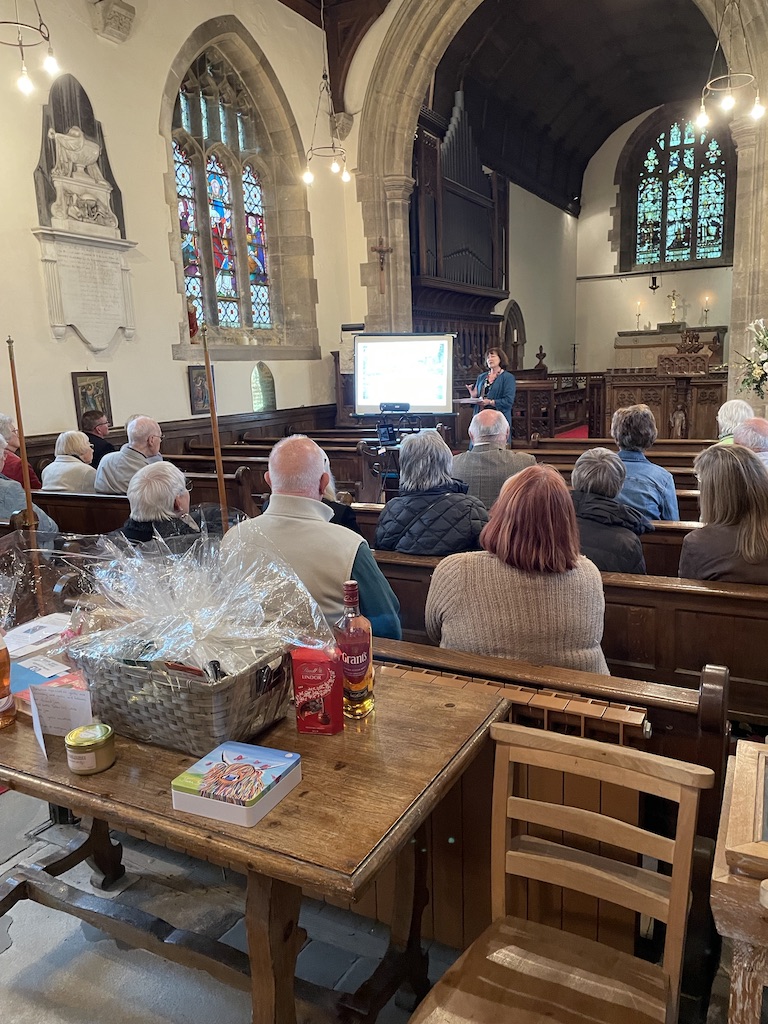
Having published my debut novel, Prince George & Master Frederick on 30th January with Alliance Publishing Press this year I’ve enjoyed a whirlwind of radio interviews, features in papers and magazines and history blogs. But, best of all, I’ve been invited to give talks to interested audiences. Possibly the most interested audience I could hope for, gathered in St Laurence’s Church in the village of Kirby Misperton, north Yorkshire on 16th May to hear my talk about the book.
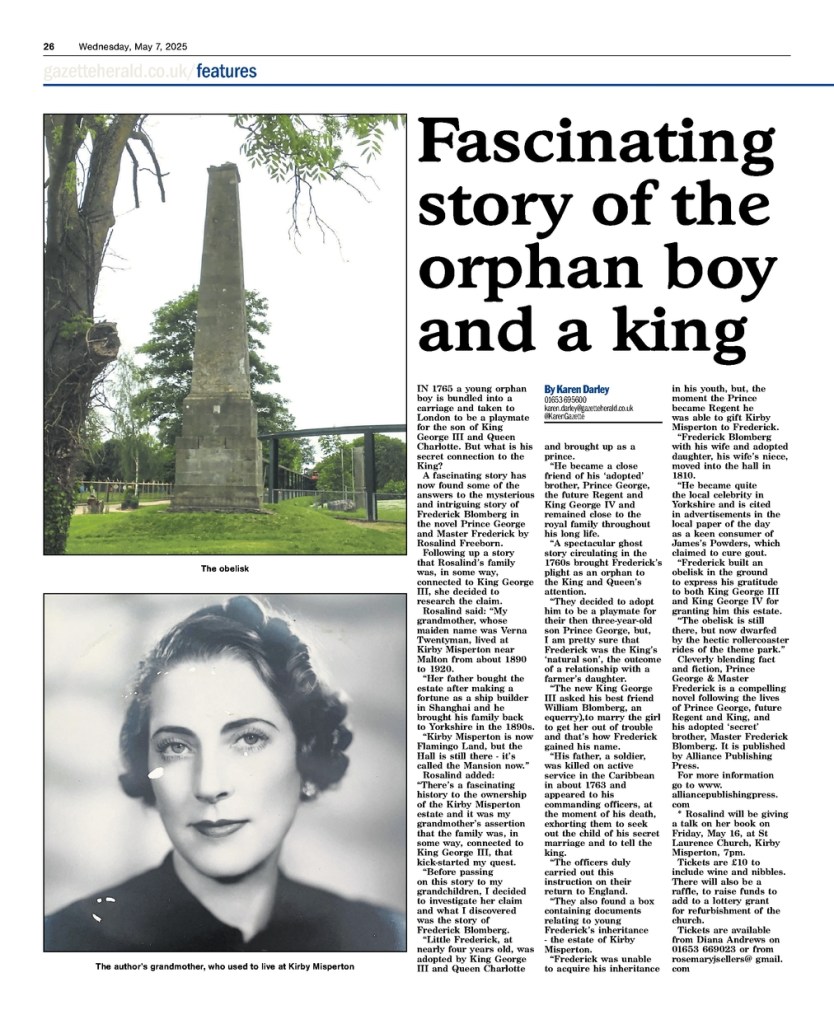
Kirby Misperton is a particularly important location for me, personally, and in relation to the book. My grandmother, Verna Twentyman, grew up in the Hall at Kirby Misperton. As a child I listened to her story about our family’s supposed royal connection. She told me: “King George III loved the countryside, and when he was a young man he came upon a farm in Kent, fell in love with a beautiful farmer’s daughter and there was a baby. To prevent a scandal for the young monarch, the king’s best friend and equerry, Major William Blomberg, married the mother and gave the baby a name.”
It was a very slender story but enough to pique my interest and it stayed with me long after she had died. I was about to tell my own grandchildren her story when I paused and decided to research her claim. Well, it turns out it was all true. The ‘accidental’ child of King George III was indeed called Frederick Blomberg. His mother died and his father was killed in action. When word of his orphaned state reached King George III and Queen Charlotte they decided to adopt Frederick. They already had two small sons and a third on the way. So, from the age of four Frederick was brought up within the royal household at Richmond Lodge and became best friends with his half-brother, Prince George, the future regent and King George IV.
I was thrilled when the local paper, the Malton Gazette and Herald, gave it a front cover mention and double page spread in anticipation of my visit.
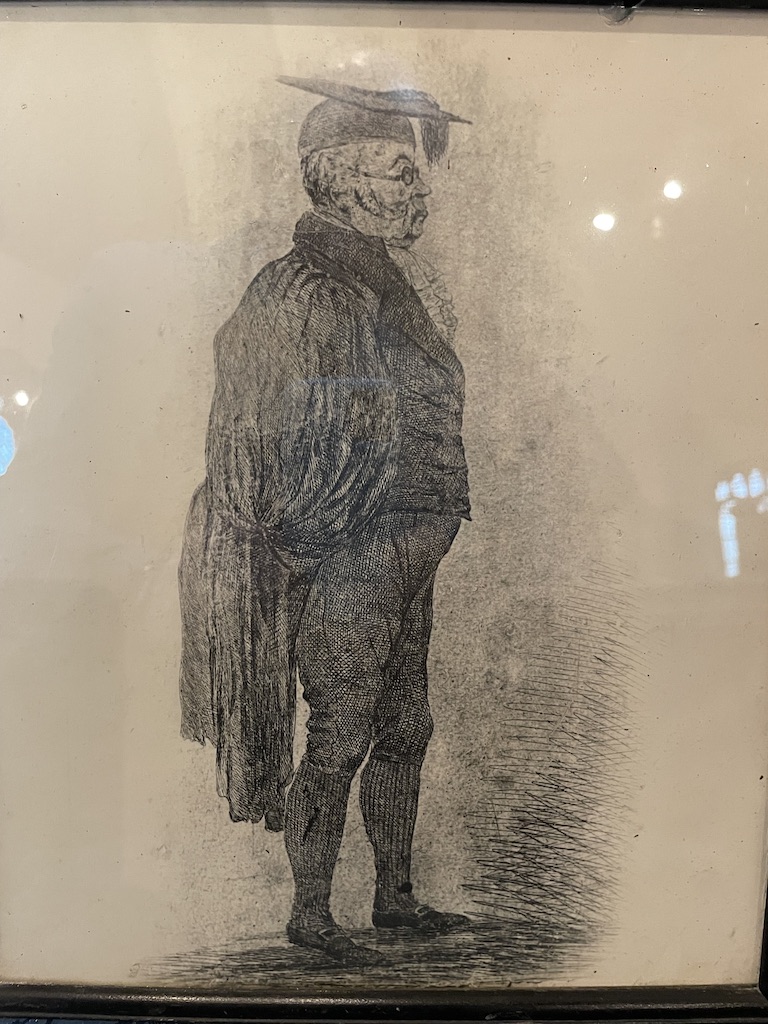
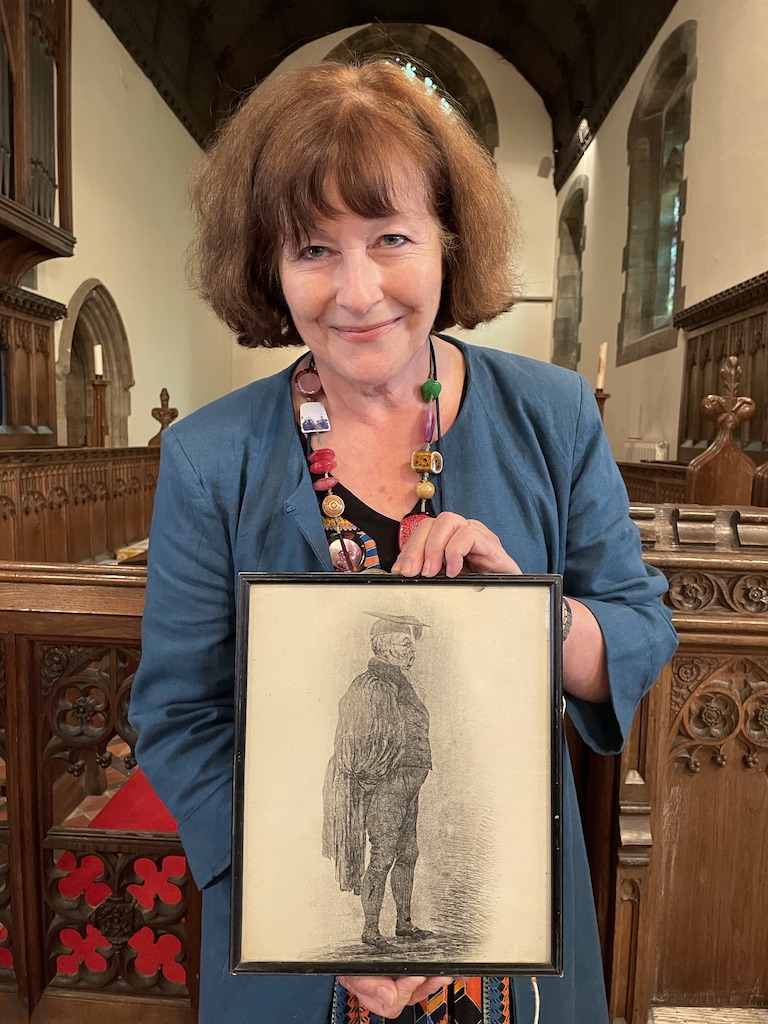
There was a great turnout for the talk on 16th May but, for me, the most exciting part of the evening was being shown a picture of Frederick Blomberg as an adult. Apparently this image had been hanging on the vestry wall for years and no body knew who it was or had taken it down to examine the back. On the reverse of the rather witty depiction of an academic in gown and mortarboard was an account of Frederick Blomberg’s life and a copy of his signature.
It’s quite a caricature image of the illustrious clergyman who had lived at Kirby Misperton. All through his youth Frederick had hoped to inherit this estate in Yorkshire but proving his claim was very hard for him.
As he grew up, it became clear that Frederick needed a profession. So King George III sent him to Cambridge University to study Divinity, he was ordained and became a clergyman. The king then granted him several lucrative livings (parishes where he could gain an income and have a rectory or vicarage to live in). However, he had to wait until his half-brother, Prince George, became Prince Regent in 1810 and was able to finally grant him the Kirby Misperton estate. So, in 1811, Frederick Blomberg became the owner of the estate and was known as Baron Blomberg. He also took services in St Laurence’s Church and became quite the local celebrity. He built an obelisk in the grounds with a plaque which says ‘Thank you’ to King George III and Prince George, the Prince Regent, for granting him this land, ‘long estranged’.
While researching the book I had seen images of Frederick as a child, but never as an adult. Imagine my excitement at finally seeing a sketch of him, albeit dressed in academic robes rather than depicted as a clergyman.
You can read more about Prince George & Master Frederick in my novel. It’s available in print form, via Amazon, on Kindle and on Audible. Or you can order it through your local bookshop. Please do let me know if you enjoy reading my book. Or order a signed copy directly from my author website And if, you are interested in inviting me to give a talk about my book please do get in touch. May 2025
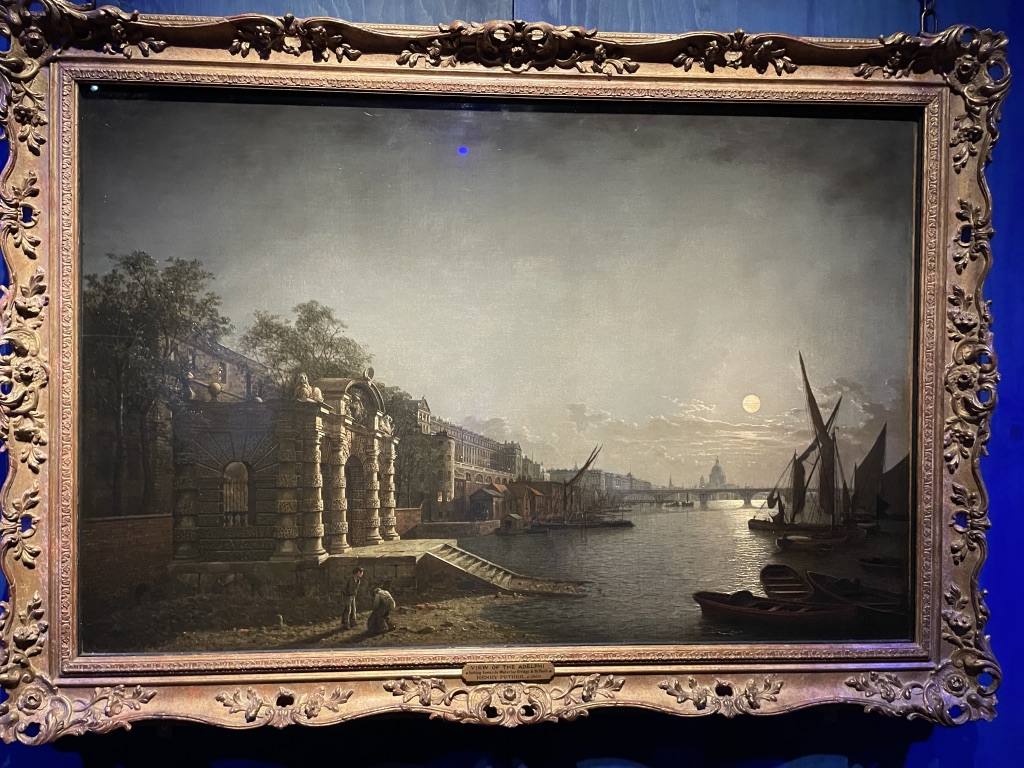
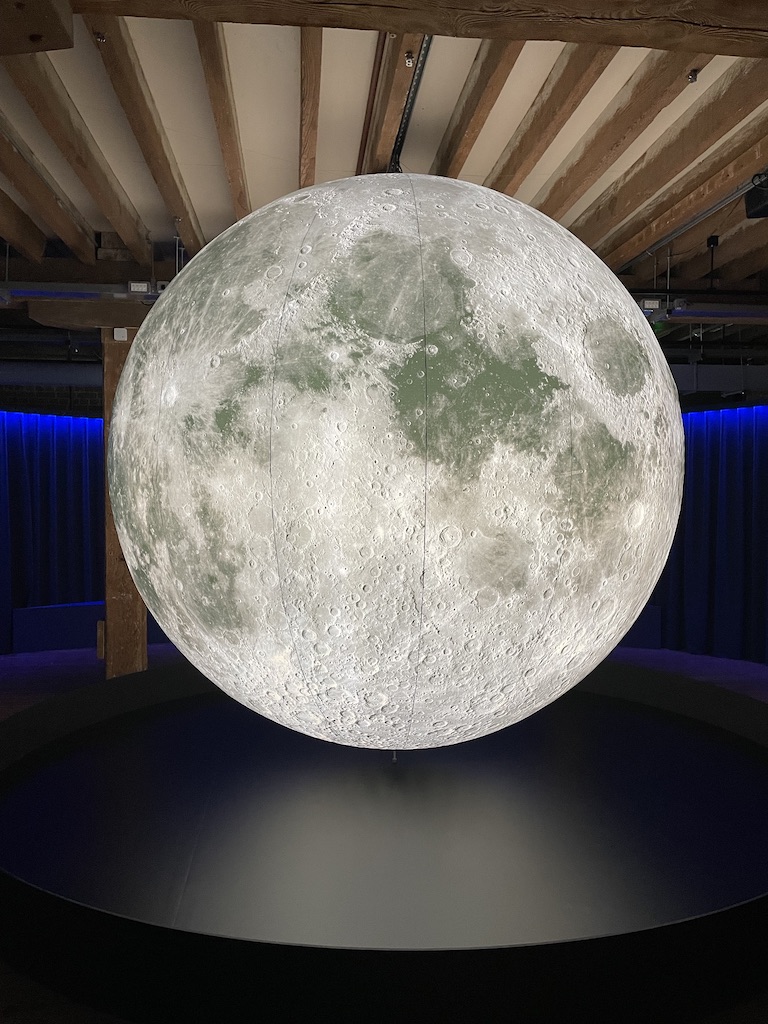
The exhibition opens with this spectacular painting by Henry Pether (around 1850) featuring mudlarkers searching the foreshore near York Water Gate, the Strand, by moonlight. Anyone living near the river will be aware of the constant rise and fall of the tide which is ordained by the moon. And there’s a fabulous sculpture of The Moon which you can circle, and peer at the extraordinary pitted surface.
You need a licence to be a mudlarker, along with sturdy shoes, waterproof clothes and a beady eye to spot potential treasure with in the mud of the river. It’s astonishing that every low tide will reveal items dropped, lost or hidden in the Thames. These pieces vary from the really ancient, pre-historic tools and items, jewels and coins, up to contemporary objects thought lost for ever.
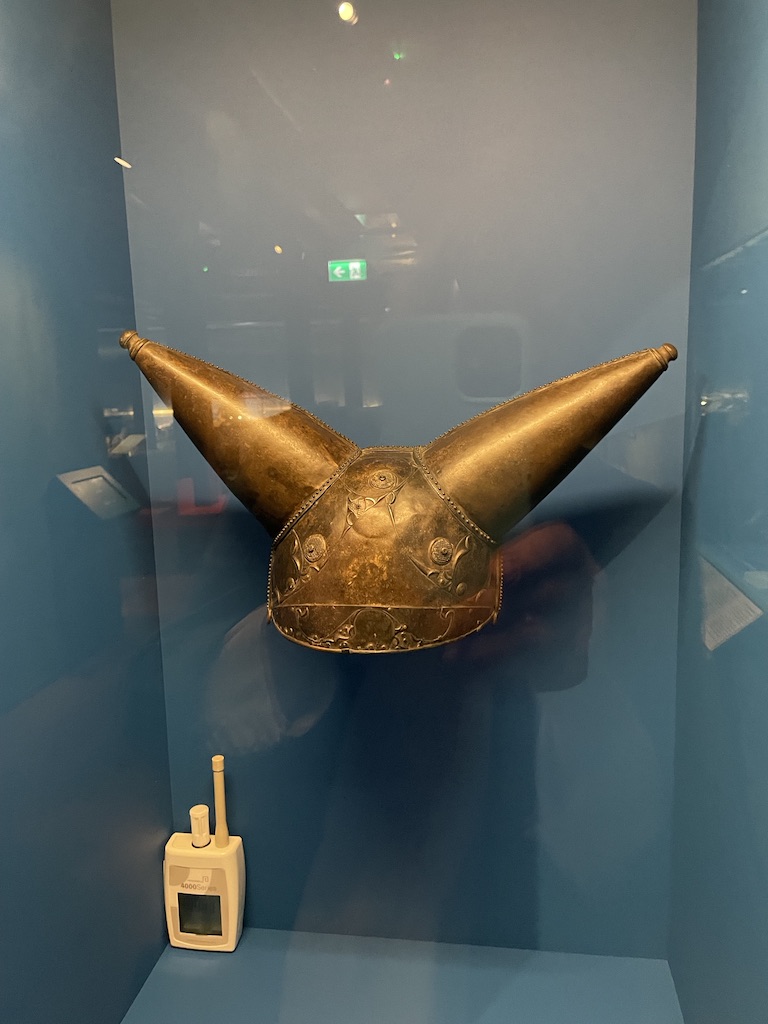
Above is a selection of figurines showing different gods and godesses from Roman times. They might have been offerings – the Romans revered water – or accidentally dropped into the river. And on the right is The Waterloo Helmet from 150 BCE. It’s the only Iron Age helmet found in southern England and the only one with horns ever found in Europe.
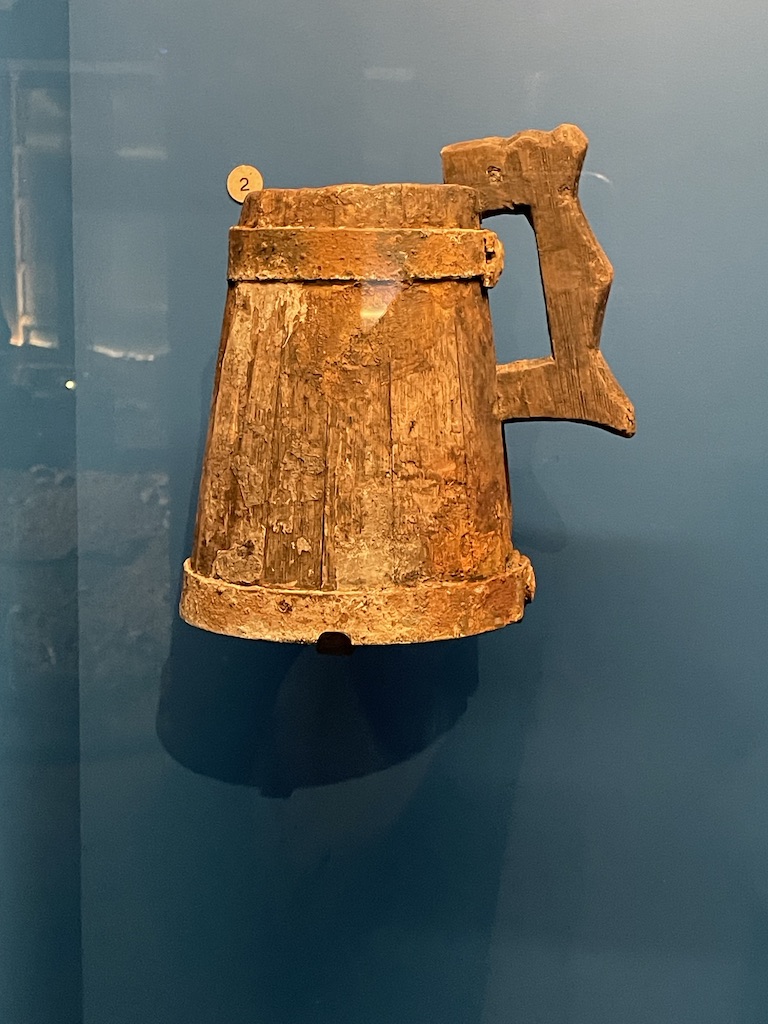
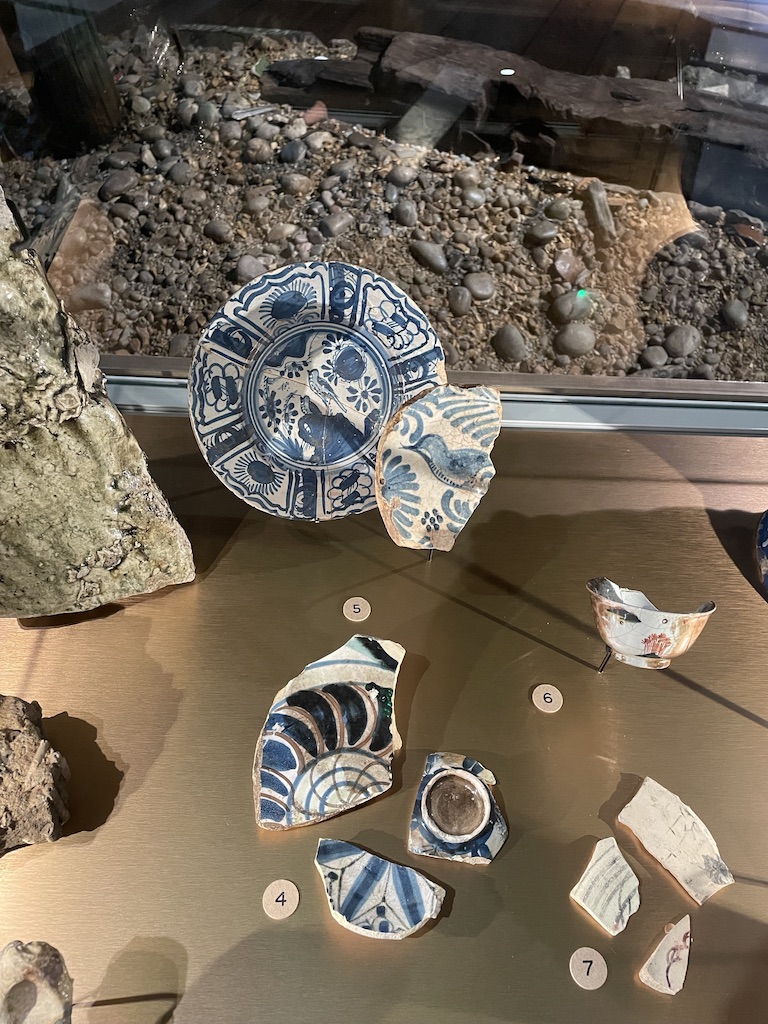
I do love seeing the everyday items which have been fished out. This wooden tankard must have been a thrilling find. It holds three pints – great for a very thirsty person, most likely a sailor. And it’s great to see these Delftware pots and dishes, even in fragments, giving you an idea of the household crockery in use from the mid 1500s to the 1800s.
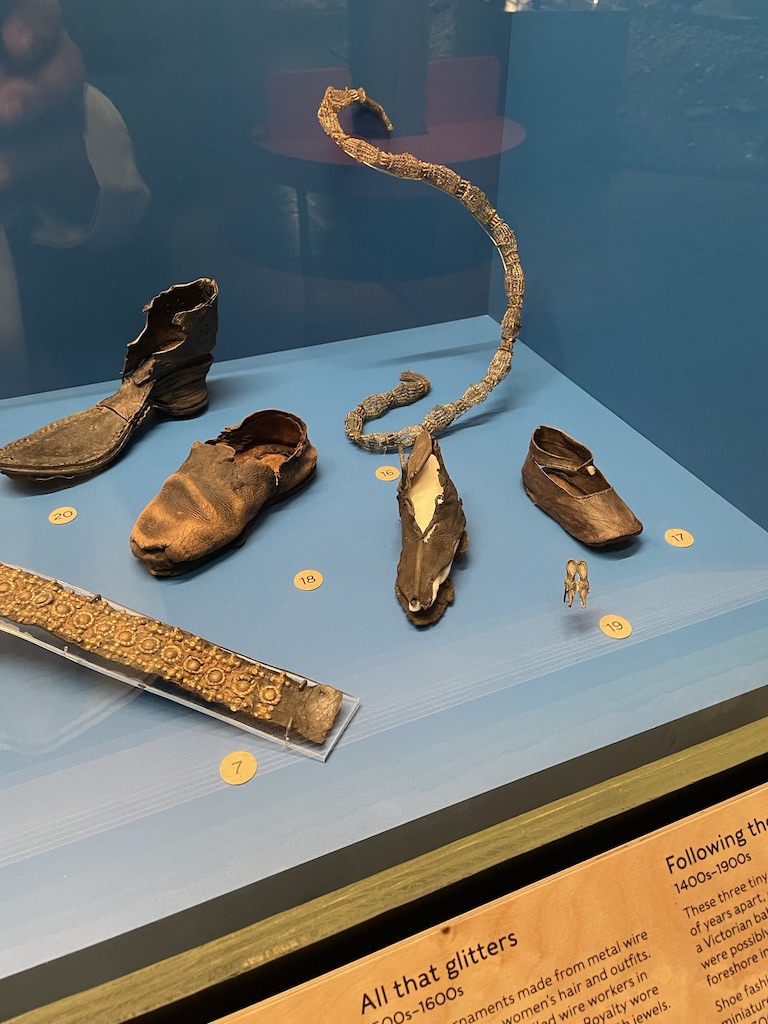
There’s something very touching about seeing children’s shoes. They have survived the centuries because the mud of the Thames is ‘anaerobic’ meaning it preserves the material from oxygen and it does not decay.
Mudlarking has been going on for centuries. For many early mudlarkers it was the coal and wood which they wanted, rather than the ‘treasure’.
The layout of the exhibition is fascinating. A very eye-catching recreation of the Thames foreshore has been recreated throughout, giving viewers an idea of how complicated it can be to sift through the detritus of the river and use just your eyes and experience to spot and uncover something exciting.
It’s a very stimulating and moving show. And impressive that so many of the items were discovered by dedicated mudlarkers and donated to the Museum of London so that they can be viewed and admired but visitors.
The exhibition at the London Museum Docklands is on until 1st March 2026. Well worth adding to your ‘must-see’ list!
I’ve always loved book launches but this one was the best ever! It’s an amazing feeling to publish your debut novel. But quite daunting to stand up in front of a large audience and explain how researching a family story turned out to be so fascinating that I simply had to write the story of Frederick Blomberg, the secret son of King George III. Having been introduced to the gathered crowds by my publisher, Janet Weitz of Alliance Publishing Press, I stood up and gave a speech.
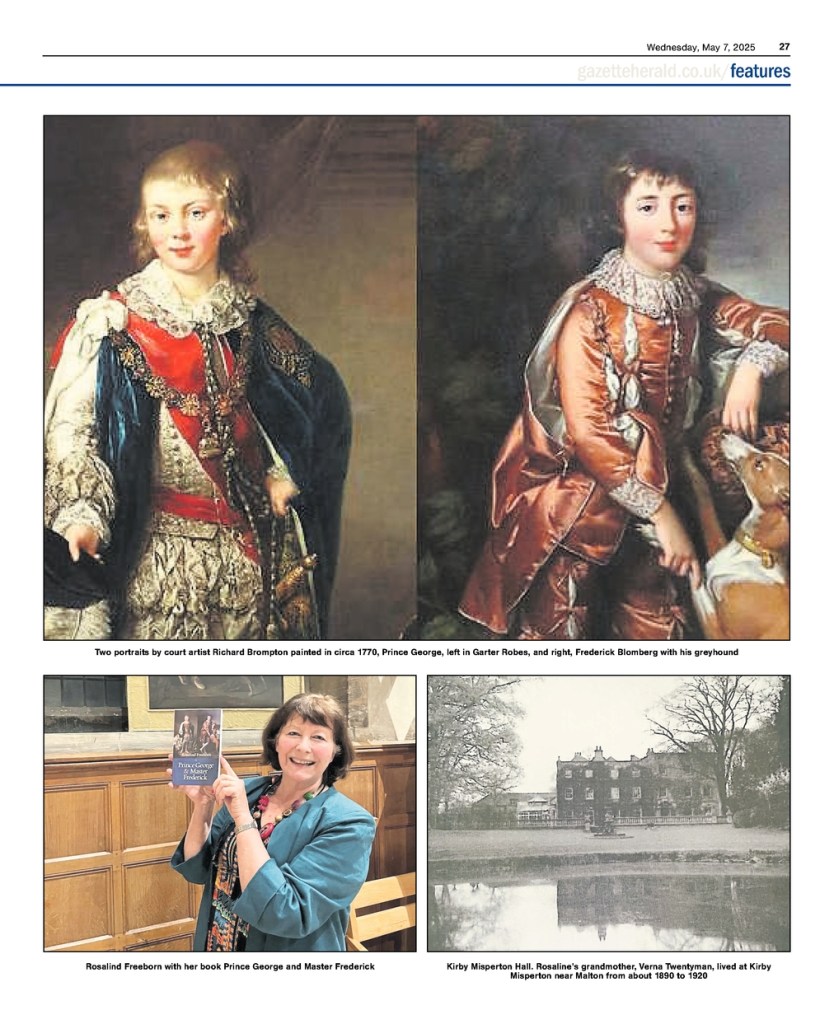
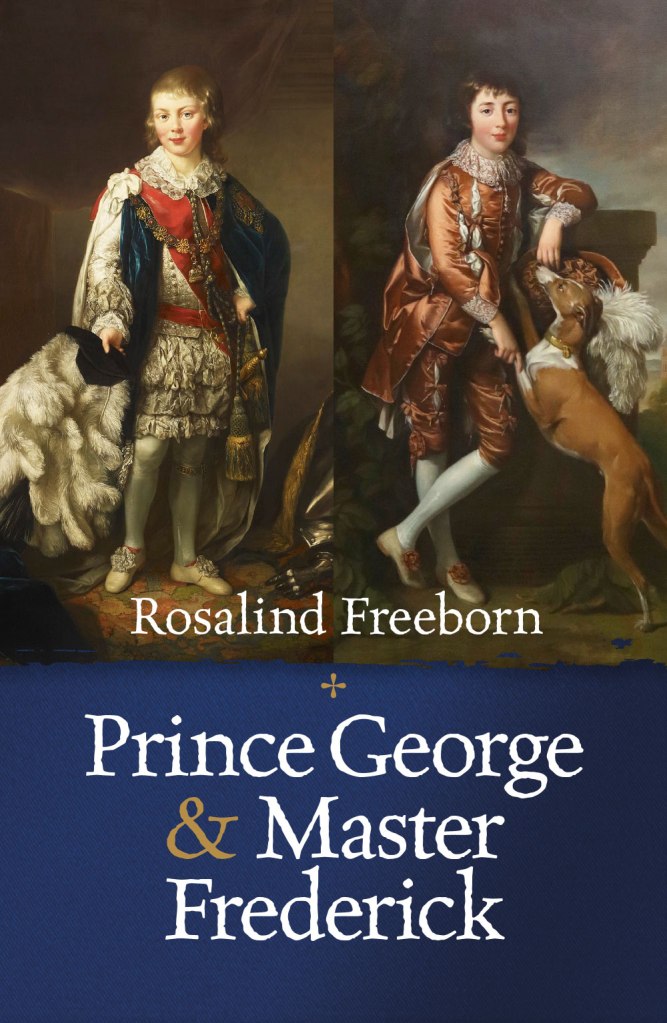
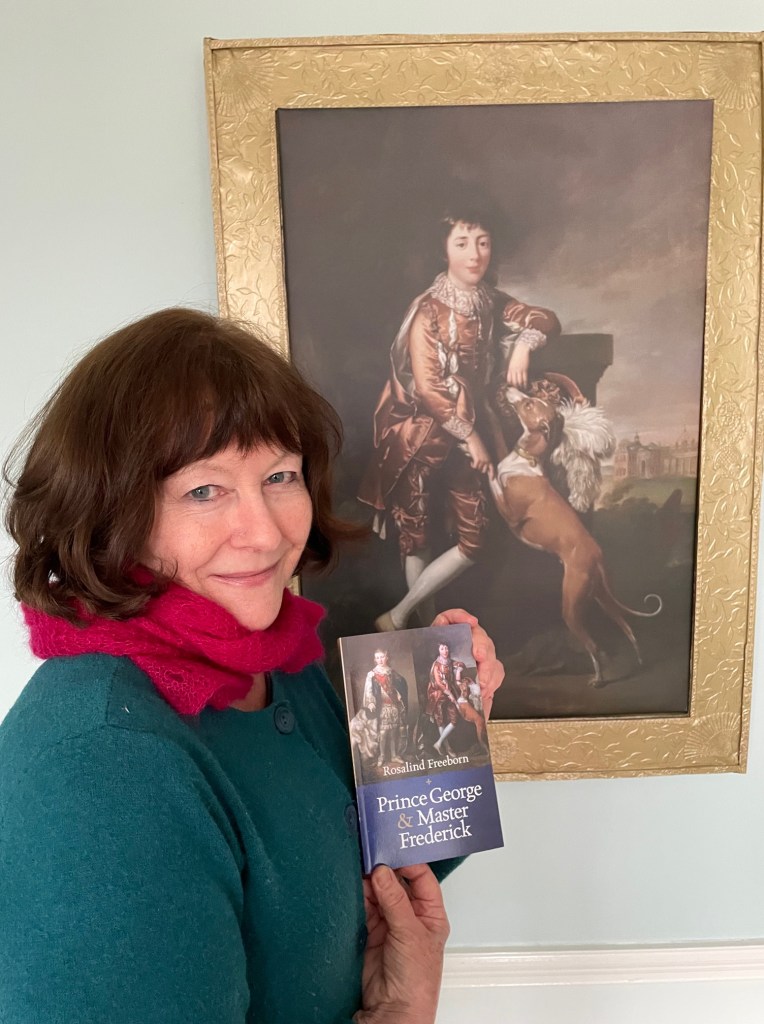
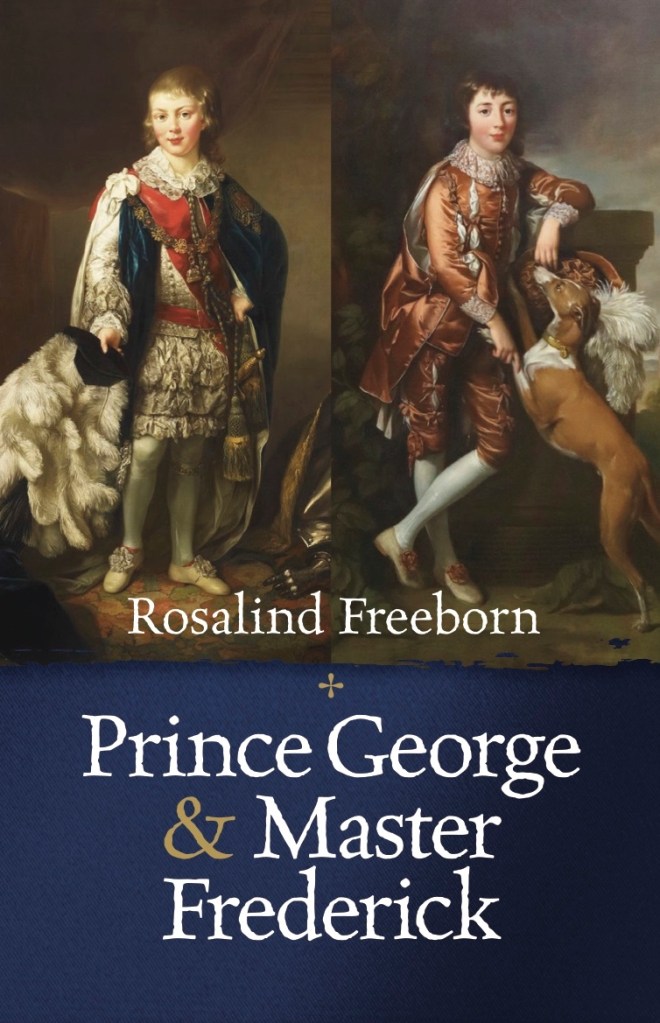
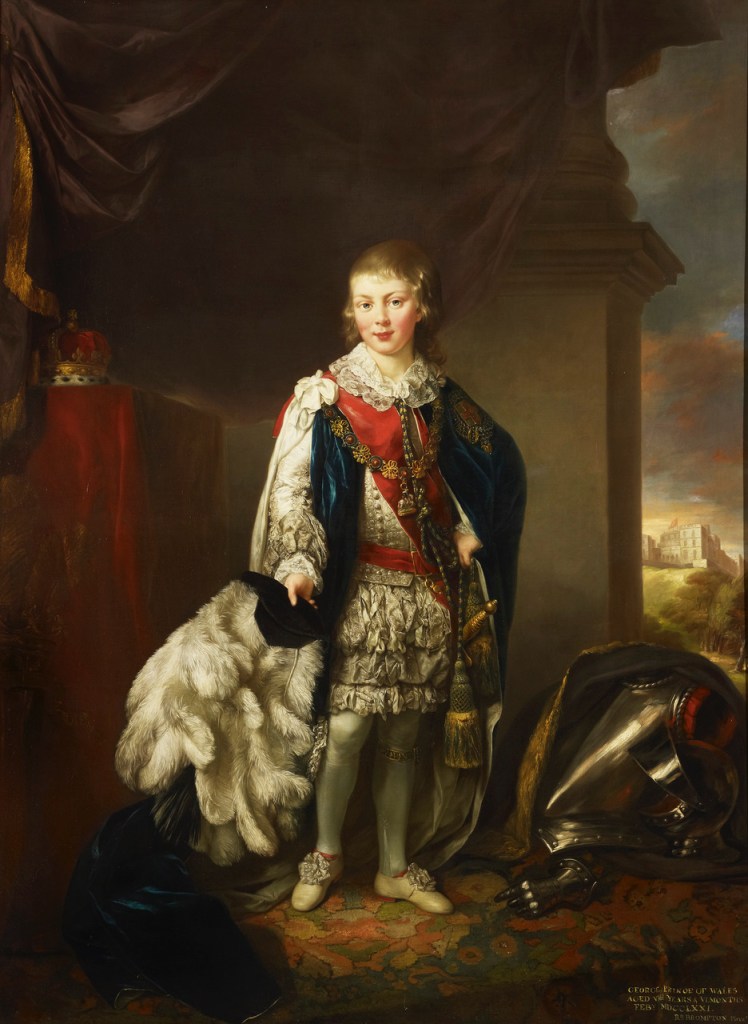
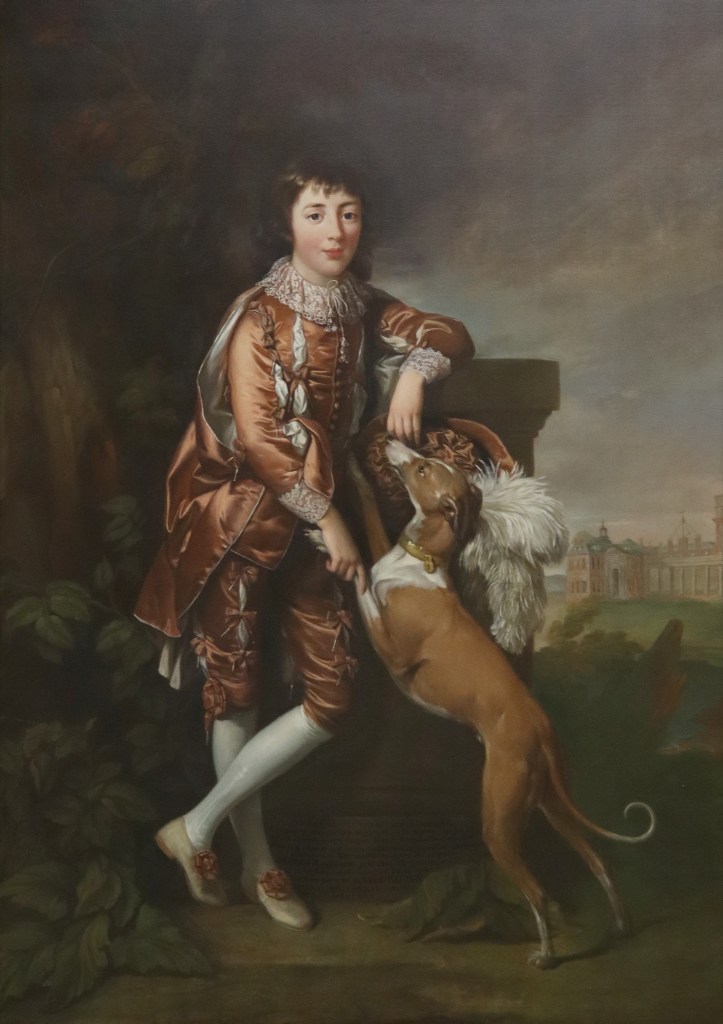
In this picture I’m standing in front of a print of a portrait of Master Frederick Blomberg, painted by court artist Richard Brompton in about 1770. The painting was commissioned by Queen Charlotte and it’s a companion piece to two other portraits of her royal sons: Prince George, Prince of Wales and Prince Frederick, Duke of York which now hang in the 1844 Room at Buckingham Palace. I was delighted to put this painting of Prince George in Garter robes next to his ‘adopted’ brother, Frederick Blomberg on the front cover of my book.
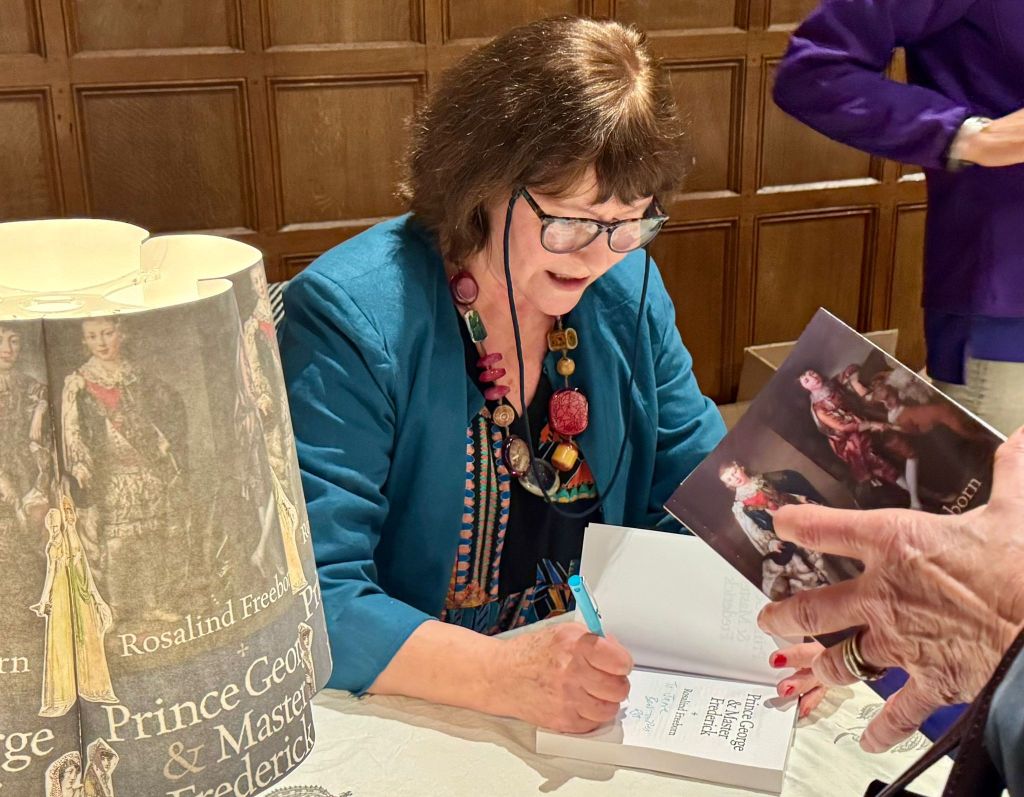
And what fun it was to welcome so many lovely friends to the book launch, sign books and chat. And for all those who could not be there, you can order a signed copy through my author website: http://www.rosalind-freeborn.com Otherwise, you can buy a copy through Amazon, (on Kindle, print or Audible) and through bookshops.
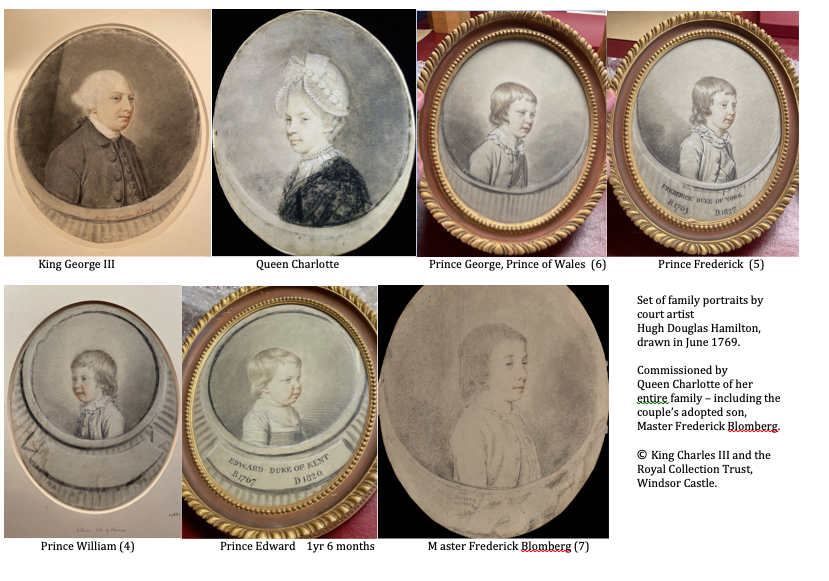
In my talk I showed a display of portraits commissioned by Queen Charlotte in 1769 of her family, drawn as a set by the artist Hugh Douglas Hamilton. The portrait of Frederick was probably given to Frederick Blomberg by Prince George and ended up at his home in Yorkshire, Kirby Misperton. After Blomberg died in 1847 the little portrait remained on the wall, through two subsequent owners, until my great-grandfather bought the estate and my grandmother grew up there. She used to look at the picture of Frederick on the wall of her home and told me that the boy was the son of King George III (wrong side of the blanket, as she put it). That piqued my interest but I did nothing about it for decades. Then, about five years ago, I thought I’d investigate this claim and find out more about Blomberg. Well, what I discovered was so fascinating that I was compelled to write this novel.
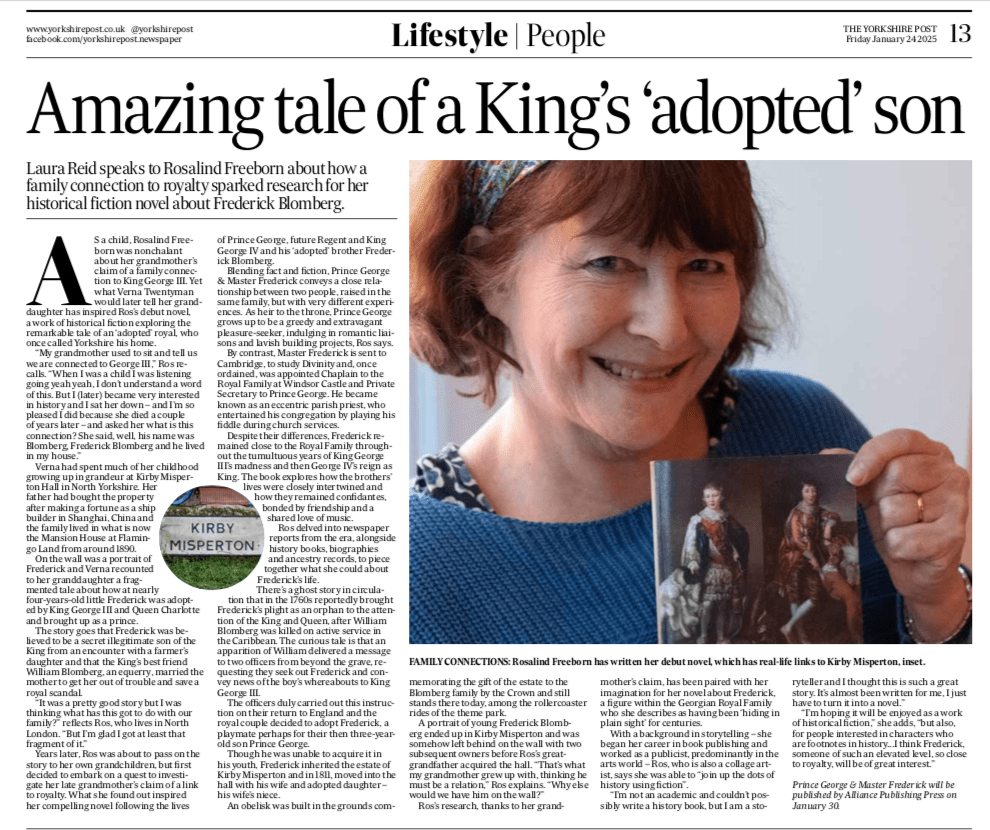
I’ve been so delighted with the quantity of publicity this book has attracted. Above is a feature which appeared in the Yorkshire Post. I’ve done radio and television interviews too. Yes, I feel very published!
Prince George & Master Frederick (by Rosalind Freeborn) will be published by Alliance Publishing Press on 30th January 2025. It will be available on Amazon and through bookshops. You can also buy it directly from me on my author website. The cost is £15 per copy (plus £5.00 postage in the UK) and I’ll send you a signed copy.
In 1765, Frederick Blomberg a four-year-old orphan, is bundled into a carriage with a woman he does not know and taken to the royal palace at Richmond to be a playmate for the three-year-old Prince George. But why have King George III and Queen Charlotte adopted this child and what is his secret connection to the king?
I was prompted to write this book after investigating a family story suggesting that there was a connection (on my mother’s side) with King George III. Researching this story opened up the most fascinating life-story of Frederick Blomberg. He’s a character who is occasionally referenced in history books and royal biographies but his story has never been told before. Yet, when you look at the portrait by court artist, Richard Brompton, which was commissioned by Queen Charlotte, it’s clear that he was an important child in the household.
Prince George & Master Frederick is a work of fiction but it is based on real events, charting the lives of real people with just a few characters added for dramatic impact.
The two portraits which appear on the book jacket are by Richard Brompton. They feature the same plinth as prop and both boys are wearing the same pom-pom shoes. The portrait of Prince George, wearing garter robes, features Windsor Castle in the background (the painting now hangs in the 1844 Room at Buckingham Palace). Frederick Blomberg, in a fabulous rust-coloured suit, with greyhound, features Buckingham House in the background. Buckingham House was later remodelled and became Buckingham Palace.
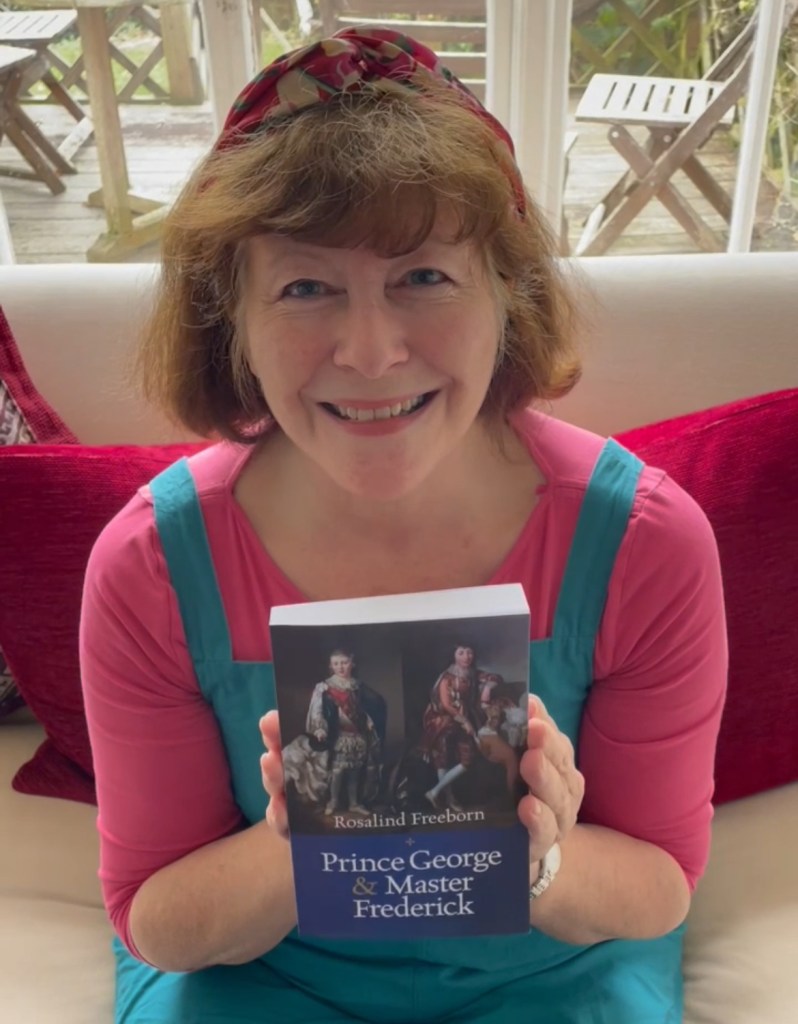
It’s very exciting to have some advance copies of the book. I look forward to the moment it is published on 30th January 2025.
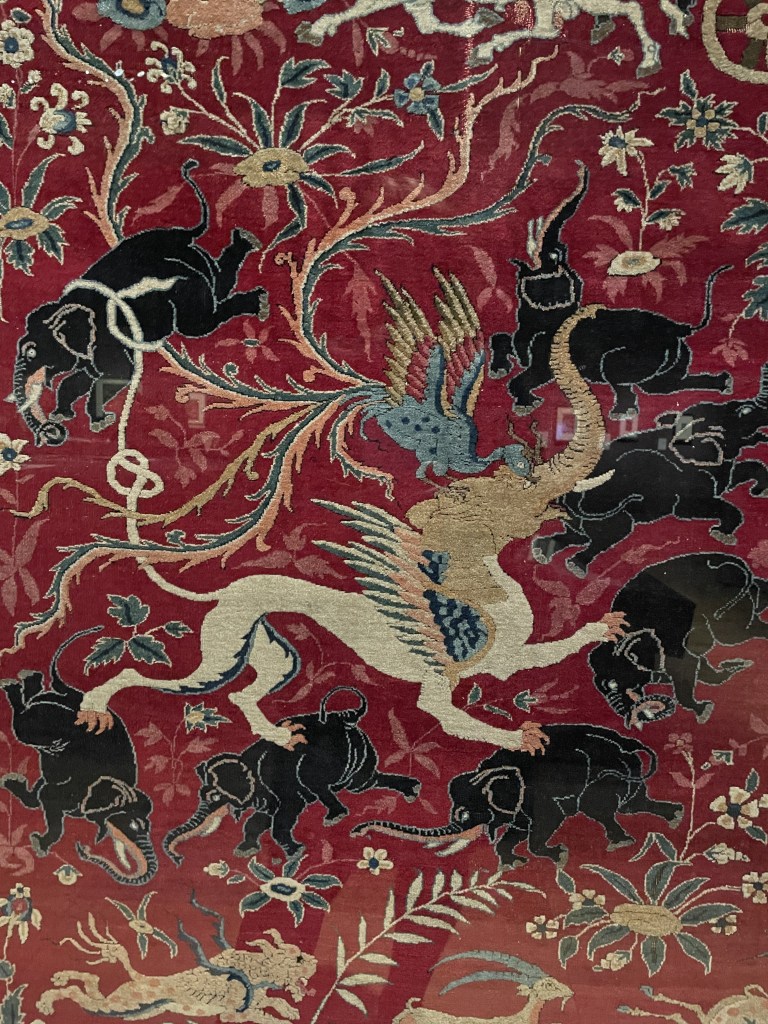
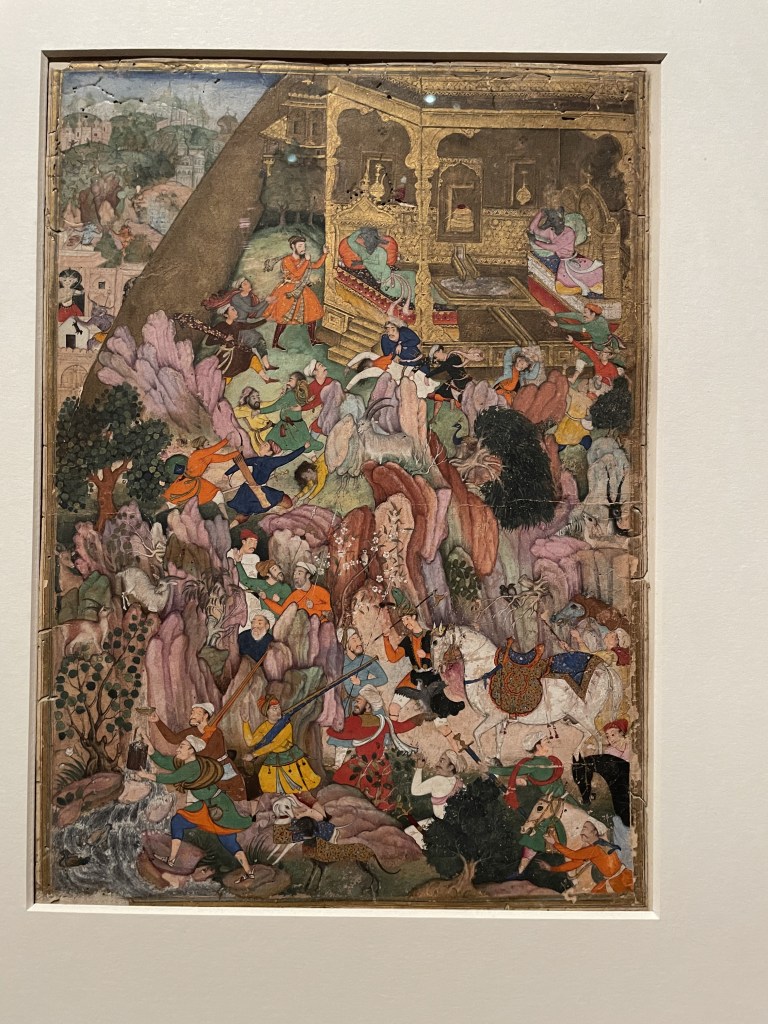
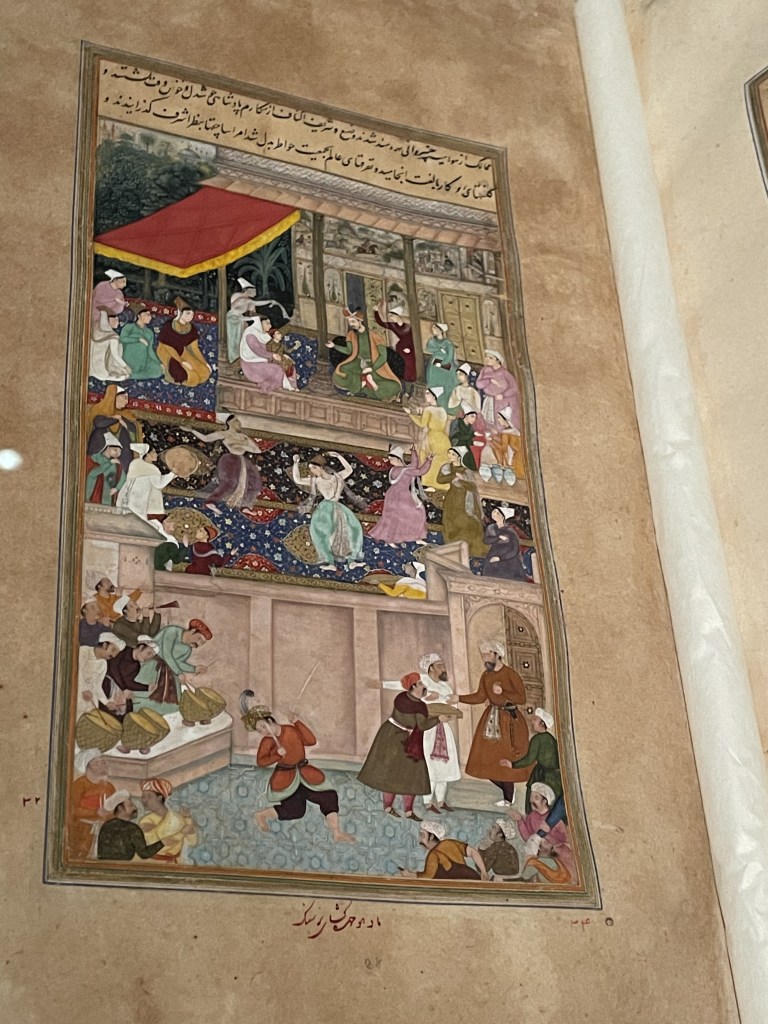
Before visiting this exhibition I had no idea that the Mughal dynasty was founded by a Central Asian ruler, Babur, in 1526 and lasted a hundred years. And in that time there was a spectacular flowering of artistry and creative excellence. The Mughal empire spanned India, Iran (Persia), Afghanistan, Gudjerat and Bangladesh. It’s so interesting to see how the art forms from these different countries and cultures merged. We regard them so separately these days but they all combined to create a beautiful Mughal aesthetic.
I did enjoy the narrative quality of the very intricate drawings and paintings. You get a terrific sense of life from these images – crowded with drama and people expressing politics, emotion and events.
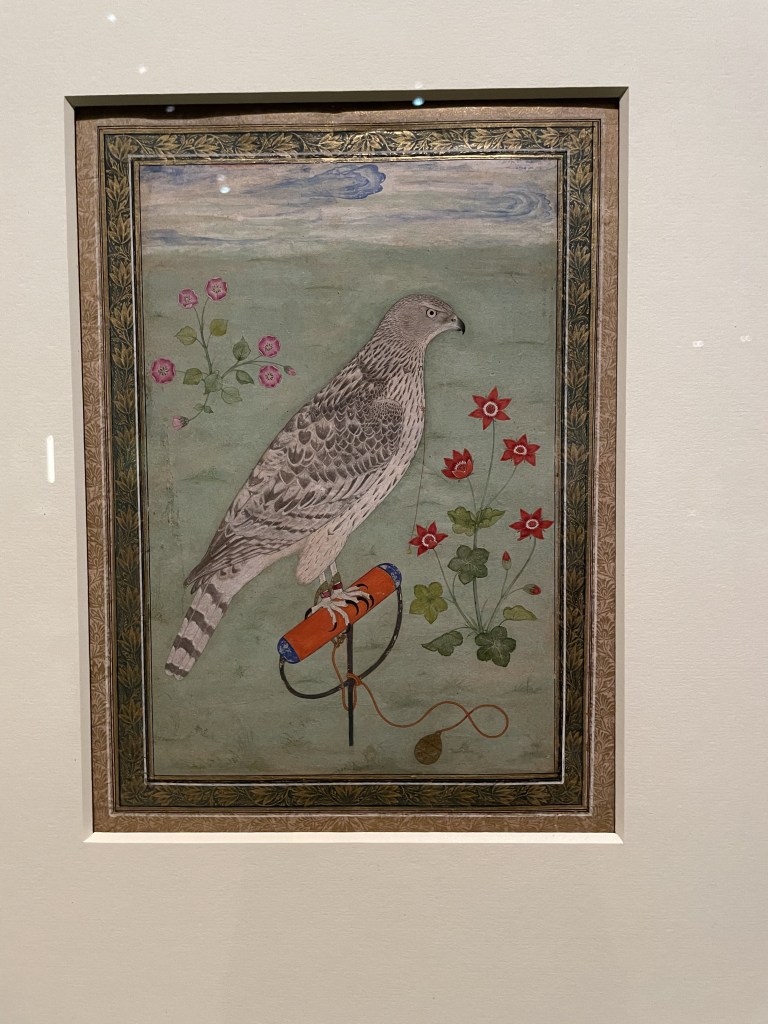
Such delicacy to the painting of this goshawk, made about 1650-1700. Falconry was a familiar sport right across Asia. These birds were a luxury item, often given by merchants to the emperor as gifts.
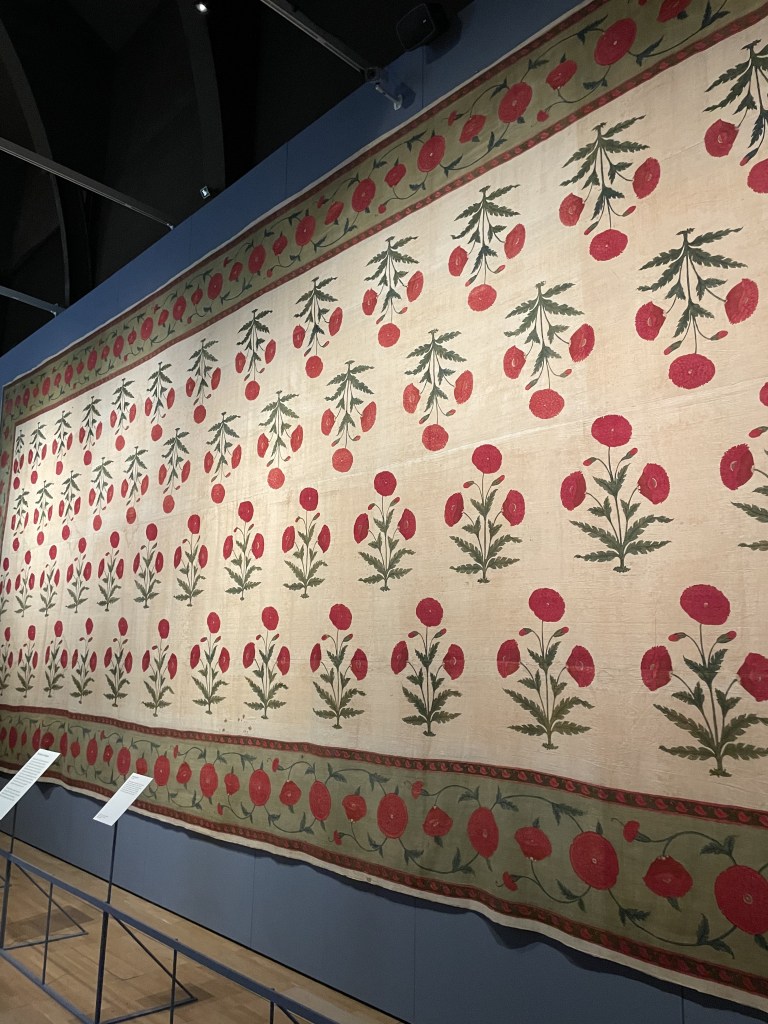
There were many examples of traditional carpet weaving, fabrics and hangings such as this poppy floorspread (celebrating the opium trade), made for a palace.
Very attractive and interesting exhibition which is open at the V&A until 5th May 2025
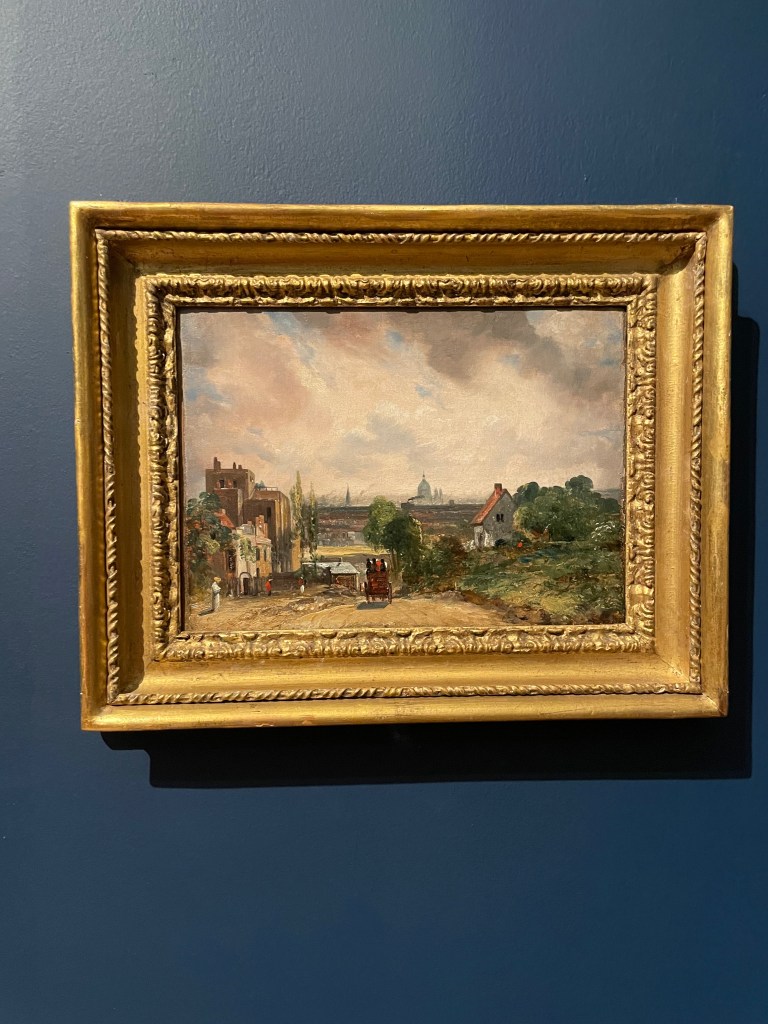
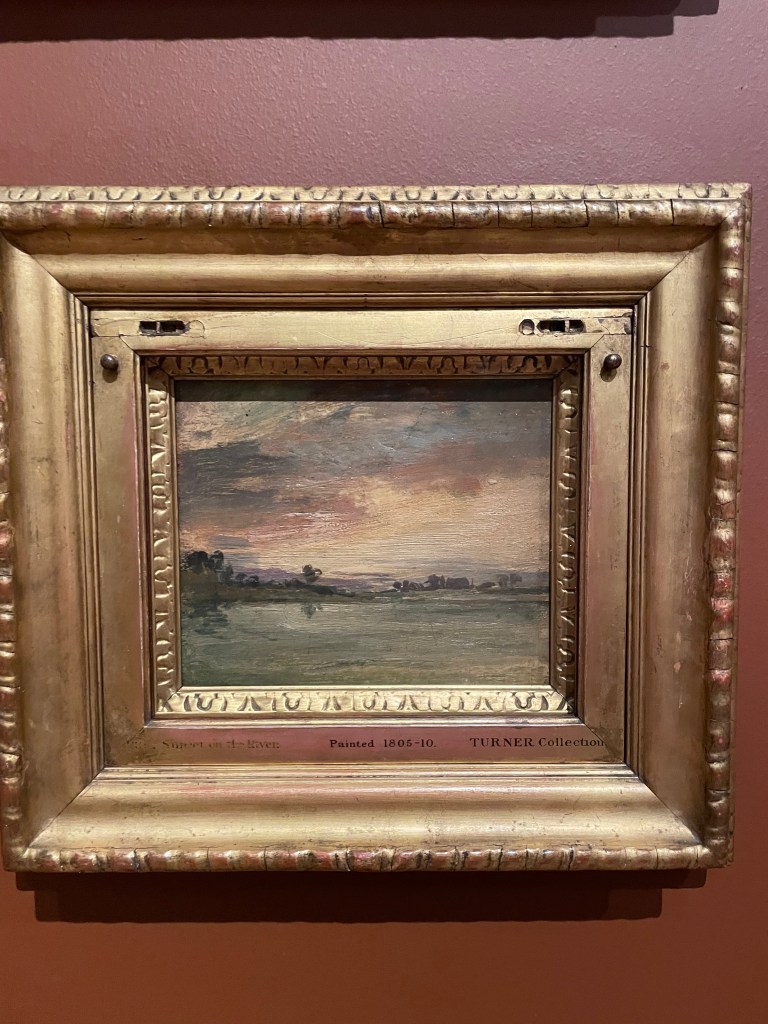
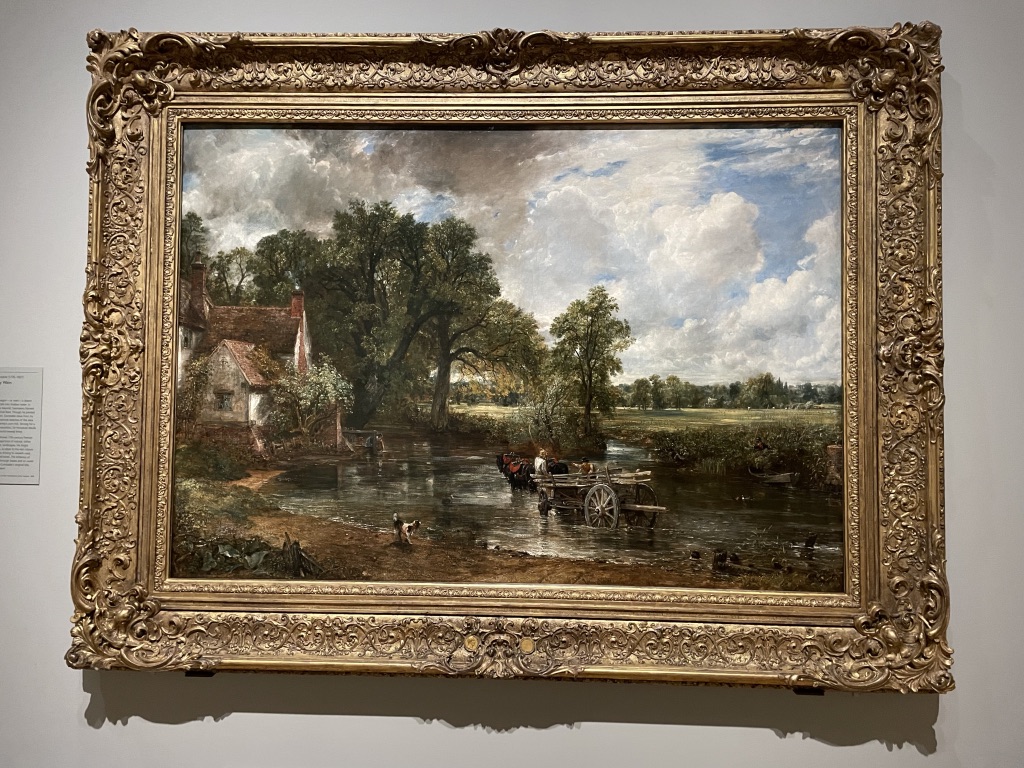
The Hay Wain is such a familiar image and conjures thoughts of ‘Merrie England’, the countryside fantasy of rural beauty, a simple life and the contented relationship between people who till the earth and the beauty of the fields where they work. At the press preview, listening to curator Christine Riding, it was fascinating to hear the context of the Hay Wain explained and then illustrated by a charming selection of complementary paintings, drawings, sketches and cartoons.
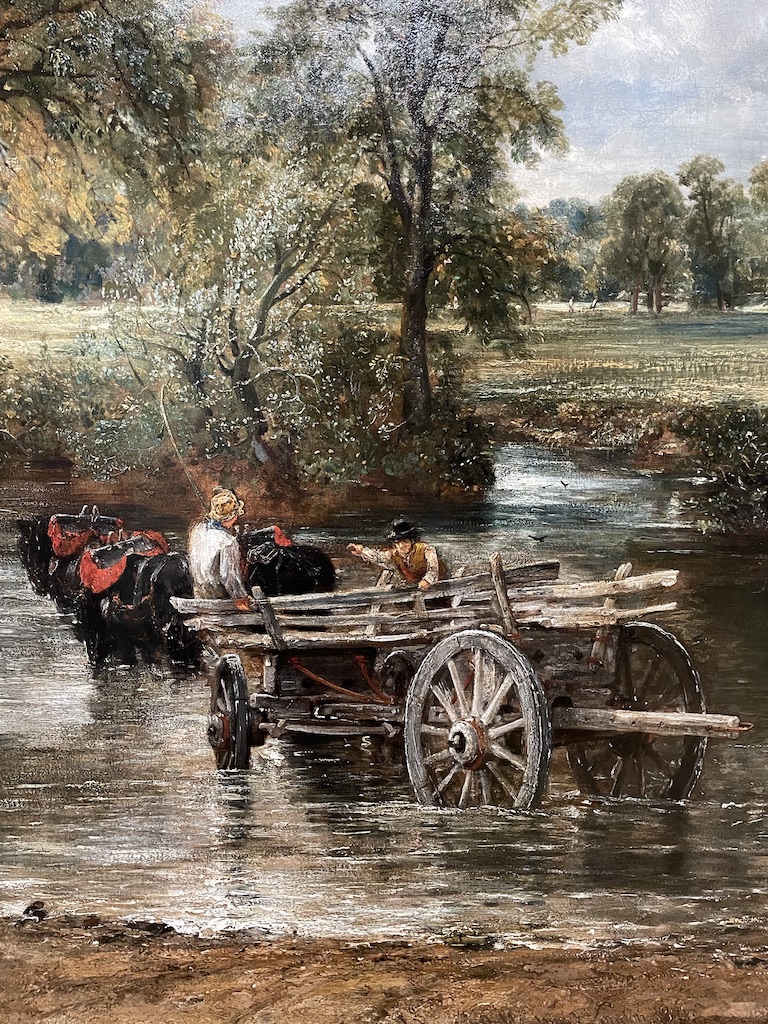
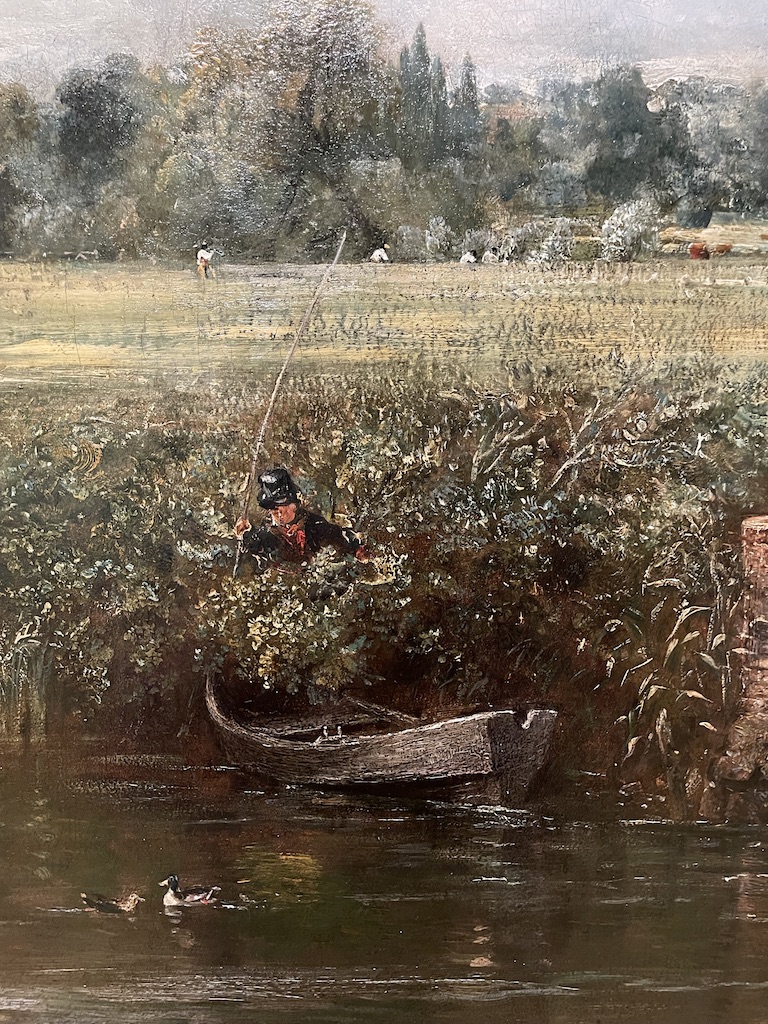
Took a couple of close-ups of the Hay Wain. It’s one of John Constable’s ‘six-footers’, a very large painting which was started in 1819 with the intention of grabbing the attention of collectors and fellow artists. Size does matter when you’re competing with other people to gain a reputation in the art work; this was an epic work, produced in his studio, but very much based on sketches and paintings made ‘en plein air’ in the Suffolk countryside Constable knew so well.
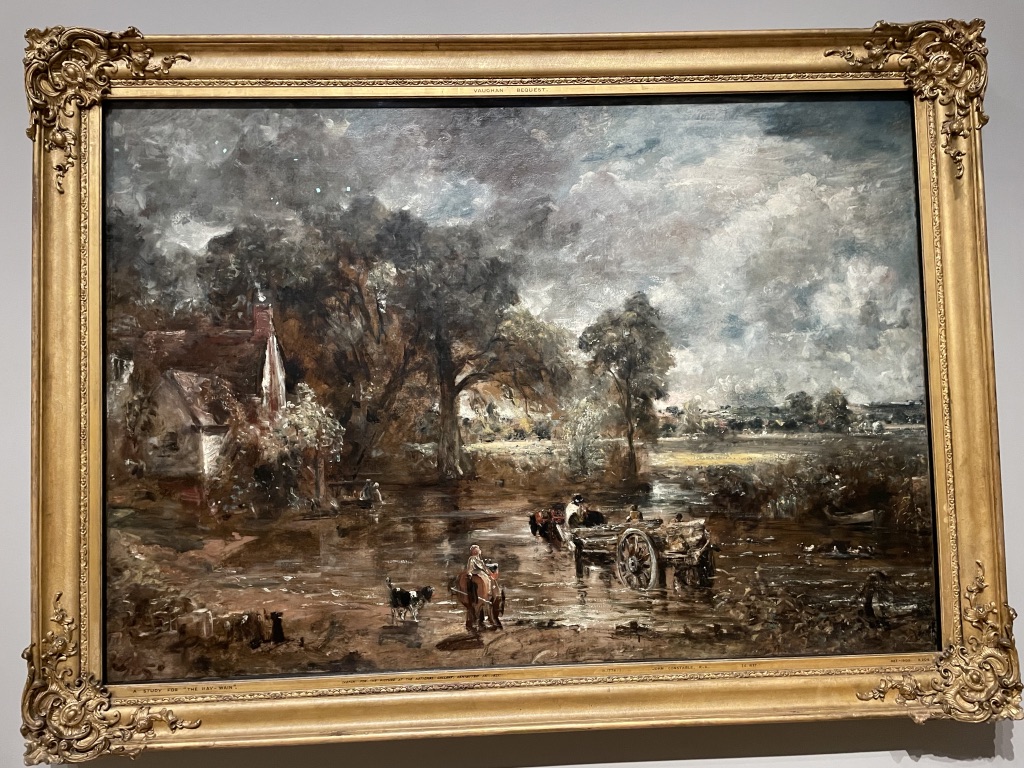
This is a large-scale (6ft) dry run which Constable painted. I love the liveliness and free painting. He does not become bogged down in detail yet all the elements of the composition are there.
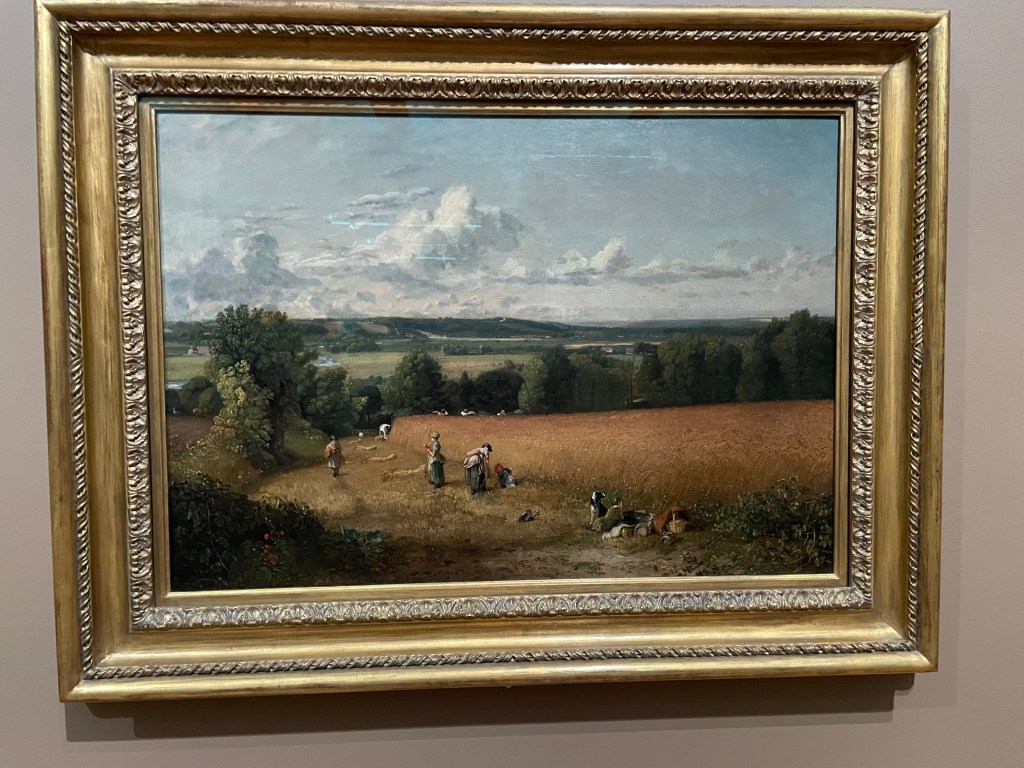
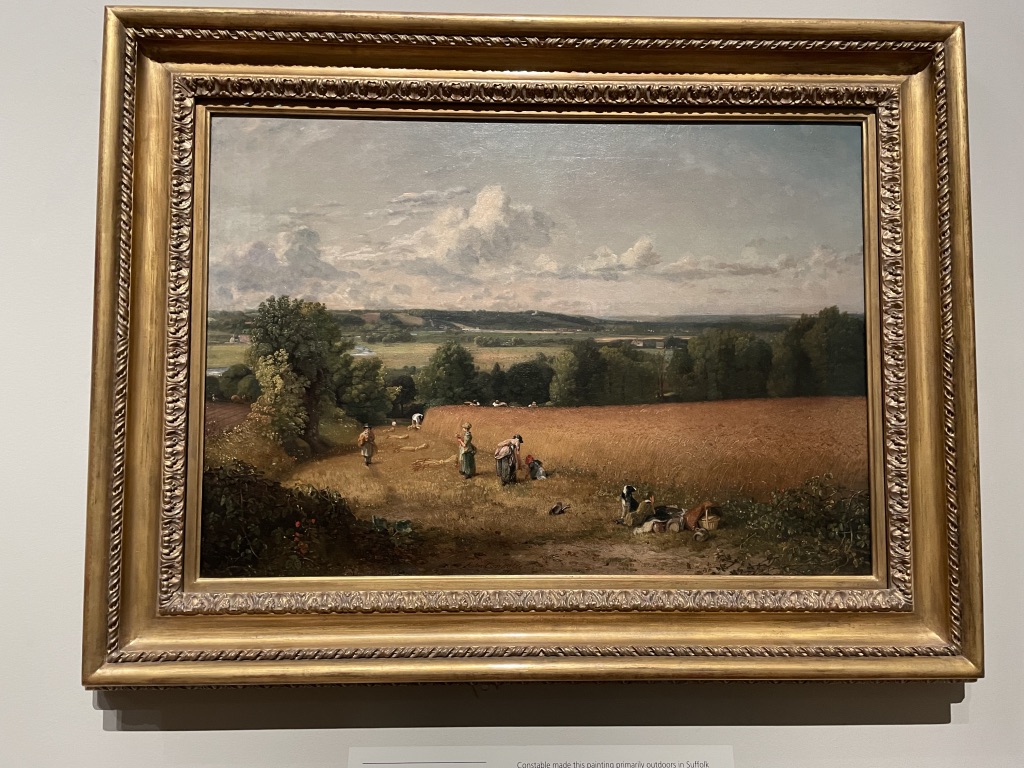
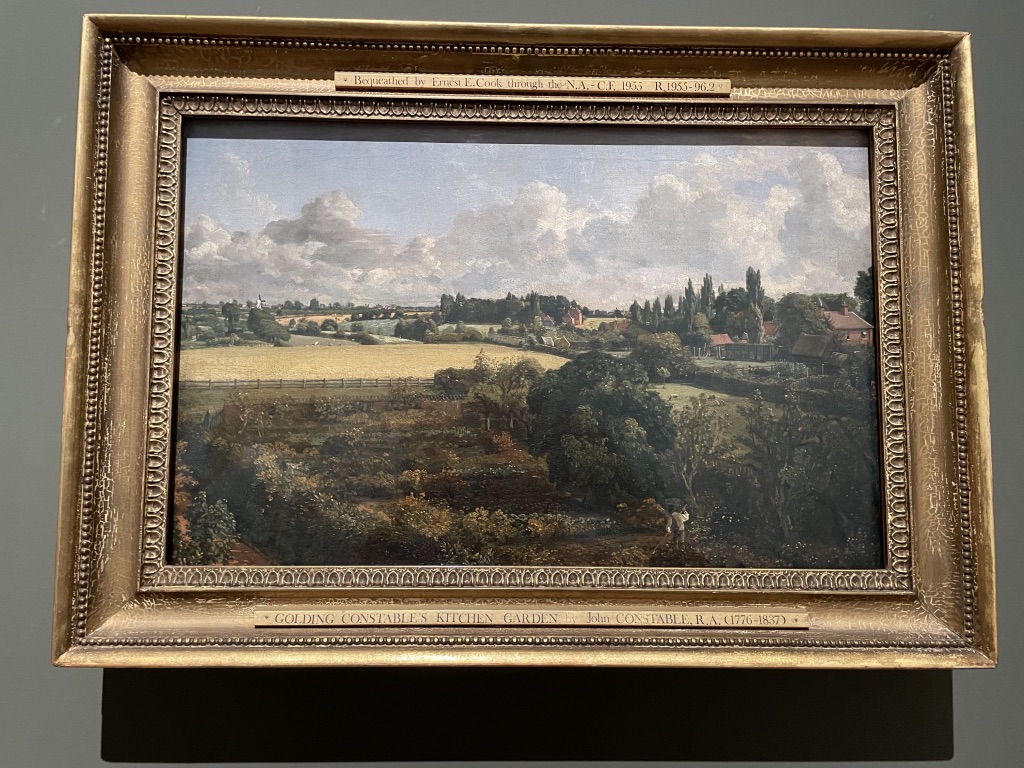
On the left is a work by Constable entitled The Wheat Field. It makes rural life look very clean, romantic and relaxed. On the right is Golding Constable’s Kitchen Garden (his father) which was very personal to Constable and he kept it for himself and it was never sold in his lifetime.
This painting is by Thomas Gainsborough (1748) Like Constable, he was born and brought up in Suffolk and was familiar with the same landscape. This work depicts Cornard Wood, common land at the time. The painting belonged to Constable’s uncle, David Pike Watts and would have been familiar to the young artist as he was developing his interest in landscape painting and admiring Gainsborough’s technique.
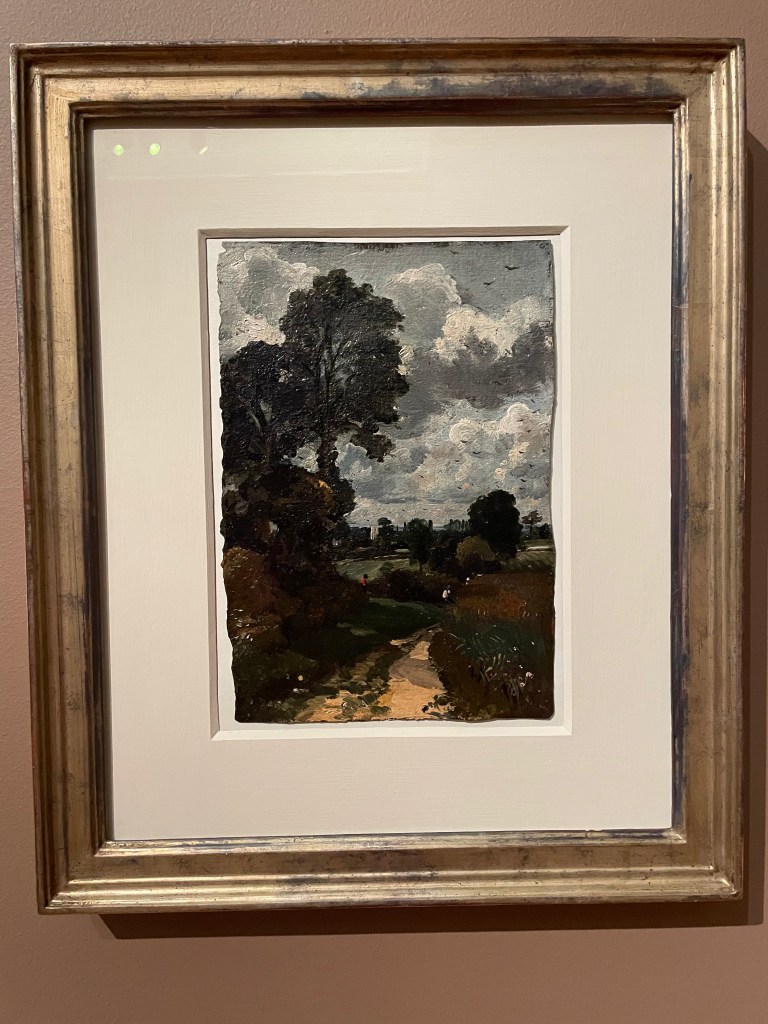
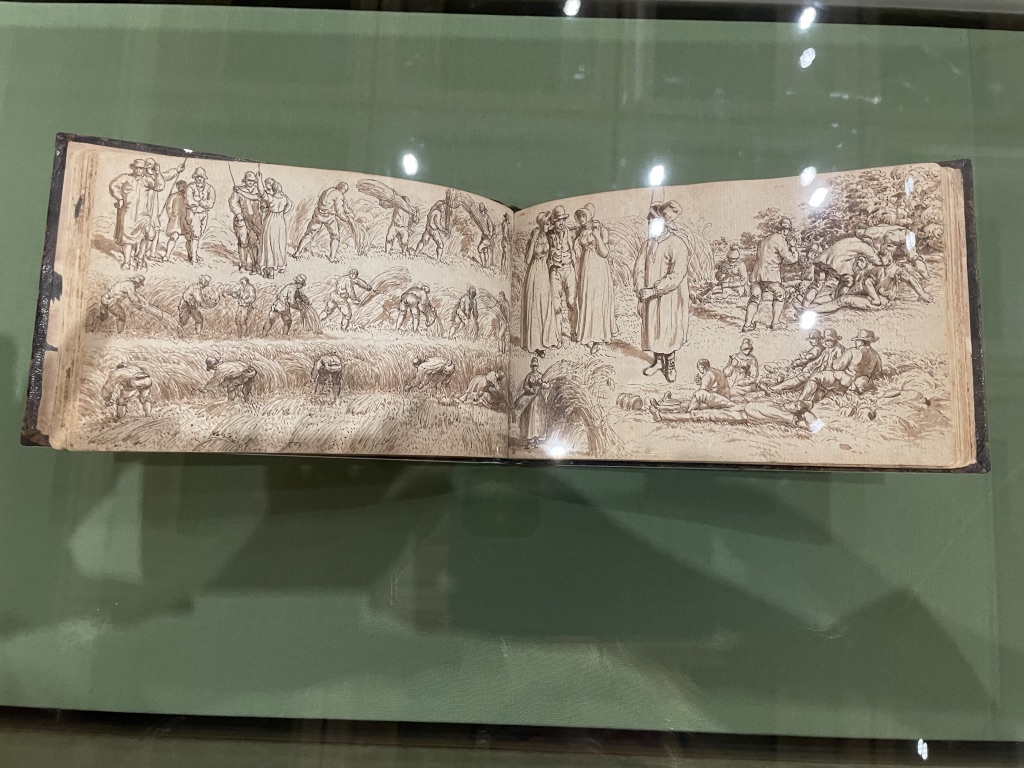
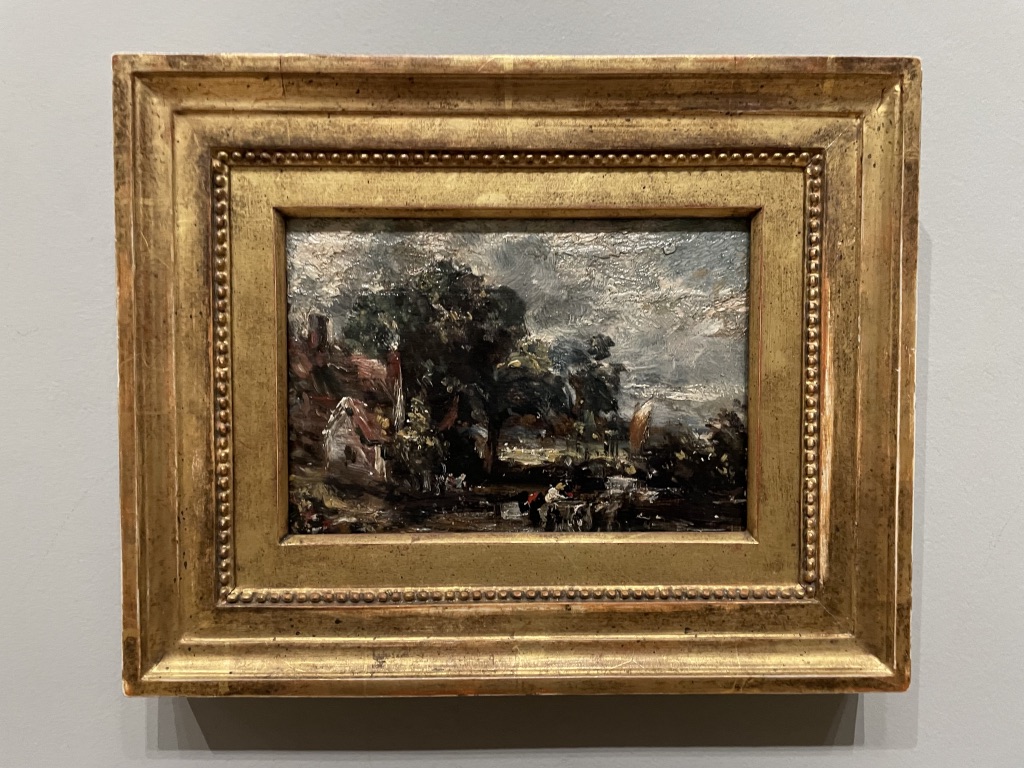
Always wonderful to see an artist’s sketch book and this shows how Constable studied field-workers and rural activity. On the right is a tiny oil sketch showing the composition of the Hay Wain. We learned that the house on the left, known as Willy Lott’s Cottage was, in fact, owned by Mr William Lott and it was a house, and a substantial dwelling. Perhaps Constable is guilty of loading his seminal work with a dose of sentimentality in order to appeal to the ideal of the rural idyll?
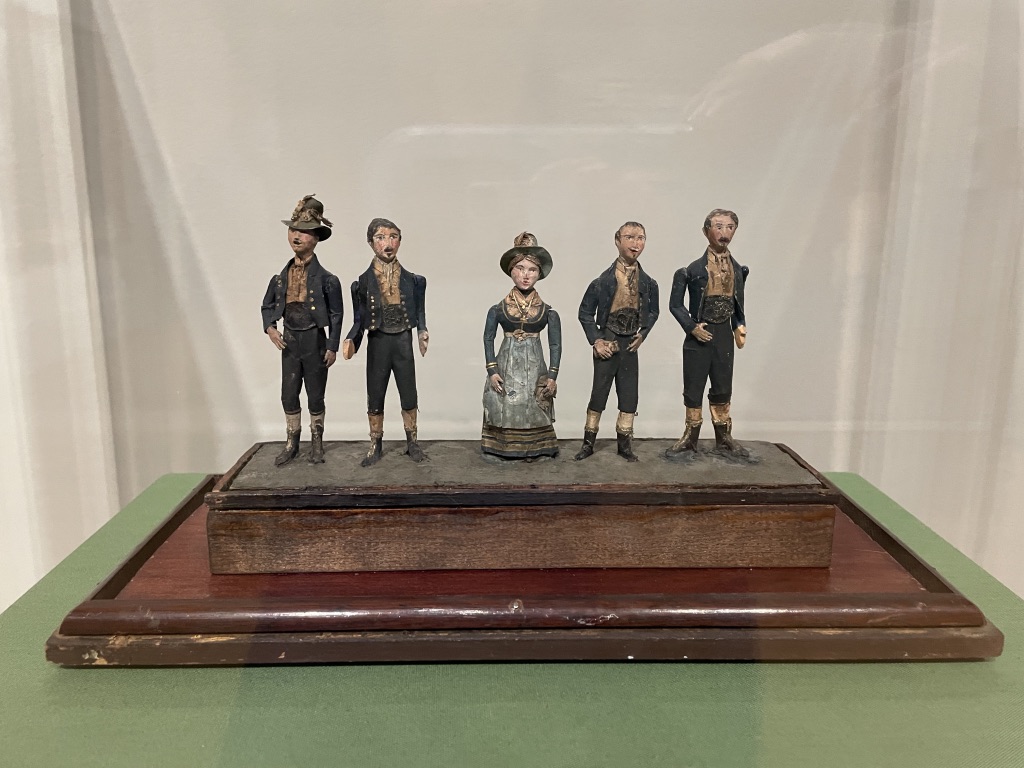
This is very charming set of tiny models depicting the best singers in the East Bergholt church choir. It has been attributed to the young John Constable as creator but we can’t be sure. They are very enchanting, tiny carved and painted wooden figures.
The show is just wonderful. It’s part of the National Gallery’s 200th year celebration and well worth a visit.


























 Paper Places