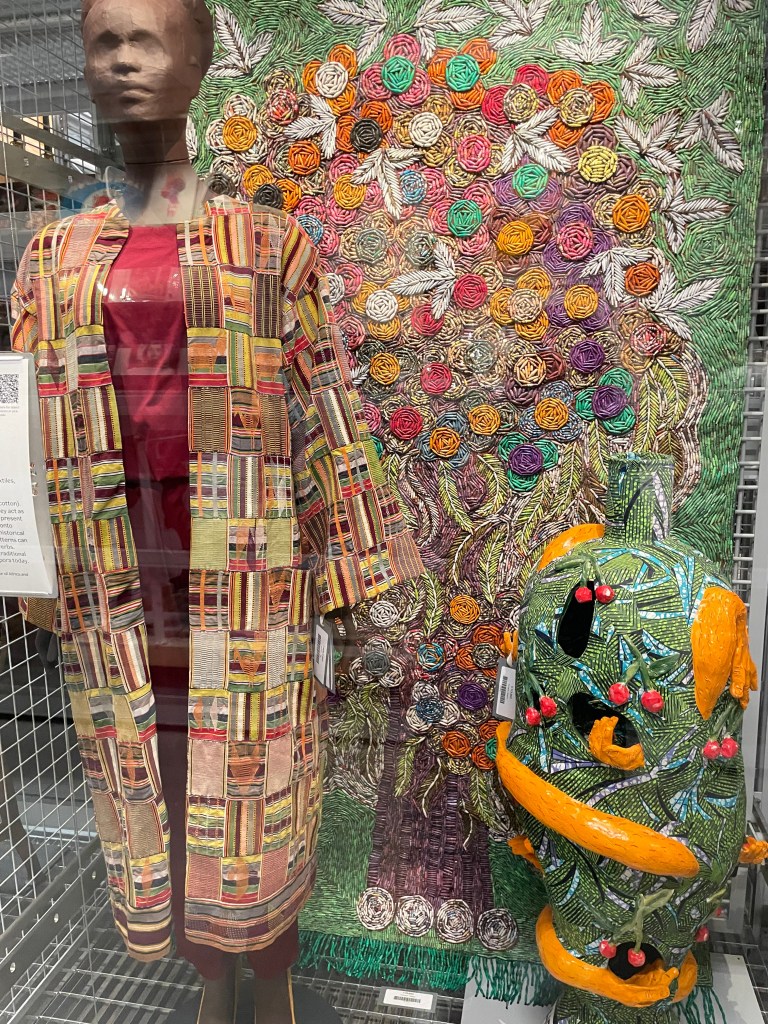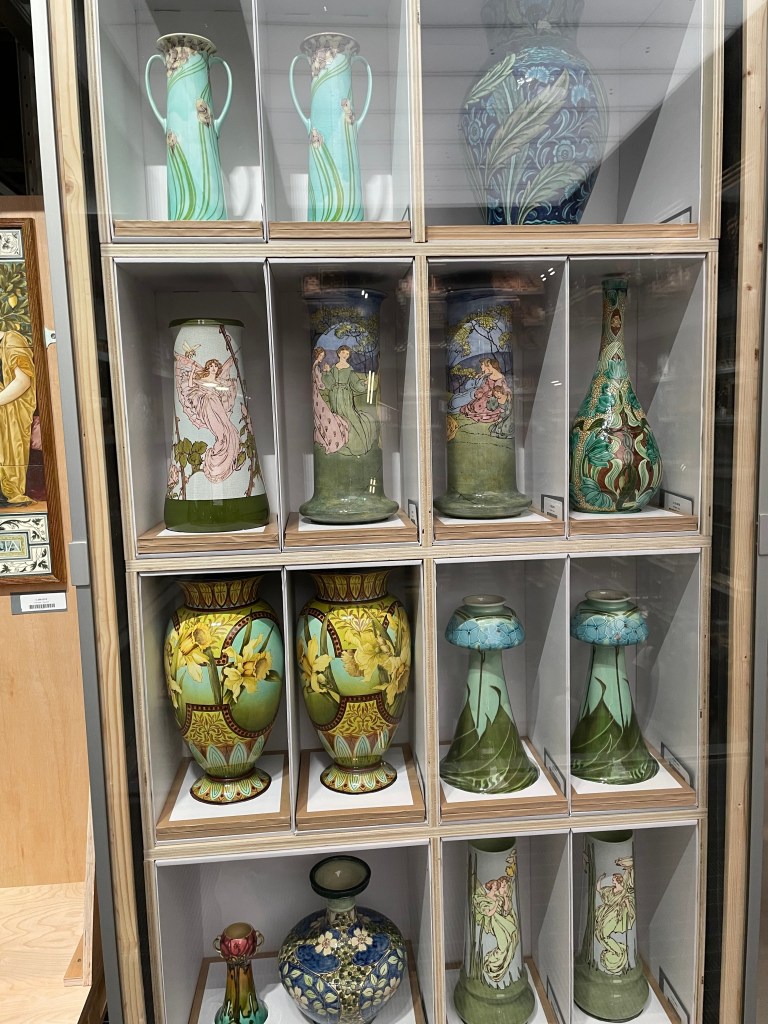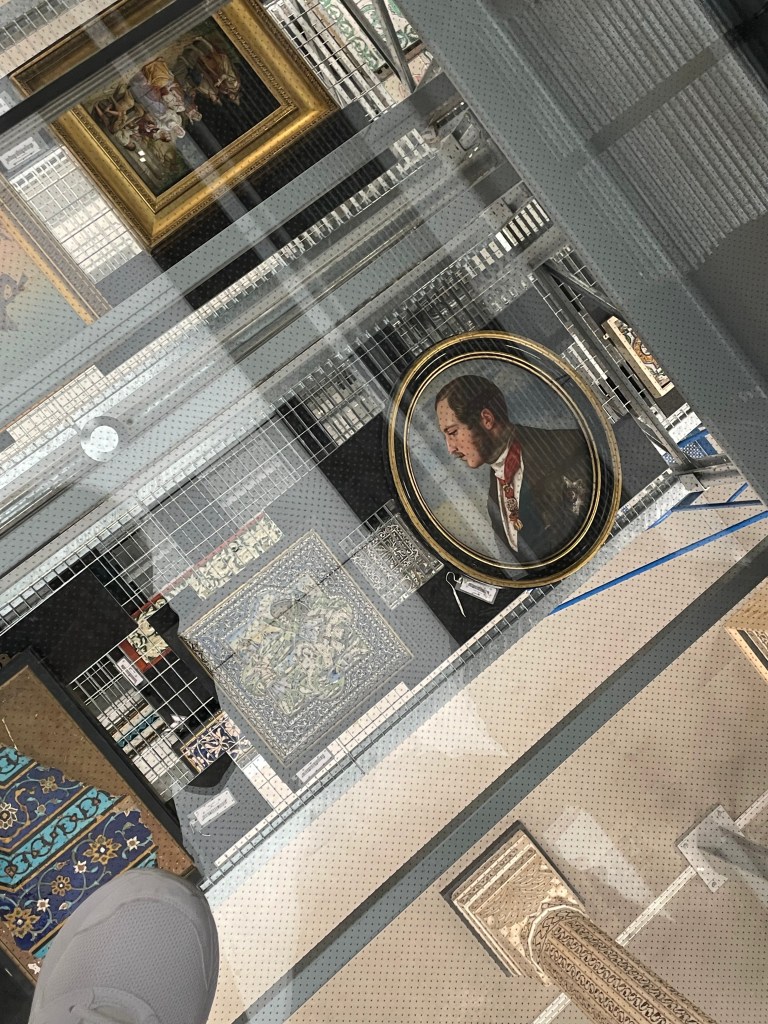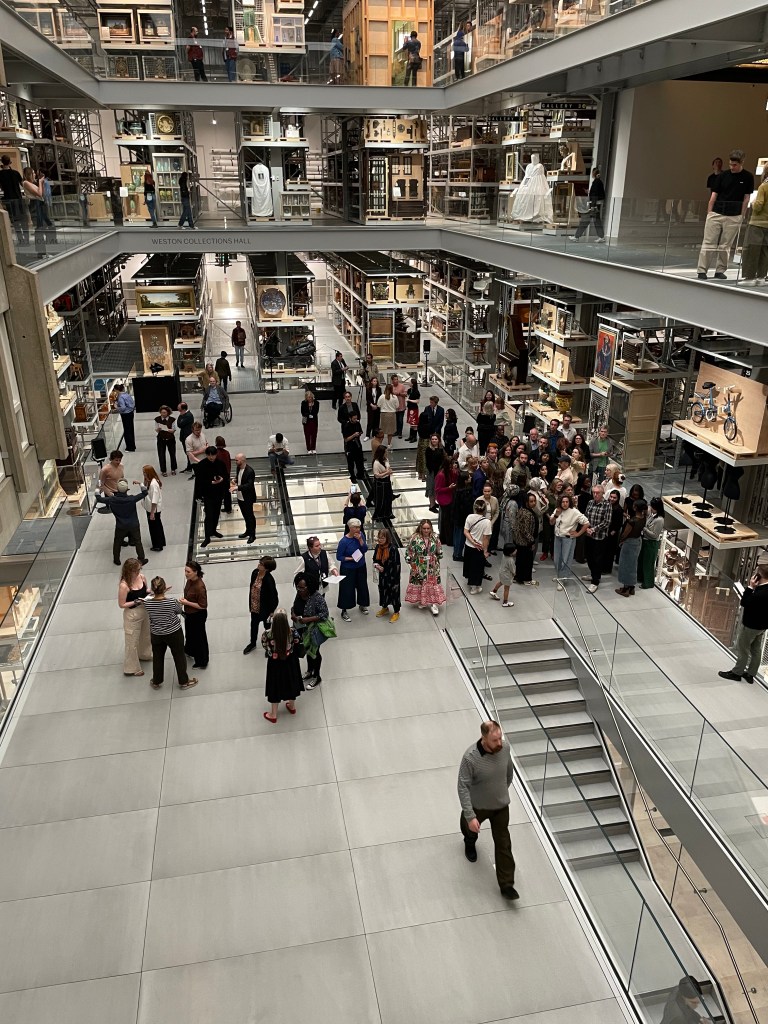
The fabulous new storage space for V&A East has opened in Stratford and it’s a ‘must see’ for any London visitor. Taking over the building created as a media centre during the 2012 Olympics, this space has been reimagined in the most original way as an exhibition/storage space for the Victoria and Albert Museum’s extensive collection. It’s like a giant cabinet of curiosities with so much to see.

What a thrill to be part of the press preview at the opening of the new V&A East storage space in east London. It’s a most dynamic space – the most extraordinary storage unit ever imagined. There’s easy access to all the objects; they are not only on display, but if there’s something you are keen to see close up, you can make an appointment, come to the space and see it close up in the company of a curator.
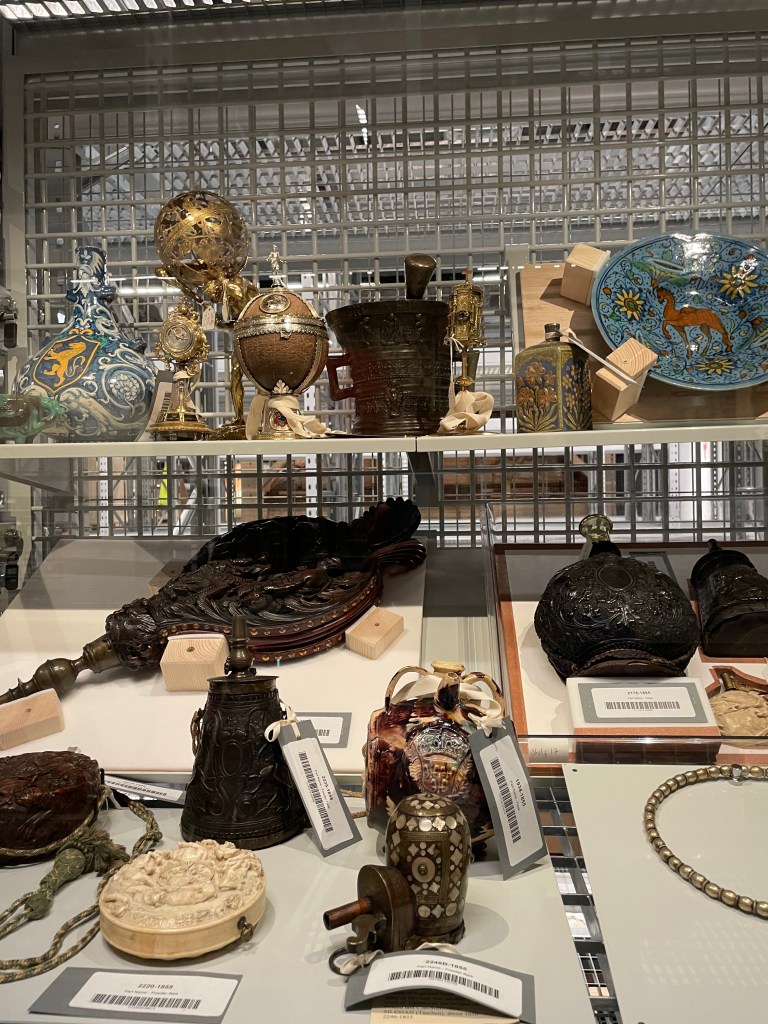
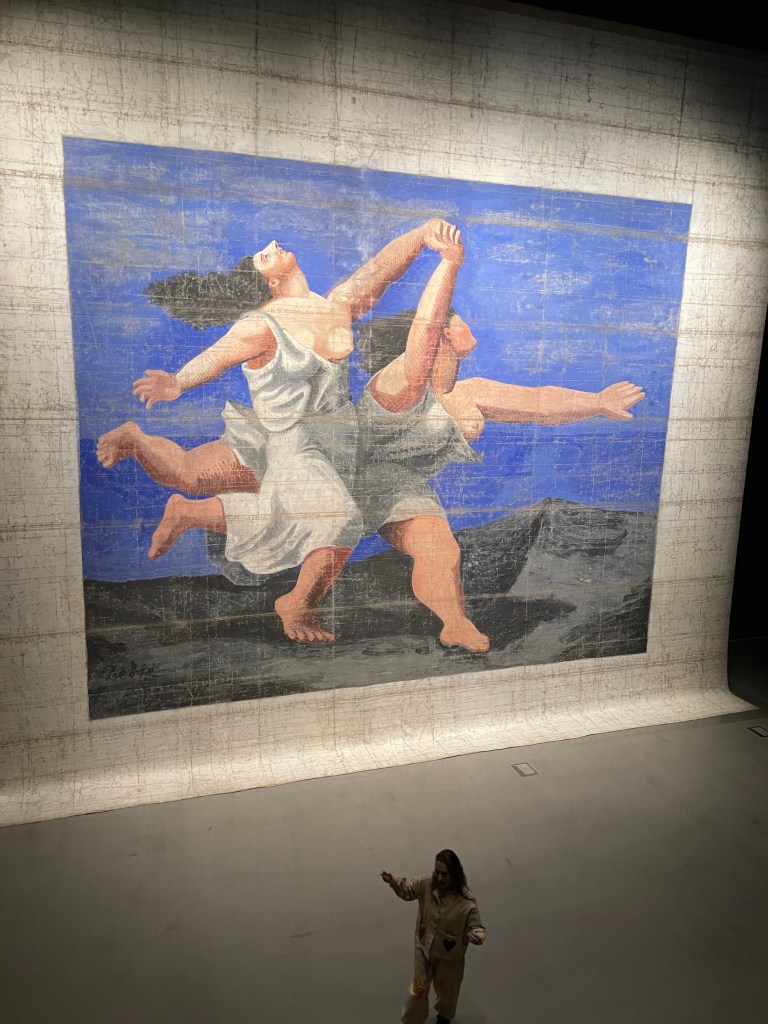
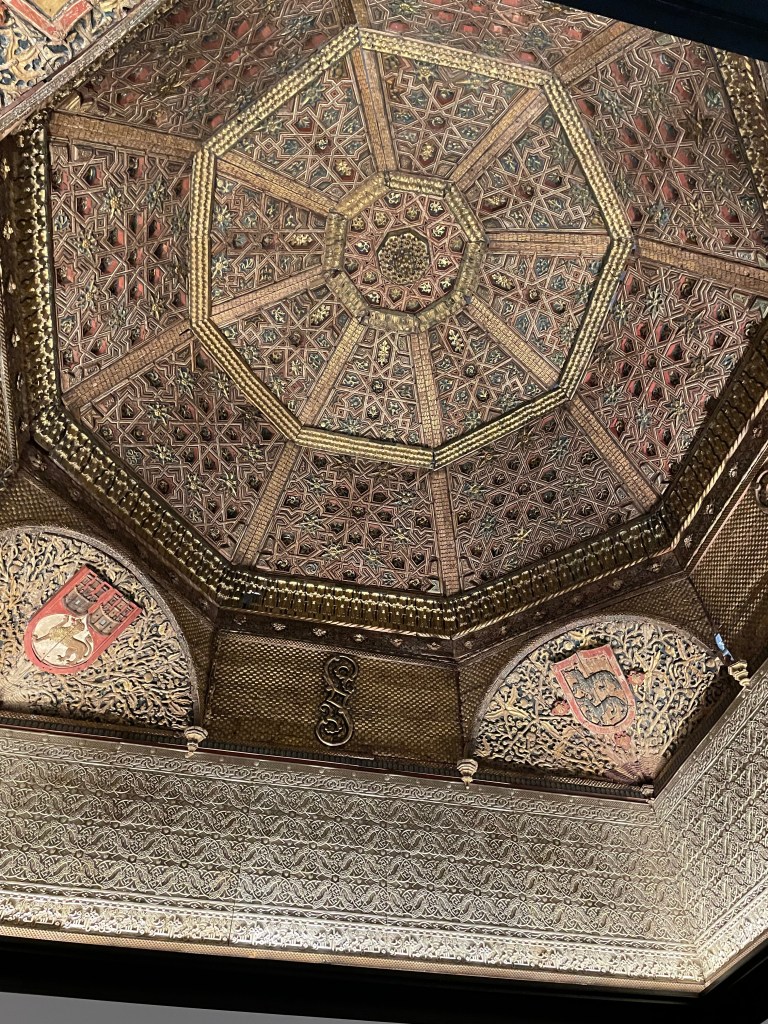
The objects are arranged on pallets, carefully lashed to their space and exude a wonderful confidence in their new environment. As well as objects from all eras, countries, cultures and faiths there are entire room sets. It was fascinating to see the complete kitchen from a Frankfurt apartment of the 1920s and the amazing Kaufmann Office designed by Frank Lloyd Wright. There’s a stunning Moorish ceiling and a giant theatre backcloth by Picasso.
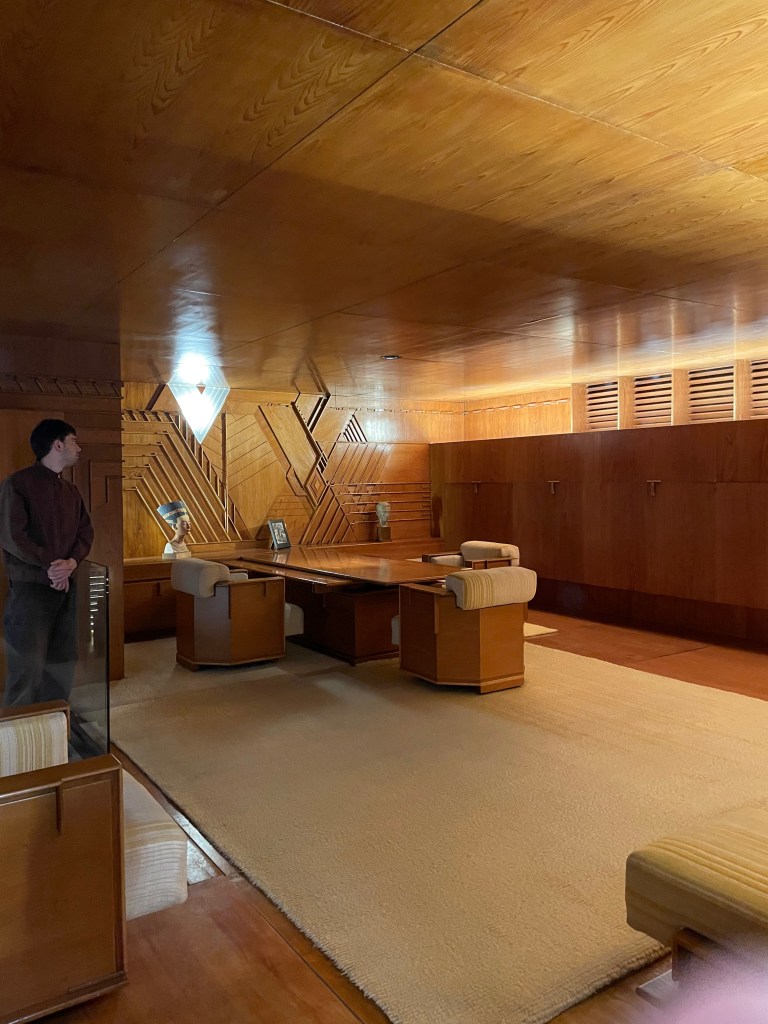
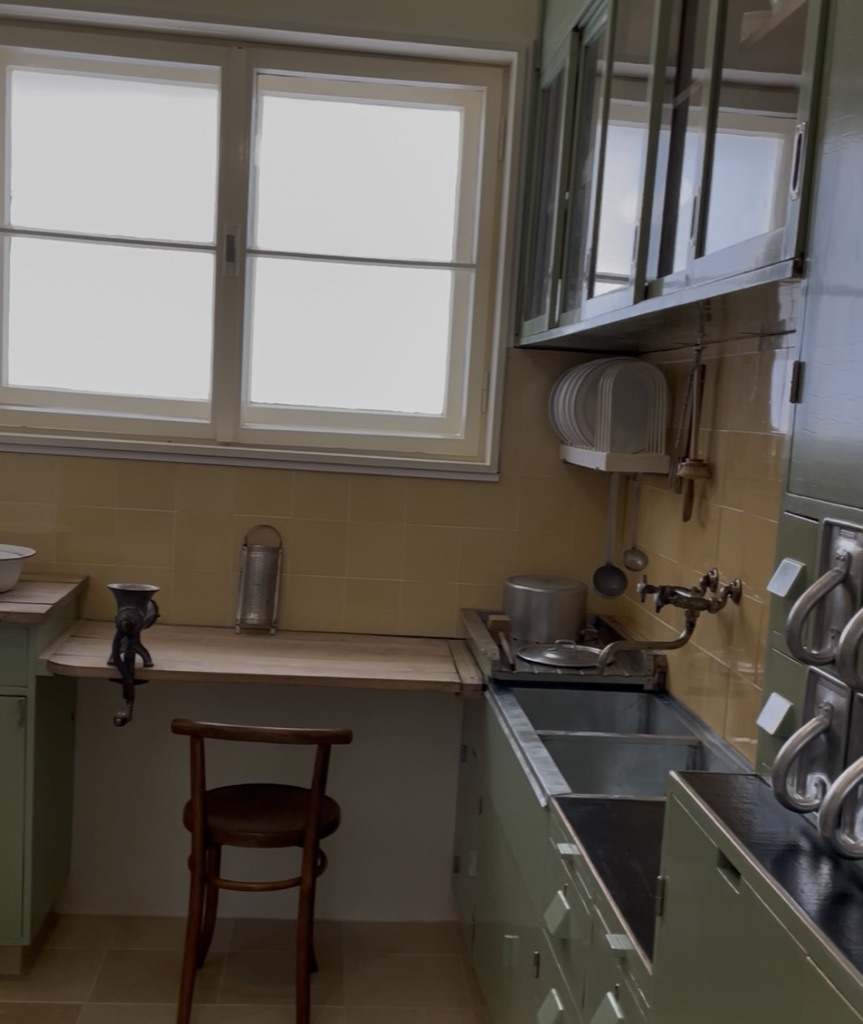
In architectural terms this new space is a joy. There is the luxury of a vast atrium in the centre of the storage unit which can be used for events, talks, concerts. The collection is displayed on five floors and seem to disappear down corridors into infinity. And the large space where the Picasso cloth was displayed provides much-needed opportunity for huge carpets and theatrical backcloths to be conserved, examined and displayed. You can also look into the conservation studios and see the work being done to restore all kinds of items, preparing them for display.
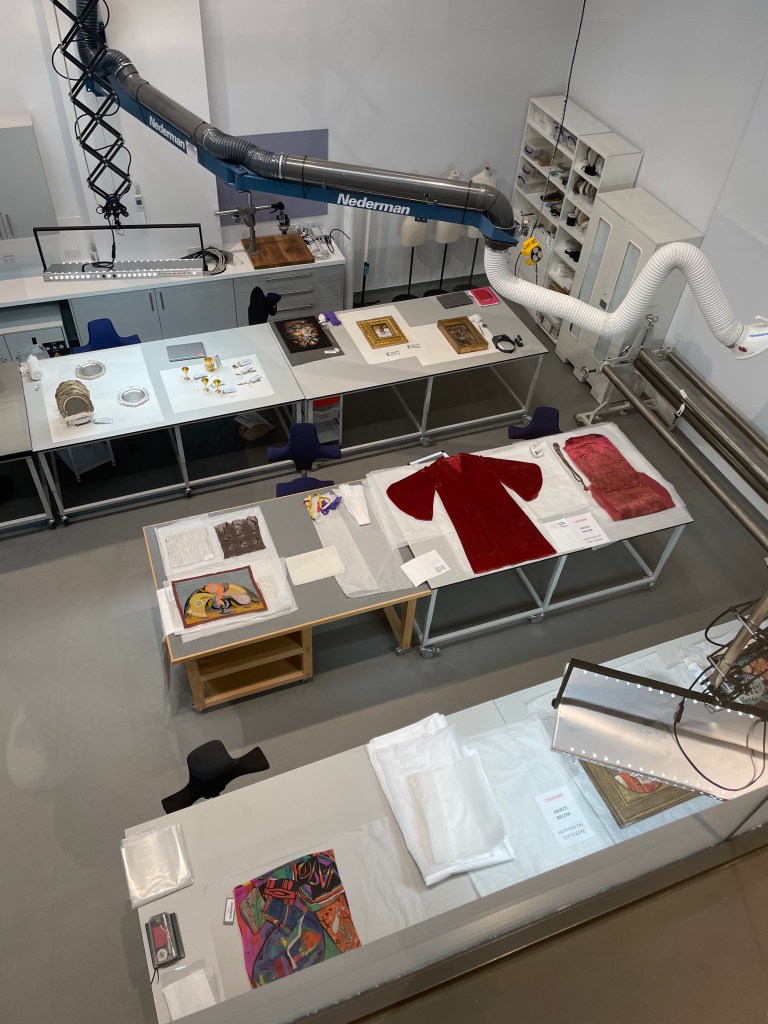
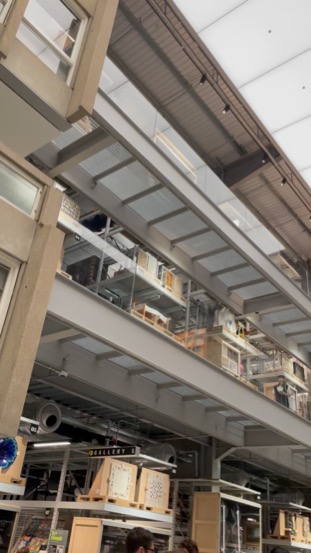
The V&A East is a short walk from Hackney Wick station and it’s exciting to see all the new buildings and attractive design which is pouring into this area. The whole Olympic Park repurposing is a shining example of legacy architecture, forward thinking and imaginative usage of the space. I’m impressed.

Secrets of the Thames. What a treat to visit the London Museum Docklands, to see their new exhibition which celebrates the determined curiosity of generations of mudlarkers. Swishing around the river’s foreshore at low tide is clearly an addictive activity and the results are wonderful.

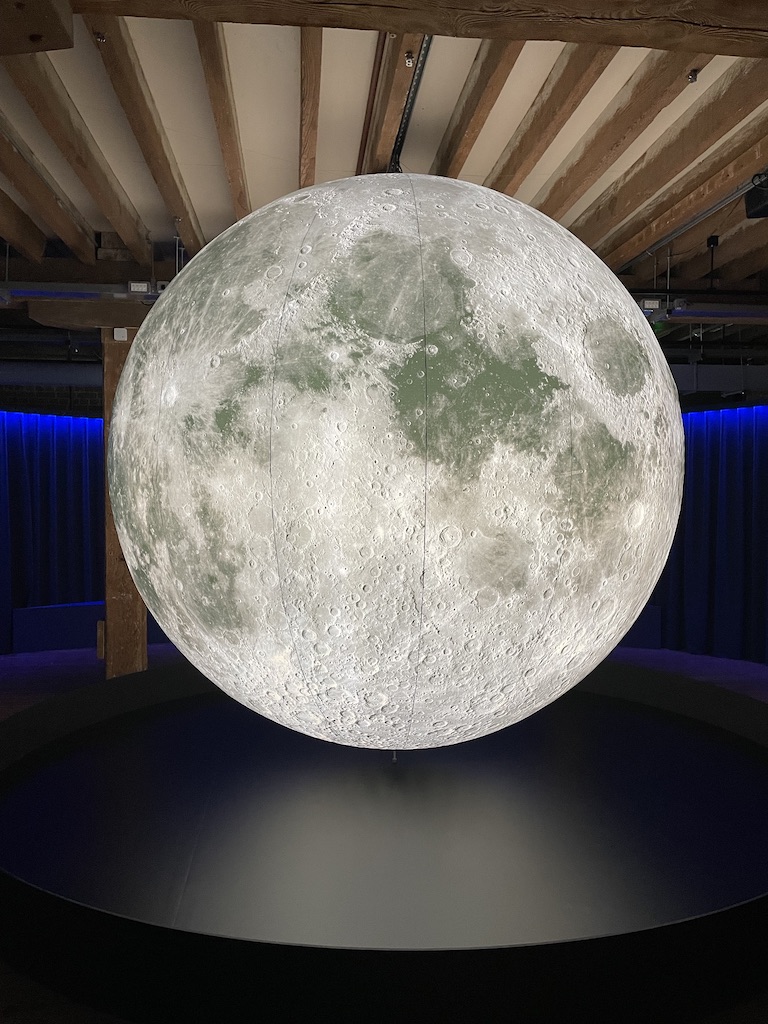
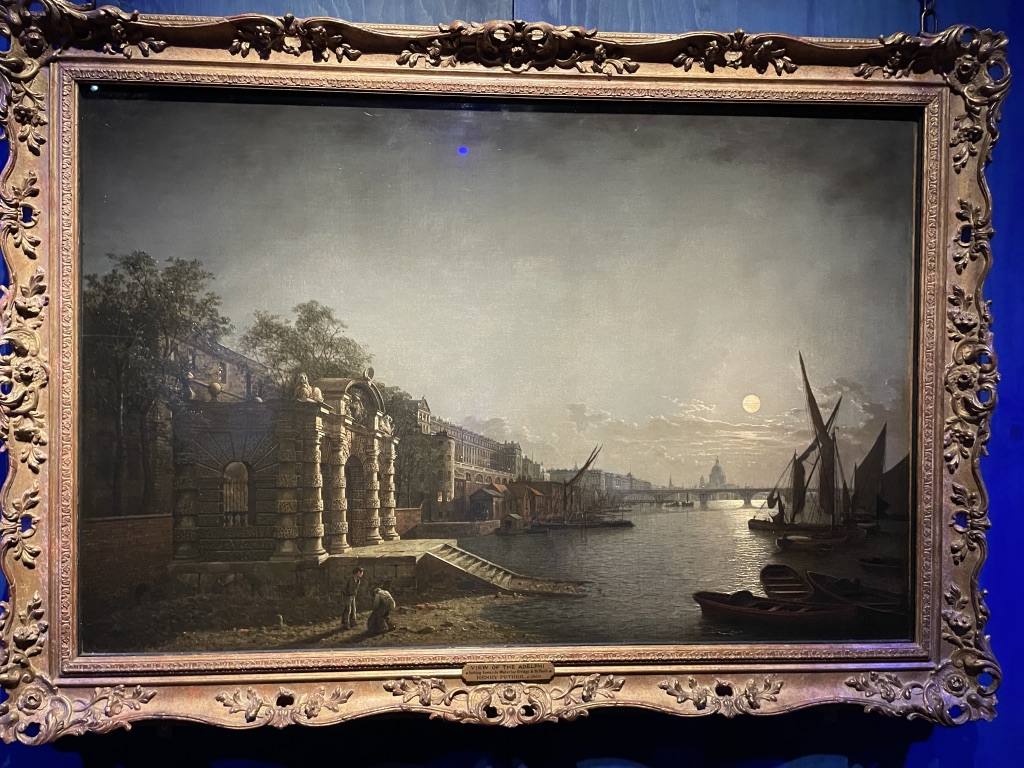
The exhibition opens with this spectacular painting by Henry Pether (around 1850) featuring mudlarkers searching the foreshore near York Water Gate, the Strand, by moonlight. Anyone living near the river will be aware of the constant rise and fall of the tide which is ordained by the moon. And there’s a fabulous sculpture of The Moon which you can circle, and peer at the extraordinary pitted surface.

You need a licence to be a mudlarker, along with sturdy shoes, waterproof clothes and a beady eye to spot potential treasure with in the mud of the river. It’s astonishing that every low tide will reveal items dropped, lost or hidden in the Thames. These pieces vary from the really ancient, pre-historic tools and items, jewels and coins, up to contemporary objects thought lost for ever.

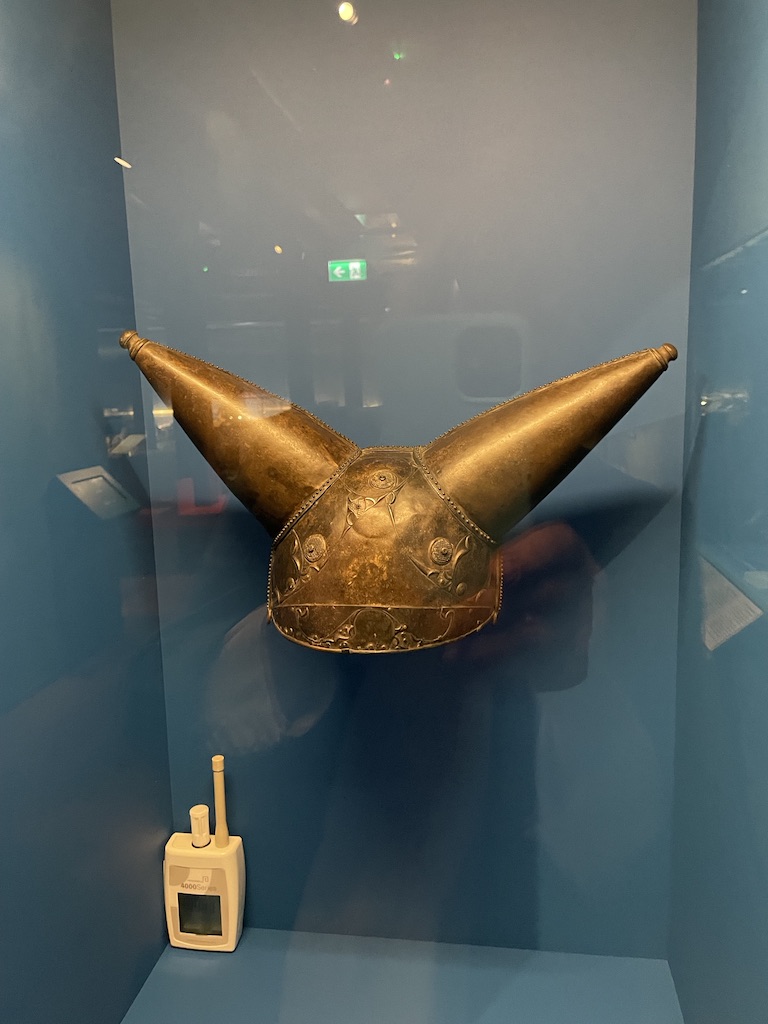
Above is a selection of figurines showing different gods and godesses from Roman times. They might have been offerings – the Romans revered water – or accidentally dropped into the river. And on the right is The Waterloo Helmet from 150 BCE. It’s the only Iron Age helmet found in southern England and the only one with horns ever found in Europe.

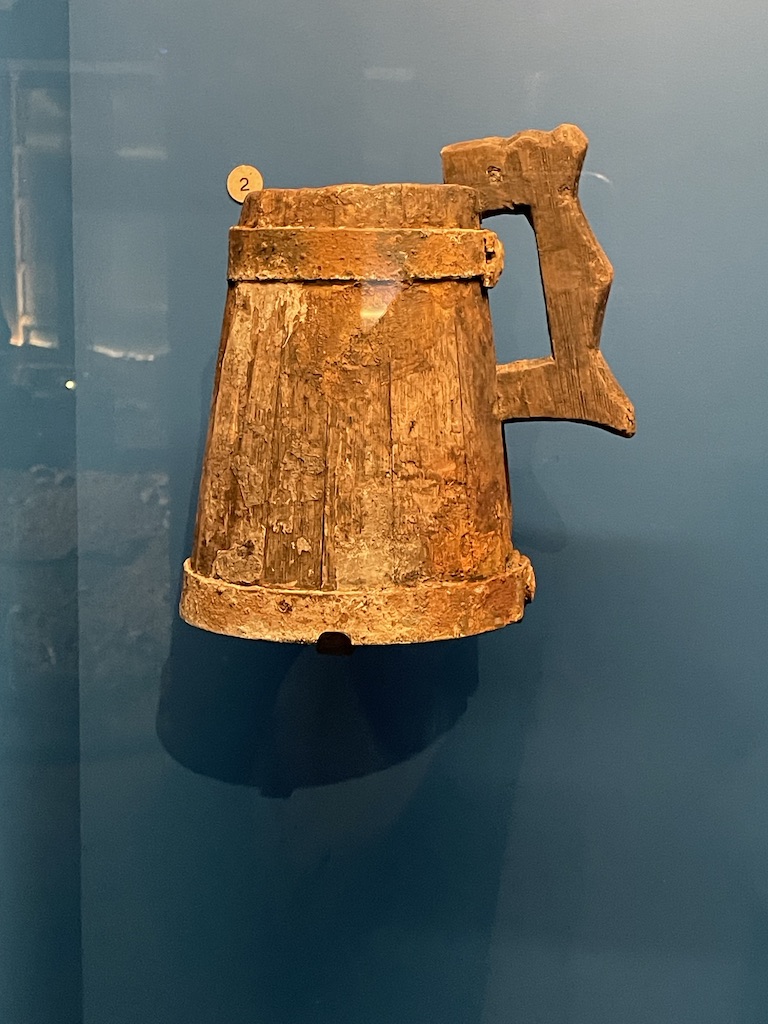
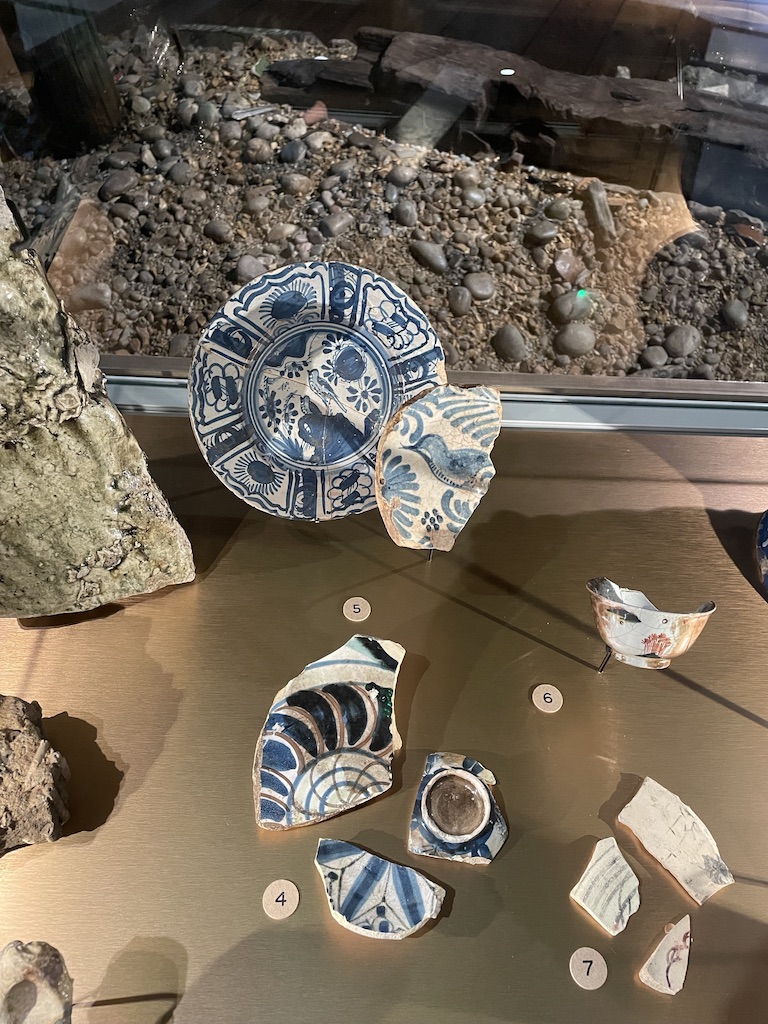
I do love seeing the everyday items which have been fished out. This wooden tankard must have been a thrilling find. It holds three pints – great for a very thirsty person, most likely a sailor. And it’s great to see these Delftware pots and dishes, even in fragments, giving you an idea of the household crockery in use from the mid 1500s to the 1800s.
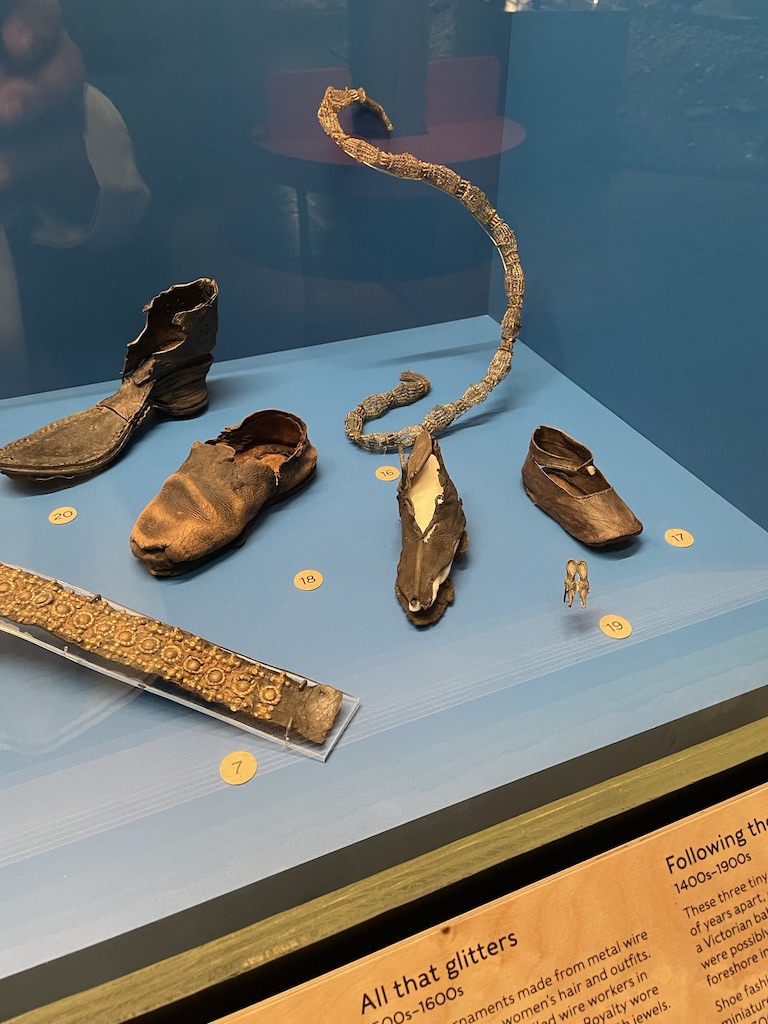
There’s something very touching about seeing children’s shoes. They have survived the centuries because the mud of the Thames is ‘anaerobic’ meaning it preserves the material from oxygen and it does not decay.

Mudlarking has been going on for centuries. For many early mudlarkers it was the coal and wood which they wanted, rather than the ‘treasure’.

The layout of the exhibition is fascinating. A very eye-catching recreation of the Thames foreshore has been recreated throughout, giving viewers an idea of how complicated it can be to sift through the detritus of the river and use just your eyes and experience to spot and uncover something exciting.

It’s a very stimulating and moving show. And impressive that so many of the items were discovered by dedicated mudlarkers and donated to the Museum of London so that they can be viewed and admired but visitors.

The exhibition at the London Museum Docklands is on until 1st March 2026. Well worth adding to your ‘must-see’ list!

Prince George & Master Frederick is my debut novel. It’s a work of historical fiction but is based on the true story of Frederick Blomberg, the little orphan boy who was adopted by King George III and Queen Charlotte in 1765 and brought up like a prince within the royal household. Was he really the King’s secret son?

Prince George & Master Frederick (by Rosalind Freeborn) will be published by Alliance Publishing Press on 30th January 2025. It will be available on Amazon and through bookshops. You can also buy it directly from me on my author website. The cost is £15 per copy (plus £5.00 postage in the UK) and I’ll send you a signed copy.

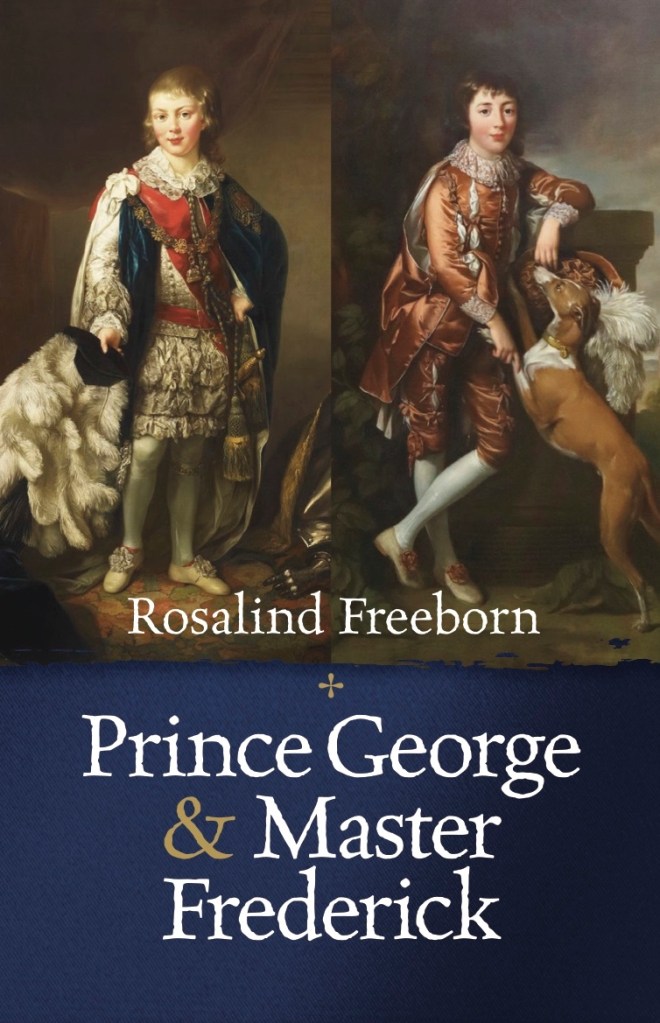
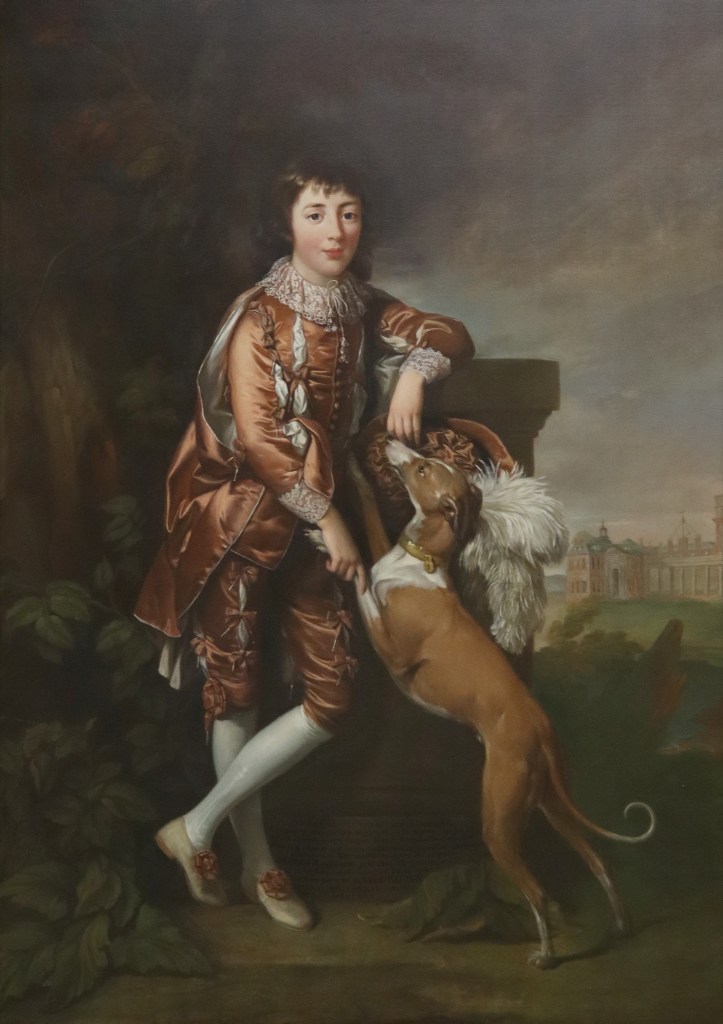
Prince George & Master Frederick by Rosalind Freeborn, book jacket, portraits of Prince George - future regent and King George IV - and Frederick Blomberg, adopted son of King George III.  The paintings are by Richard Brompton and commissioned by Queen Charlotte.

In 1765, Frederick Blomberg a four-year-old orphan, is bundled into a carriage with a woman he does not know and taken to the royal palace at Richmond to be a playmate for the three-year-old Prince George. But why have King George III and Queen Charlotte adopted this child and what is his secret connection to the king?

I was prompted to write this book after investigating a family story suggesting that there was a connection (on my mother’s side) with King George III. Researching this story opened up the most fascinating life-story of Frederick Blomberg. He’s a character who is occasionally referenced in history books and royal biographies but his story has never been told before. Yet, when you look at the portrait by court artist, Richard Brompton, which was commissioned by Queen Charlotte, it’s clear that he was an important child in the household.

Prince George & Master Frederick is a work of fiction but it is based on real events, charting the lives of real people with just a few characters added for dramatic impact.

Prince George & Master Frederick by Rosalind Freeborn, historical novel about the secret son of King George III. Published by Alliance Publishing Press on 30th January 2025.

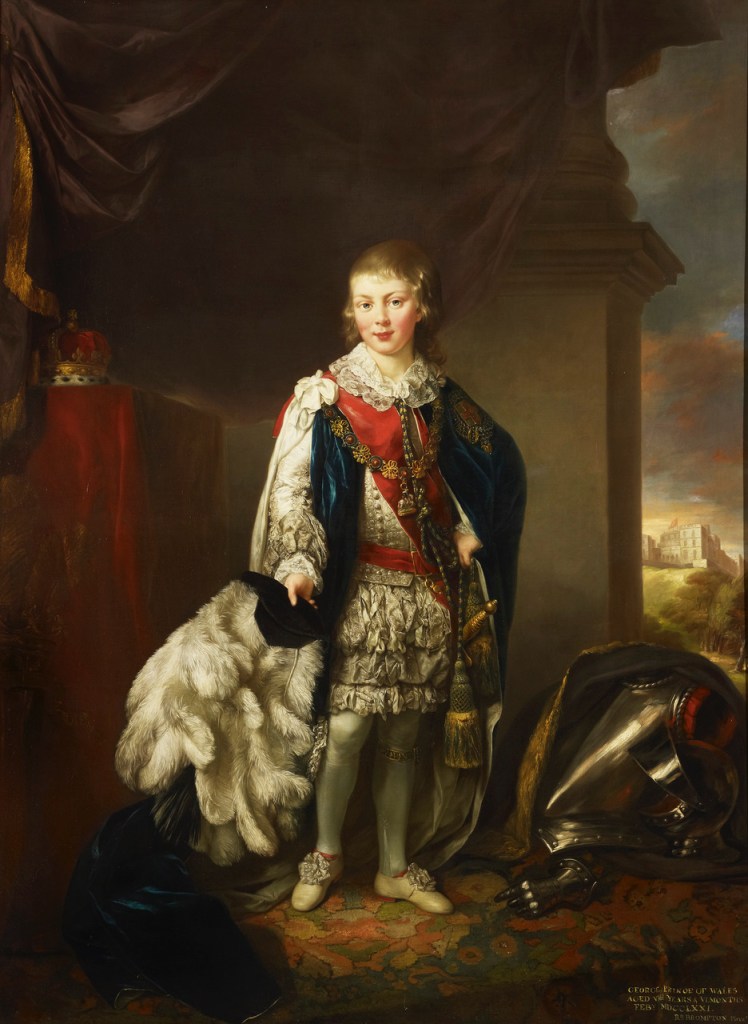
The two portraits which appear on the book jacket are by Richard Brompton. They feature the same plinth as prop and both boys are wearing the same pom-pom shoes. The portrait of Prince George, wearing garter robes, features Windsor Castle in the background (the painting now hangs in the 1844 Room at Buckingham Palace). Frederick Blomberg, in a fabulous rust-coloured suit, with greyhound, features Buckingham House in the background. Buckingham House was later remodelled and became Buckingham Palace.

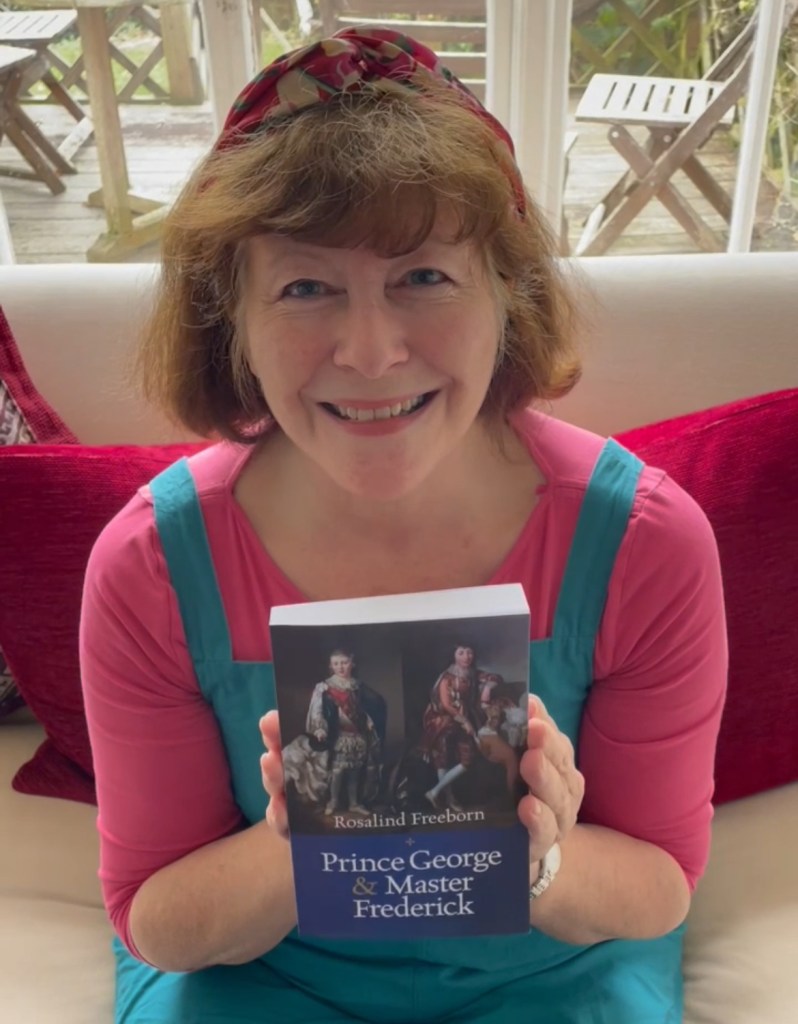
It’s very exciting to have some advance copies of the book. I look forward to the moment it is published on 30th January 2025.

Photo of Rosalind Freeborn, author of Prince George & Master Frederick with a copy of her historical novel due to be published on 30th January 2025.

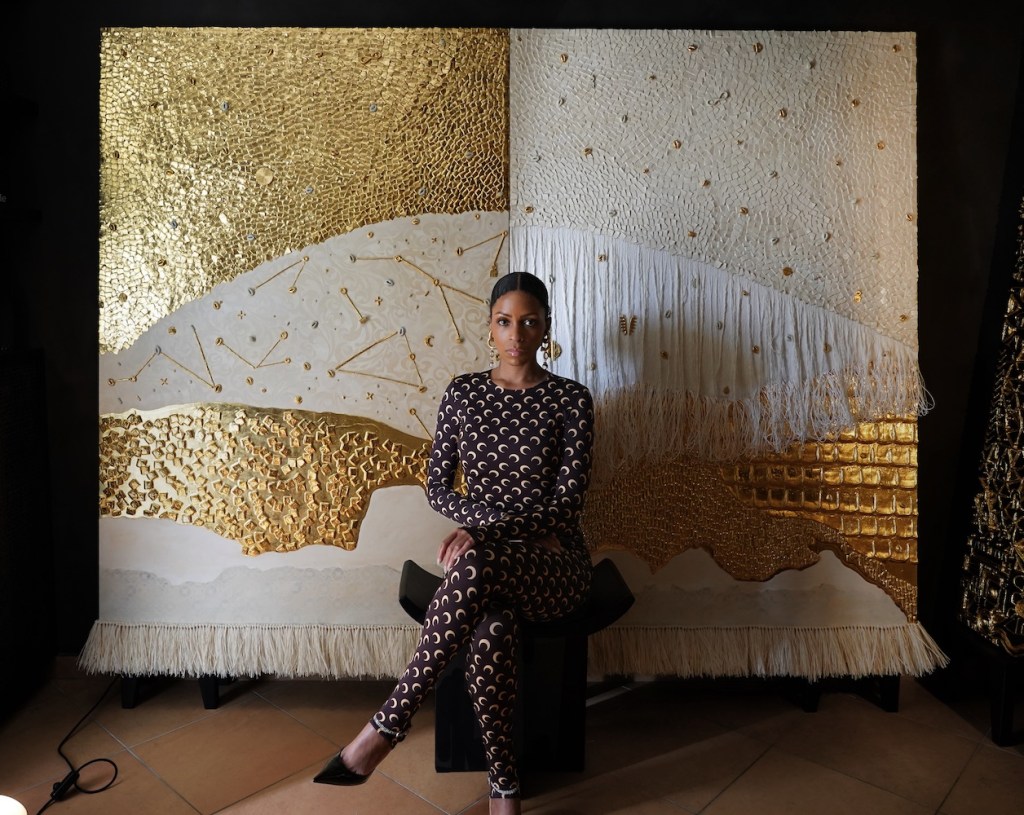
Mythic Time / Tens of Thousands of Rememberings by Lina Iris Victor. And what a fascinating exhibition at the Sir John Soane’s Museum this is. A celebration of African culture, mingled with inspiration from the astonishing collection of ancient artefacts assembled by Sir John Soane and housed in his idiosyncratic home in Lincoln’s Inn Field, London.

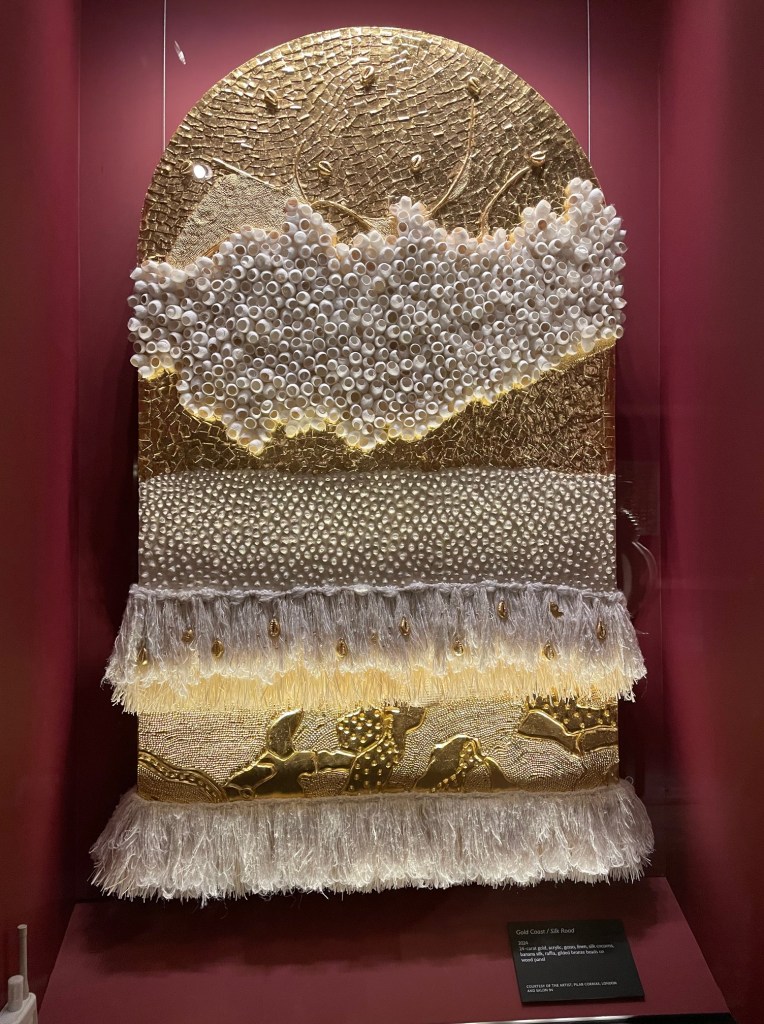
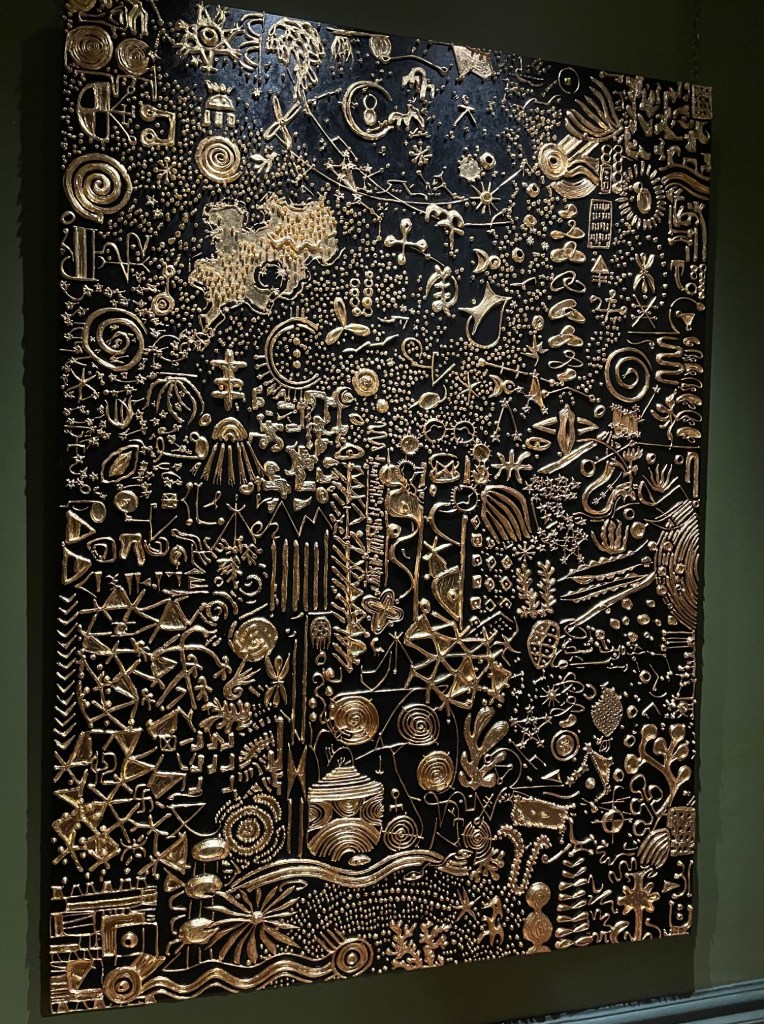
Visiting the Sir John Soane’s Museum is always a pleasure. It’s a treasure-trove of cultural history which is open to the public, free, from Wednesdays to Sundays, and well worth a trip. Every now and then the museum collaborates with a contemporary artist. This year Lina Iris Victor, a Liberian/British multidisciplinary artist who lives and works between Italy and the UK, has taken on the challenge of creating works which reflect and complement the collection. Her African heritage really comes through in these pieces. She combines all manner of materials, most fascinatingly, she uses empty silkworm cases, fragments of woven fabric and weaves them in amonsgt acrylic forms gilded with gold.

Many of the works are on paper – sturdy paper, because these pieces are heavy – and there’s an impressive gutsy-ness to the pieces.

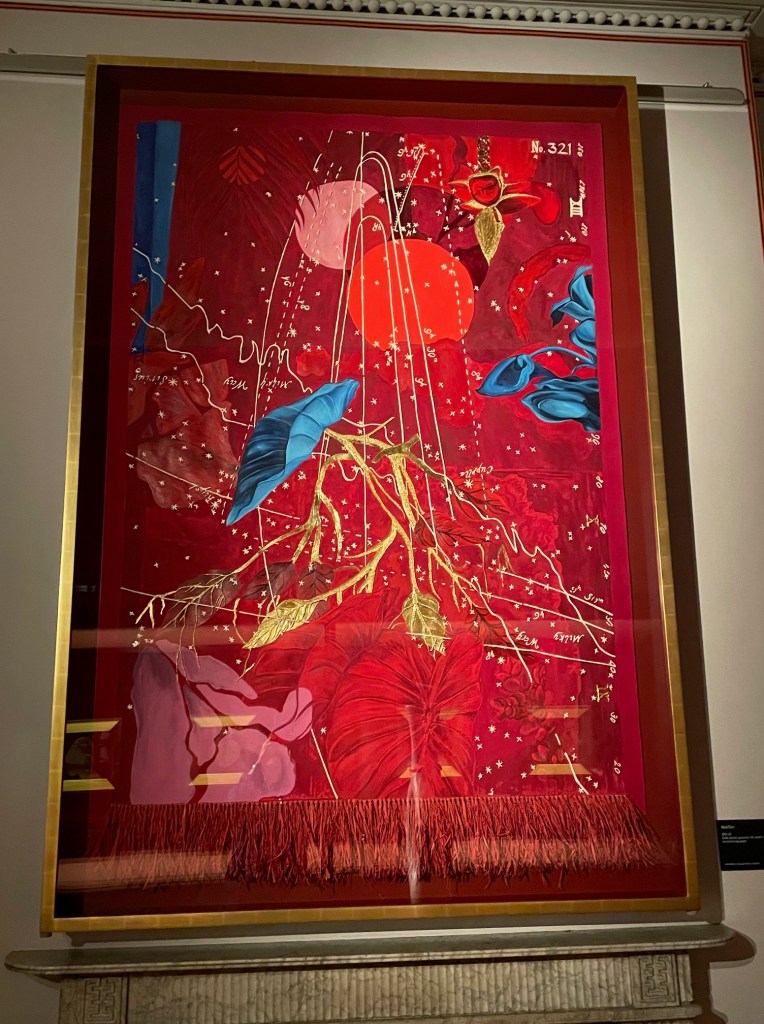
I was really taken by the large scale colourful work which combined gold with red on paper. Red Ornamental (series of four works) mixed media on paper.

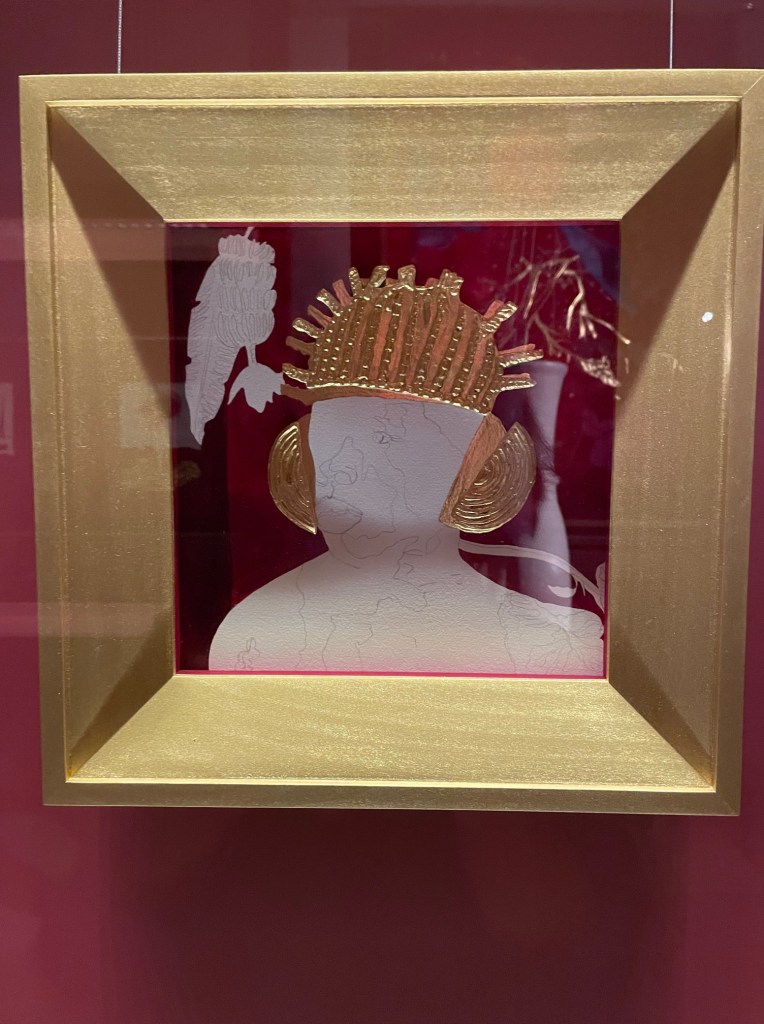
I liked the array of portraits too which combine the gold element with strongly pigmented paint and drawing on paper.

It’s very interesting to see such original art in such a spectacular setting. The amalgam of contemporary and ancient really blends well. Down in the crypt are two ‘Ritual Thrones’ and an extraordinary sculpture entitled Nbiru which goes rather well with the Greek and Roman statues collected by Soane.

The exhibition opens on 10th July and will be there until 19th January 2025. Free

Entangled Pasts 1768 – Now is a very thought-provoking show at the Royal Academy in London. In the late late 18th century many of the leading artists, and members of the new Royal Academy of Art, were instrumental in helping to change attitudes towards indigenous people and the abolition of slavery. There’s a very imaginative mingling of works from the late 19th century to pieces by artists working today, many of them contemporary members of the Royal Academy.

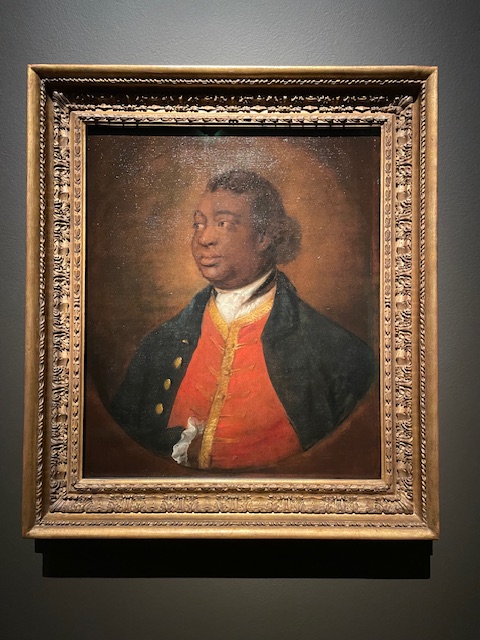
Starting with the late 1700s, the first gallery is filled with charming and sensitive portraits of black sitters. Above, I’ve selected a Portrait of a man in a Red Suit by an unknown artist and a wonderful portrait of Ignatius Sancho, the first man of African descent to vote in a British election. He was a musician, shopkeeper, man of letters and friend of artists. Apparently this portrait by Thomas Gainsborough was completed in one sitting in 1768.

This painting is quite familiar because the subjects, Dido Elizabeth Belle and Lady Elizabeth Murray were bought up together at Kenwood House in London and have been the subject of a film. Painted by David Martin in 1779 this painting is beguiling because Lady Elizabeth appears in a conventional pose, with her book, but she’s affectionately connected to her second cousin, Dido (the illegitimate child of an enslaved woman and a Royal Navy officer) who is depicted in a rather mischievous pose as if she’s about to dart away with her collection of fruit and flowers. Lord Mansfield, who owned Kenwood House was Lord Chief Justice in England and instrumental in the abolition of slavery.

This magnificent bust by Francis Harwood, made in 1758, is placed at the centre of the first gallery and gives a wonderful gravitas and graciousness which sets the tone of the the exhibition.

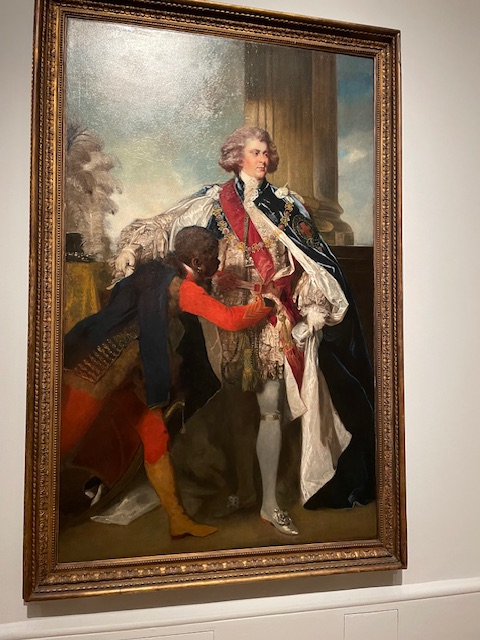
Inevitably we see the role of the black servant in aristocratic homes. And this painting by Joshua Reynolds shows George, Prince of Wales (later King George IV) by Joshua Reynolds. The pose of the attendant – who is intimately arranging the prince’s clothing, caused a stir amongst audiences who first saw it at the RA Annual exhibition in 1787. No identity is given to the attendant but he is described as ‘Black’ by Reynolds.

The shadow of slavery continues with Edwin Longsden Long’s The Balylonian Marriage Market. Young women are selected by male spectators for marriage. I get the feeling he used the same model for most of the young women but darkened their skin colour.

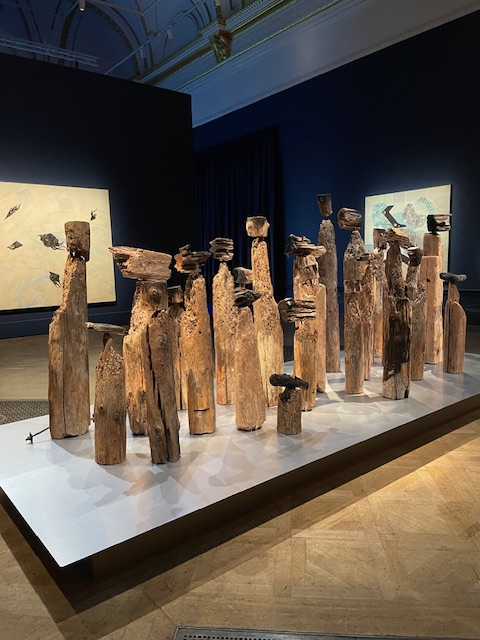
The later galleries leave the iniquities of slavery behind but still reference the engagement of the British Empire with indigenous peoples and leave us a bit troubled by the lack of respect which travelled with the expansive ideas of British Imperialists. For example, the found wood and metal sculpture by El Anatsui called Akua’s Surviving Children is very powerful. Primitive Matters: Huts (2010) depicts the plain, sparse slave huts which contrast with the dwellings enjoyed by Europeans in Trinidad.

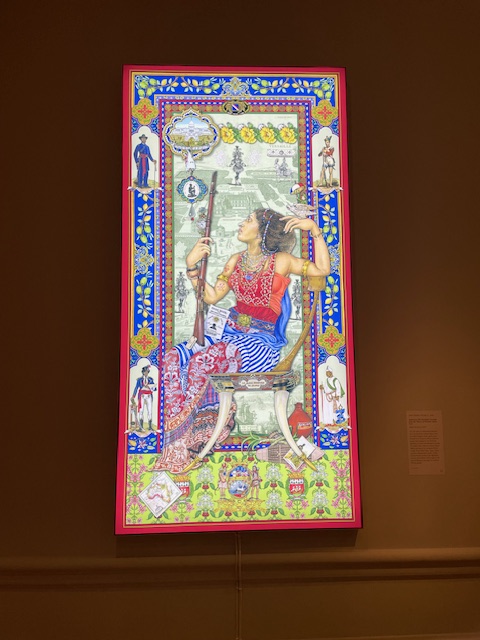
It’s good to see females well represented in the show. On the left you can see a work by The Singh Twins which references the ‘triangular trade’: goods were shipped from Europe to Africa, enslaved people were shipped to the Americas, plantation produce was shipped to Europe. The model featured is Fanny Eaton and you can see a sketch of her by Frederick Sandys on the right.

The show runs at the Royal Academy form 3rd February until 28th April 2024.

This fabulous sculpture placed in the courtyard of the Royal Academy is by Tavares Strachan. Made of bronze, black and gold leaf it’s called The First Supper (Galaxy Black) made in 2023.