Hockney – the joy of looking

I’ve been a fan of David Hockney for years and have tried to catch every London show of his work over the last few decades.  This retrospective show at Tate Britain brings his phenomenal career together – not that it’s over!  This most twinkly-eyed of artists may be 80 years old but he shows no sign of slowing down.  His ever curious sense of pleasure in all that he sees of the world demands that he finds a way to record the sights that surround him.   The thing he feels so strongly about is the importance of really LOOKING. He laments the loss of drawing as an important part of art education.  Yes, you can take a photo of something, he says, but what matters is the sensation of a view, the notion of sharing the artist’s eye and becoming immersed in the view or psychology of the image.

Wandering around the Tate was an immersive joy. Hockney plays with eye-lines and perspective everywhere you look.  You find your eye zig zagging across a picture hunting for the focus point and that dancing sensation draws you into his world.  The early paintings, made when he was a star pupil of the Royal College of Art established his style but feel weighted with a kind of English gloom. Then everything bursts into glorious technicolour – a bit like that scene in the Wizard of Oz when Dorothy wakes up from her black and white world of Kansas into the saturated colours of the enchanted world of Oz. And for Hockney California was that magical place.  The fabulous colours are like the kick of a cocktail or that hit of the sea you get from eating an oyster.  That sky, those pools, that heavenly blue…. who wouldn’t love that environment.

Of course I’m very drawn to his portraits and with some of the galleries I felt as though I were entering a room full of old friends – oh, there’s Mr & Mrs Clarke and Percy, Christopher Isherwood and Don Bachardy sitting in their chair, Hockney’s mother gazing at us, his father peering at the paper, Kasmin the art dealer and many more.  It’s such a pleasure to see these people all together and available for close scrutiny.

Hockney returned to Yorkshire in the 1990s and was struck by the transformative beauty of the countryside and  the alteration of the seasons. He express this with a series of large scale, multi-canvas impressions of trees, paths, bends in the road and vistas of the rolling Wolds.  I was transfixed by the video installation of Four Seasons which makes mesmerising use of slow motion films of a lane shot by cameras mounted on Hockney’s Landrover which drove past the trees and hedges  in spring, summer, autumn and winter.

We have a treat in the last room which includes portraits and sketches done on an iPad. You can see the drawing process in action and the way his hand moves across the screen using different colours, materials and tools to create the images.  Wonderful.  This show is a joy to behold and I hope everyone gets the chance to see it.  It’s on until 29th May 2017.


Paper Poetry – sculpting paper into fantastic forms.

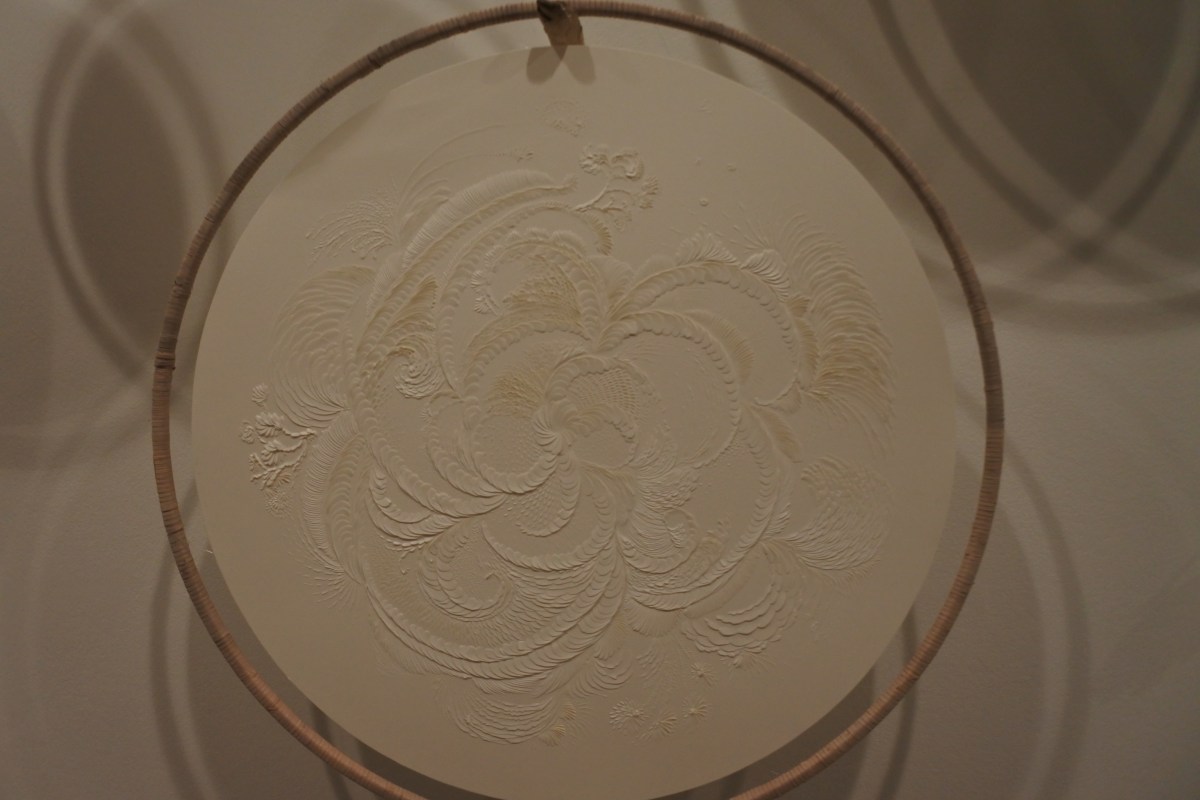
I was very struck by the work of Domitilla Biondi on show at Collect (at the Saatchi Gallery).  Naturally, being drawn to all things involving paper, I thought her work was breathtaking. Domitilla carves thick paper with a surgical blade and creates sensational, miniature bas reliefs. A shadow from the paper is cast from the cut which resembles the detail of fine porcelain.  There’s a very particular energy to the way each cut contributes to delicate and fluid shapes like no other medium.

On at Collect until Monday 6th February 2017.

Collect – the best contemporary craft

Makers are amazing. They are artists, artisans, inventors and innovators. And they use such a variety of materials which is why it is an absolute joy to see the array of creative excellence on show at Collect.  This show, presented by the Crafts Council, is currently on at the Saatchi Gallery in Chelsea.  The vast building is filled with visual delights which make you stop in your tracks and think “how on earth did they make that?”.

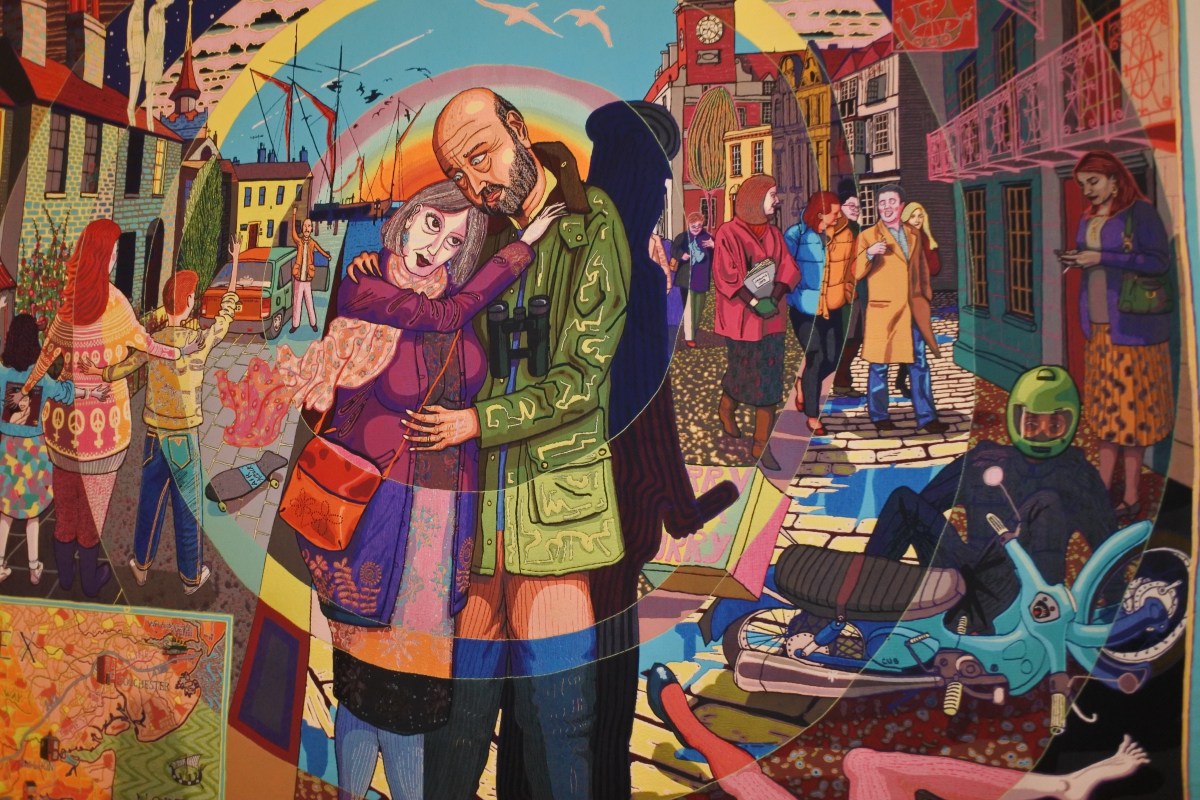
There are too many sensational pieces to go into great detail here, but I’ve posted a little pick and mix of photos I took at this morning’s press preview.  It’s always good to see work by Grayson Perry and his two Essex House Tapestries are a focal point, there’s also a chance to see one his early pots (below).

But Collect is primarily a selling show and a wonderful opportunity for collectors and craft enthusiasts to buy some remarkable and highly individual pieces.

For an artist, it is thrilling to see what people are making and the materials they are using and it’s a visual treat for the eye. Collect is on until 6th February and well worth a visit.  http://www.craftscouncil.org.uk/what-we-do/collect/ 

Glorious colour and inspired design – Josef Frank at the Fashion and Textile Museum

If you’re in need of a boost of sunshine and vibrant colour to brighten up a damp and dreary February day then the Josef Frank show at the Fashion and Textile Museum could be just the tonic.

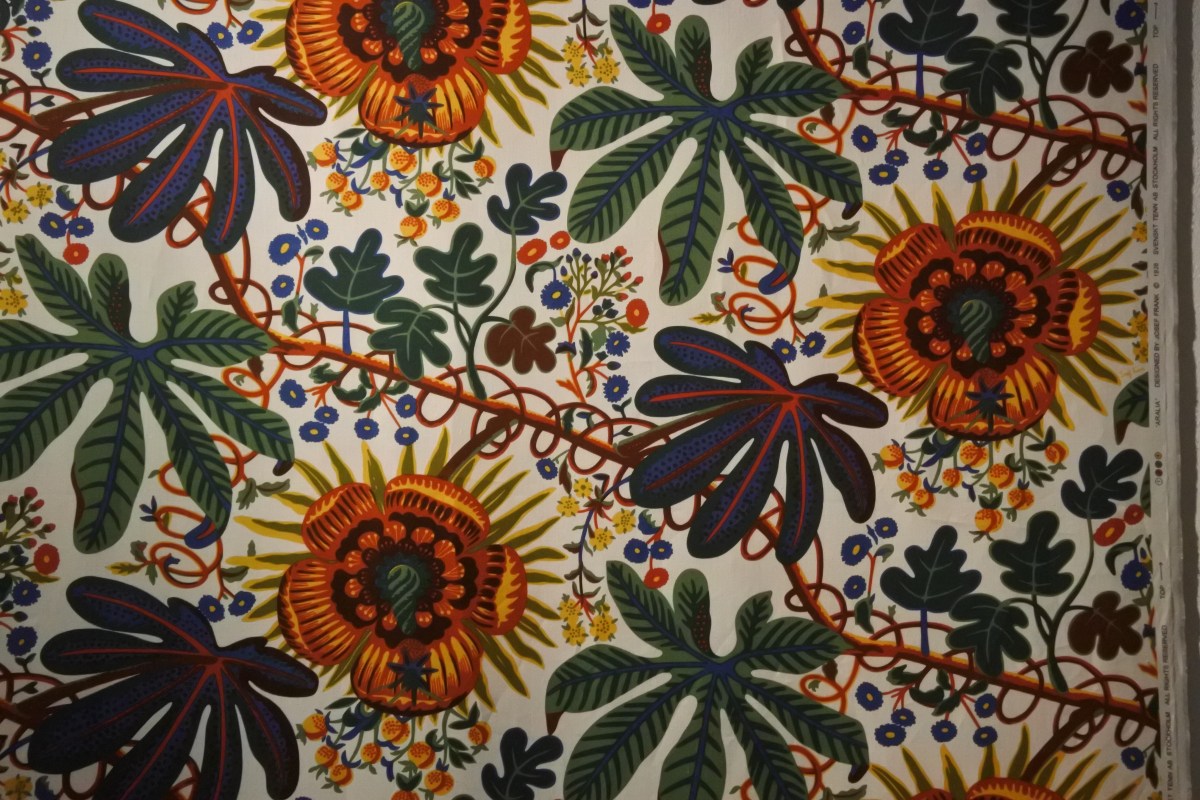
I confess I was unaware that artist, architect and designer Josef Frank was behind some of the most colourful and enduring designs of the 20th century.  Born and brought up in Vienna he had strong views that a house should be cosy and comfortable. He found intense inspiration from natural forms – flowers and plants, animals and landscape.  But he combined serious draftsmanship with a wonderful sense of abstract art and used fierce, primary colours, combined opposites and brought an element of fun and humour to his designs.  His designs from the 1920s, 30s and 40s look fresh and contemporary to today’s eye and must have been a joy to see when they first appeared. No wonder they have endured and it’s easy to understand how Scandinavian designers adopted and celebrated his pared down but exuberant work.

The Fashion and Textile Museum in London’s Bermondsey Street (not far from London Bridge Station) has done him proud. They’ve also assembled examples of some 4oo watercolours which he painted in later life.  His use of bright colours to depict interiors, still life, street scenes, gardens and landscape convey his enduring delight in the natural world and human activity.  Everyone seemed to emerge from the show with a smile on their face.  Josef Frank: Patterns – Furniture – Painting is on until 7th May  www.ftmlondon.org  #joseffrank

Peter Capaldi calls halt to ‘cosmic’ spell as Time Lord

So, Peter Capaldi is handing over the keys to the Tardis to a new Doctor.  He’s had a brilliant four years as a Time Lord and brought a much needed gravitas and slightly sinister air to our favourite immortal.  Hearing him speak on Radio 2 I can totally see that playing a role like this is the closest an actor might get to having a ‘proper job’ – without being in a soap – and it would be wrong for him to closet himself away for too long.

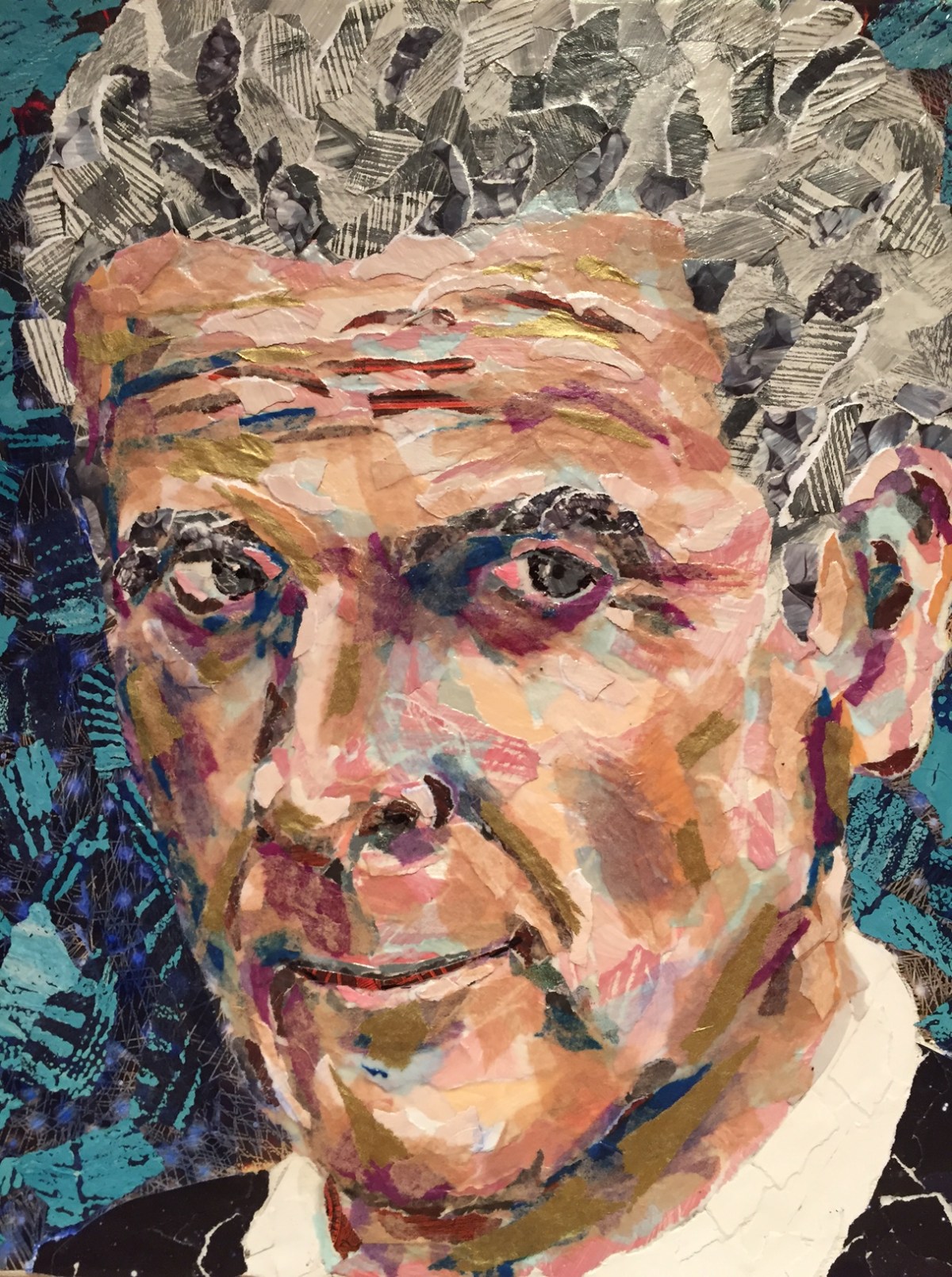
I’ve long been an admirer of Peter Capaldi and look forward to seeing him tackle new roles which will make fulsome use of his impressive dramatic skills.   With this in mind, I decided to make a portrait of Peter last year.  I challenged myself capture not only a good likeness of Peter but to represent something of the enigmatic character of Doctor Who and the depths of intellect which Peter brings to his work.  It took quite a while to get the many layers sorted, to work into the tones, the contours of the face and keep that piercing stare in place. I’m pleased with the result and would be interested to see what Peter thinks.

The background went through several stages and in the end I decided on a collage of  midnight blue paper printed with pale blue emulsion. Don’t ask me to analyse it too deeply, it’s artistic intuition!

So good luck, Peter, and I hope you enjoy your final year flying around the universe, dipping into its many time zones and doing battle with all those monsters. I look forward to seeing what you do next.

If anyone out there is interested in buying the picture, let me know. And remember,  you can commission me to make portraits in my paper collage style by checking out the Paperface website: http://www.paperface.co.uk

img_4681

Papershades in their place….

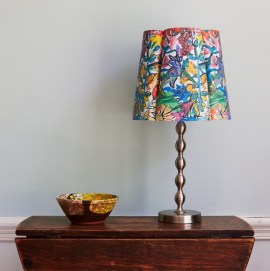
Some fantastic lampshades were produced at Papershades workshops last year.  It was thrilling to see what everyone produced on the day but even more exciting to see what the shades looked like once they were in place in homes.

So I thought I’d post a few photos of Papershades in their place, looking resplendent in their new spaces.

The next series of workshops will take place at the end of February – Friday 24th and Saturday 25th at 10am and on Sunday 26th at 2pm. They’ll take place at the Papershades studio space in north London.  All the details are on the website.  I really look forward to seeing what the next batch of Papershades ‘students’ come up with.

And if anyone wants to set up their own workshop on a different date and maybe at a different venue, just drop me a line.


Sussex Modernism at Two Temple Place


Think of Sussex and you might conjure images of rolling hills, dramatic cliffs, quaint villages and rural delights. Ah, but no, there’s so much more to this ancient English county, east and west, than meets the eye, not least its role as the geographical home to many artistic modernists of the 20th century.

A charming new show,  Sussex Modernism: Retreat and Rebellion, has just opened at Two Temple Place in London and provides a sweeping view of the people, their ideals and the art in a wide variety of media which found form in that area from the 1910s to the 1960s.

Small groups of like-minded artists gravitated to the rambling farmhouses and country dwellings of the county which provided space for creative enterprise and for visitors to stay as well as the opportunity to meet and ‘cross-pollinate’ ideas.  As the curator of the show, Dr Hope Wolf, said: “The show presents a cacophony of ideals – from feminism to pacifism to sexual freedom – mingled with a desire to escape from the city and make things by hand.”

Charleston, near Lewes, was home to Vanessa Bell, Duncan Grant with their sprawling family, and is a delight to visit because the whole fabric of the building became an extended canvas for the artists. This exhibition puts the focus on a wonderful linen box, wittily painted by Grant with the story of Leda and the Duck (rather than the swan) and a sleekly stylised swimmer on the front. And, naturally, I was drawn to a freely painted lamp-stand and shade created by Vanessa Bell.

Edward James, the surrealist, lived at West Dean and enjoyed using his fortune communing with artists and created a home which reflected his passion for art.  I was pleased to see the fabulous sofa (much copied) which he designed with Salvador Dali, based on Mae West’s lips.

Of course there are references to county’s countryside and my favourite is a fabulous collage and mixed media work by John Piper entitled Beach and Star Fish, Seven Sister’s Cliff, Eastbourne (which I’ve added at the top of this post). He’s combined scraps of newsprint with plain paper, paint, pen and ink and pencil. Glorious. But I’m also a huge fan of Edward Burra and it was fascinating to see his rather sinister watercolours of fields near Rye, where he grew up, and hear that he regarded that most chocolate box of places as “a ducky little TinkerBell towne… like an itsy bitsy morgue quayte dead”.

Paintings, drawings, books, sculptures, films and models have been sourced from Sussex’s many excellent museums and galleries along with pieces borrowed from private collections. It’s a fascinating glimpse of a time and place which literally flowered with ideas throughout the last century.

And I should add, that it’s well worth seeing this show simply for the chance to explore Two Temple Place. It was built for William Waldorf Astor by Gothic Revival architect John Loughborugh Pearson in the 1890s and is full of wood-panelled rooms, stained-glass windows, carvings and artworks. It’s one of London’s hidden gems and a joy to visit. The show is on until 23rd April 2017.

Papershades workshops

Lampshades don’t have to be boring, they can be art!

As well as creating my own paper lampshades I’ve discovered that anyone else can have a go too – at one of my Papershades workshops. There are details on the website: www.papershades.co.uk  along with a calendar of the dates when I plan to to hold them (usually the last weekend of each month). There’s a short film which gives a good idea about how they work.

But the glory of these workshops is that they can be set up anywhere – as long as there’s a big enough table, or tables, and a power plug.  I bring all the materials and the event is fuelled by plentiful supplies of tea, coffee and cake.

At the workshops in December I was blown away by the variety of skill and creativity which everyone brought to the table (literally!).  Each lampshade was made from a single template – a piece of A4 card – and reflected personality, passion and love for special people.  The results were a joy to see and everyone had fun.

If you’re interested in coming to a workshop, or setting one up in your own space, please do drop me a line.

Image

Paper Places: How it all began

I wanted to start this Paper Places blog so that I can share the fun I have in exploring the world of paper and all the creative things that people do with the material.  It’s been my ‘thing’ for years.  As a child I loved nothing better than making papier mache , folding paper or making drawings or paintings on paper. Clearly I never had enough paper when I was young because virtually every childhood book which has survived into my grownup life has drawings and scribbles all over the blank pages at the back.

Being an artist was something I always wanted to do but it’s hard when you’re young to power through with such dreams and then life gets in the way – having a career, earning money, bringing up a family, paying for stuff….  However, the passion for art came to the boil about 15 years ago when I finally made it to art school. Having spent years doing evening classes in art, two art A-levels and a Foundation Course,I was doing yet another course in portrait painting at Central St Martin’s when the tutor there said the magic words ‘you are very good, why don’t you go to art school?’  This was what I’d spent my life waiting to hear!  She said, ‘go to City and Guilds of London Art School and tell them I sent you.’  By this time it was June and when I saw the Head of Painting there he said they were full but felt sure he could fit me in.  Later on, once I’d enrolled and had my garret studio at the school, he confessed he couldn’t turn me down because my eyes burned so brightly with the need to come that he just had to find a place!

Well, it was the most fantastic experience.  Being amongst fellow artists and finally having permission to describe myself as an artist was a glorious and heady time.  I had gone there with the aim of learning how to paint in oils but the paper just kept creeping into my work. My tutors were intrigued by the way I stuck wallpaper onto my canvases and mingled it with oil paint.  In the end I ditched the oils and found a way to create painterly pictures using torn paper, all kinds of paper, and haven’t looked back. I think I always knew that paper was my medium, my language, but it took a spell at art school to give me the confidence to really explore it and feel I could create works made entirely with paper.

Once I’d left art school I kept making art, having shows and selling work. I even created a range of greetings cards based on my work which were sold in shops all over the UK including John Lewis.  Then I realised I could use my new medium to create portraits made entirely from paper. But not only could I create a good likeness in paper I discovered I could surround the subject with images, on paper, of their ‘favourite things’. This evolved into Paperface, which is still going strong.  I love working with either the subject or the person who is commissioning the portrait, to plan the piece and make sure that all the right images of important people, places and things are incorporated into the picture.

My latest paper-led adventure has been Papershades.  I’d made a collection of paper collages featuring wild flowers, poppies, daisies and a tangled colourful foliage which were popular and sold well. I started wondering how I could do rather more with them than just sell them on canvas.  I wanted to find a way to use my art as a product or to make it more available.  For years I’d been thinking that the lampshades in my home were really very dull – always the same, plain fabric things and wondered whether they could be made of paper.  Of course they could!

So, I created loads of prototypes for paper lampshades printed with my own designs.  The result is a flat packed lampshade which fits an A4 envelope which is easy to construct using two sizes of unique Papershades ‘wheel’s.  The first range features six of my floral designs. There will be more coming later in the year.

shaftesbury-lifestyle
Shaftesbury paper lampshade from Papershades
leicester
Leicester paper lampshade from Papershades


Coming up with the idea for Papershades was quite a long haul and it took a while to get to the stage where I felt I had a viable product.  And I’ve had to get a website with an online shop made as well as planning and creating all the visuals and getting the marketing side of things sorted.

So, the passion for paper goes on and keeps taking me in new directions.  I look forward to expanding my enthusiasm for this wonderfully versatile material in loads of new directions by going to more exhibitions, finding fellow paper enthusiasts, makers and doers.  I would be delighted if you would like to join me on this incredible journey!

tart a new post.

The launch of Papershades

Papershades is my newest venture. It all began one very dreary winter, which seemed to go on for ever, and I started ripping up brightly coloured tissue paper to make a range of exuberant canvases covered with blowsy blooms, rosy roses and eye-popping poppies plus a tangle of foliage and a glimpse of blue sky.  I had a show of these works and they sold rather well.

Confident that the images had commercial appeal I set about exploring how I could use my artwork to create a product which would be more affordable than a large canvas and bring a bit of art into the home.  I looked around at the lampshades in my house and concluded that they were really very boring.  I decided that lampshades should not be boring, they should be art.

The next stage took quite a while to develop. I discovered a way to print details from my artwork onto special, stiff, translucent paper, and created a kind of ‘wheel’ to grip five printed panels.

The result is www.papershades.co.uk, an online shop through which I am selling the first range of floral Papershades lampshades. They cost a very modest £25 each and that includes the postage and packing.  The results have been very well received and I love nothing better than receiving a photograph of the lampshades looking glorious in homes.